Who lived on the peninsula, who ruled it, and how it became part of Ukraine
The history of Crimea is a history of intersecting civilizations, peoples, trade routes, and imperial ambitions. For thousands of years, the peninsula was home to the Tauri, Cimmerians, Scythians, Greeks, Sarmatians, Goths, Alans, Khazars, Cumans, Mongols, Crimean Tatars, and many other peoples. Ancient city-states, the Bosporan Kingdom, the Principality of Theodoro, and the Crimean Khanate existed here. Crimea came under the influence of Byzantium, the Golden Horde, the Ottoman Empire, and the Russian Empire, before eventually becoming part of Soviet Ukraine.
Modern disputes over Crimea are often accompanied by attempts to rewrite its past. Some political narratives reduce the peninsula’s history to the period of Russian imperial rule, while others take individual historical episodes out of context to suggest that a particular state has an uninterrupted historical right to the territory.
However, historical evidence reveals a much more complex picture.
To understand why Crimea is an integral part of modern Ukraine under international law, it is necessary to examine its history chronologically: from its earliest known inhabitants to the political decisions of the twentieth century and Russia’s occupation in 2014.
1. Ancient Crimea: Early Inhabitants and Classical Civilizations
The Crimean Peninsula has an exceptionally long history of human settlement. Archaeological discoveries indicate that people inhabited this territory in prehistoric times. However, the written history of Crimea begins much later, with the appearance of ancient Greek authors who described the peoples of the northern Black Sea region.
The Tauri — One of the Earliest Known Peoples of Crimea
During the first millennium BCE, the mountainous regions of the peninsula were inhabited by the Tauri, an ancient people whose origins have not yet been conclusively established.
Their main occupations included animal husbandry, agriculture in river valleys, and fishing. They had their own traditions, settlements, and religious practices.
Ancient authors described the Tauri as a distinct community, although their accounts often contained exaggerations and stereotypes typical of ancient literature.
Over time, the Tauri interacted with other peoples of the peninsula, including the Scythians, Greeks, Alans, and Goths. These long-term contacts brought cultural changes and processes of assimilation.
The Cimmerians and the Scythians
The steppe regions of Crimea were closely connected to the history of the nomadic peoples of Eurasia.
Among the earliest known nomadic groups in the region were the Cimmerians, mentioned in historical sources from the ninth century BCE.
In the seventh century BCE, the Scythians began to play a major role in the northern Black Sea region.
The Scythians were not a single homogeneous people in the modern sense. They consisted of related and politically connected Iranian-speaking groups, known primarily for their nomadic lifestyle, military organization, and sophisticated material culture.
An important centre of Scythian statehood developed in Crimea: Scythian Neapolis, located near present-day Simferopol. It became one of the principal political and economic centres of the Late Scythian kingdom.
In the third century BCE, the Sarmatians began to gain influence in the steppe territories. Some Scythian groups moved south and interacted with the Tauri. Ancient sources subsequently used terms such as “Tauro-Scythians” and “Scytho-Tauri.”
Greek Colonies: The Emergence of Cities, Trade, and Political Entities
In the seventh and sixth centuries BCE, Greek settlers began establishing colonies along the Black Sea coast.
Several cities emerged on the territory of Crimea:
- Panticapaeum — present-day Kerch, founded approximately in the late seventh or early sixth century BCE;
- Chersonesus Taurica — an ancient city near present-day Sevastopol;
- Theodosia;
- Kerkinitis — located on the site of present-day Yevpatoria;
- Nymphaeum, along with other settlements.
Greek colonies became important trading centres. They maintained connections with Mediterranean cities and traded grain, fish, wine, manufactured goods, and other commodities.
In the fifth century BCE, the Bosporan Kingdom emerged in eastern Crimea, with its capital at Panticapaeum. It united several Greek cities and neighbouring territories inhabited by local peoples.
The Bosporan state survived for many centuries, experiencing political changes and periods of dependence on more powerful neighbours.
It is important to note: the existence of Greek colonies did not mean that the entire Crimean Peninsula became Greek territory. Different peoples, settlements, and political entities existed simultaneously across the peninsula.
The Romans and Byzantium
In the second century BCE, parts of Crimea came under the influence of the Kingdom of Pontus, ruled by Mithridates VI Eupator.
Later, the influence of the Roman Empire grew. During the first centuries CE, the Romans maintained military garrisons and political relations with local states.
Following the division of the Roman Empire, its eastern successor — the Byzantine Empire — retained considerable influence over the southern coast of Crimea.
By the sixth century, Chersonesus and other coastal territories had become important centres of Byzantine presence.
Crimea served as a commercial, military, and religious crossroads connecting the Black Sea region, Constantinople, and the steppe territories of Eastern Europe.
Thus, even in antiquity, Crimea was a multiethnic region where local tribes, Greek communities, and political powers from the Mediterranean world coexisted.
Sources for this period:
- Kerstin S. Jobst, A History of Crimea: From Antiquity to the Present, Bloomsbury Academic.
- Encyclopedia of Ukraine — Taurians.
- Ministry of Foreign Affairs of Ukraine — Historical Background of Crimea.
2. Medieval Crimea: Goths, Khazars, Cumans, Genoese, and Mongols
Following the decline of the ancient states, Crimea did not lose its strategic importance. On the contrary, it became a meeting point for new waves of migration and competing political interests.
At different times, the following peoples lived and operated in the region:
- Goths and Alans;
- Huns;
- Khazars;
- Byzantines;
- Hungarian tribes;
- Pechenegs;
- Cumans, also known as Kipchaks;
- Mongols;
- Genoese;
- Armenians and other trading communities.
The Goths and Alans
In the third century CE, some Gothic tribes appeared in Crimea. They interacted with the local population and gradually established their own settlements in the mountainous areas of the peninsula.
The Alans, Iranian-speaking groups, also lived in the region and played an important role in its medieval history.
Over time, some of these communities adopted Christianity and came under the cultural and religious influence of Byzantium.
The Khazar Khaganate
Between the seventh and tenth centuries, much of steppe Crimea came under the influence of the Khazar Khaganate, a powerful medieval state that controlled important trade routes between Europe and Asia.
The Khazar state was multiethnic. Its population included Turkic-speaking, Iranian-speaking, Slavic, and other communities.
Some members of the Khazar ruling elite practised Judaism, while Christians, Muslims, and followers of traditional pagan religions also lived within the state.
Crimea in the Time of Kyivan Rus and Byzantium
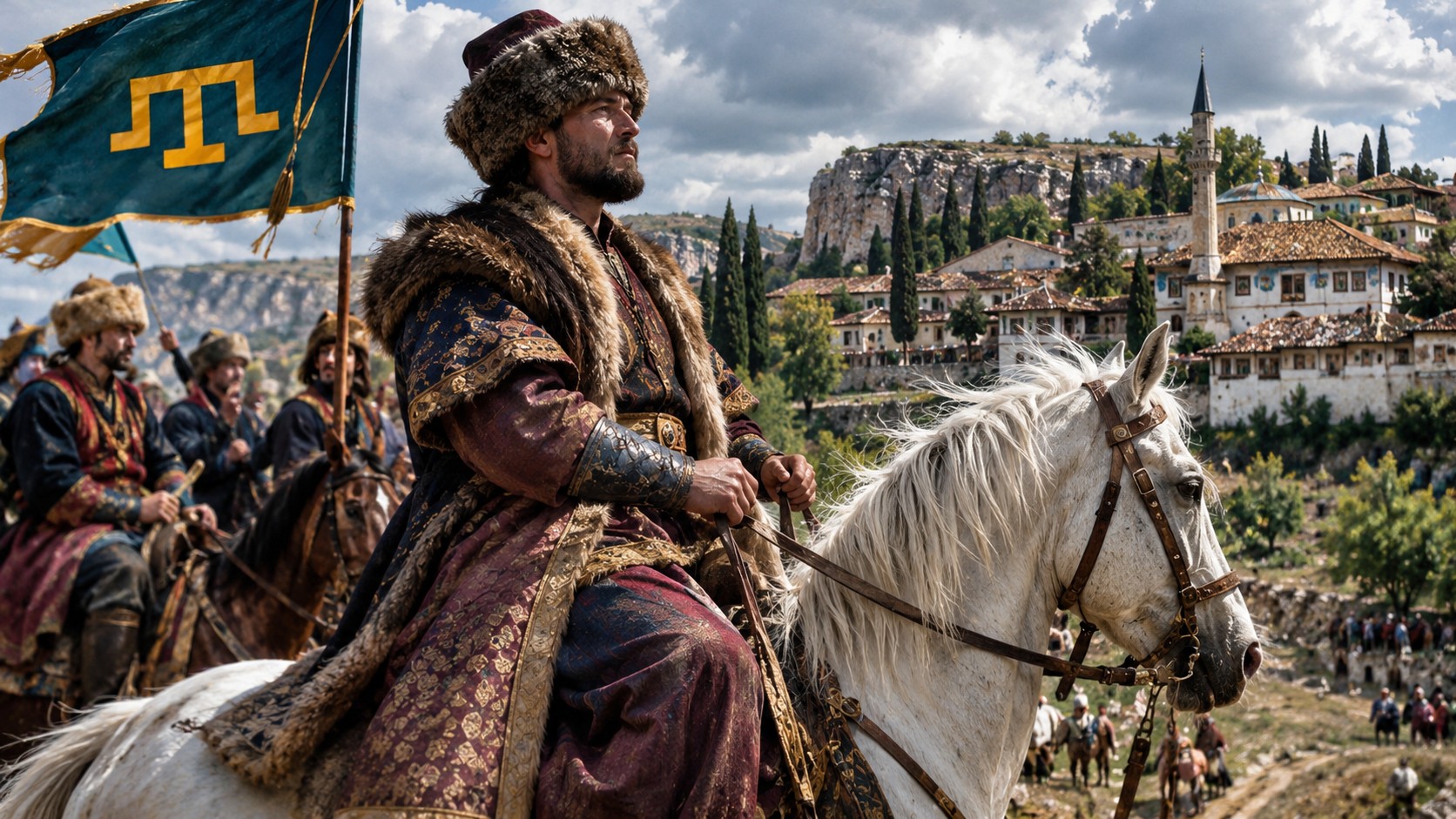
Crimea played an important role in the history of Kyivan Rus.
Kyivan princes maintained political, commercial, and military contacts with Byzantine cities on the peninsula.
One of the best-known events was Prince Volodymyr’s campaign against Chersonesus in the late tenth century. According to the chronicle tradition, this event was connected with the prince’s baptism and the subsequent spread of Christianity in Rus.
At the same time, this episode should not be interpreted as the establishment of permanent Kyivan rule over the entire Crimean Peninsula. Volodymyr captured a specific Byzantine centre, not the whole peninsula.
The Cumans and the Mongol Invasion
Between the eleventh and thirteenth centuries, steppe Crimea was strongly influenced by the Cumans, a Turkic-speaking nomadic people known in Western sources as the Cumans and in some Eastern sources as the Kipchaks.
In the thirteenth century, Mongol armies reached Crimea. Following the Mongol conquests, much of the peninsula became part of the political system of the Golden Horde.
Mongol rule did not mean the disappearance of the earlier population. Local communities continued to live on the peninsula, preserving different religious, linguistic, and cultural traditions.
Genoese Colonies and the Principality of Theodoro
Between the thirteenth and fifteenth centuries, Genoese trading colonies existed along the southern and eastern coasts of Crimea.
The most famous of these was Caffa, present-day Feodosia. It became one of the largest trading centres on the Black Sea.
The Genoese traded with Europe, the Caucasus, Central Asia, and other regions. Their territories were home to representatives of different ethnic groups and religious communities.
In the mountainous part of Crimea, the Principality of Theodoro existed, with its capital at Mangup. Its population was multiethnic, and its political and cultural connections were largely associated with Byzantium.
Thus, before the formation of the Crimean Khanate, the peninsula already had a complex political and ethnic structure.
3. The Crimean Khanate: The State of the Crimean Tatars
One of the most important periods in Crimean history was the existence of the Crimean Khanate.
It emerged around the 1440s following the disintegration of the Golden Horde. Hacı I Giray is regarded as the founder of the Giray dynasty.
The Crimean Khanate became an independent state with its own political system, military forces, diplomacy, administration, and legal traditions.
Its capital was initially Solkhat and later Bakhchysarai, which developed into an important political and cultural centre.
Who Are the Crimean Tatars?
The Crimean Tatars emerged as a distinct people through a long historical process.
Their ethnogenesis involved various Turkic and local population groups of Crimea, including the Kipchaks, Cumans, Mongol groups, and earlier inhabitants of the peninsula.
The Crimean Tatar language belongs to the Turkic language family.
Over time, the Crimean Tatars became the indigenous people of Crimea, developing their own language, culture, religious traditions, architecture, music, literature, and political history.
The majority of Crimean Tatars followed Sunni Islam.
Relations with the Ottoman Empire
In 1475, the Ottoman Empire conquered the Genoese colonies and the Principality of Theodoro.
Following these events, the Crimean Khanate came under Ottoman suzerainty while retaining considerable internal autonomy.
The Khanate had its own dynasty, army, administration, and diplomatic interests. The Ottoman Sultan influenced the appointment of khans, but Crimea was not simply an ordinary province of the Ottoman Empire.
The Crimean Khanate became an important political actor in Eastern Europe.
It maintained relations with the Ottoman Empire, Poland, the Grand Duchy of Lithuania, Muscovy, and the Cossack political formations.
The Crimean Tatars and Ukrainian Cossacks
Relations between the Crimean Khanate and the Ukrainian Cossacks were complex and multifaceted.
They included military conflicts, diplomatic agreements, trade, military alliances, and mutual political support.
One of the best-known examples of cooperation was the alliance between Crimean Khan İslâm III Giray and Bohdan Khmelnytsky in 1648.
Crimean Tatar forces participated in several battles of the Khmelnytsky-led National Liberation War.
At the same time, these relations were not free of conflict. Crimean Tatar raids into Ukrainian and Polish territories, the capture of prisoners, and the slave trade left a deep mark on the historical memory of neighbouring peoples.
These facts are part of history. They should neither be concealed nor used to deny the historical existence of the Crimean Tatar people.
The Slave Trade and Crimea
One of the most difficult aspects of the Khanate’s history was the slave trade.
During military campaigns, Crimean Tatar forces captured prisoners in Eastern Europe. Some captives were taken to markets in Crimea, particularly Caffa, and from there transported to the Ottoman Empire and other regions.
The slave trade was an important part of the Black Sea region’s economy in the early modern period. Various states, trading networks, and intermediaries participated in it.
However, this historical fact does not change the fact that the Crimean Khanate was a separate state and the Crimean Tatars were a people with their own historical homeland.
Historian Brian L. Davies, in his study of the Crimean Khanate, emphasizes its role in the balance of power between the Ottoman, Russian, and Habsburg empires and the Polish-Lithuanian Commonwealth.
Sources:
- Brian L. Davies, Crimean Khanate, The Encyclopedia of Empire, 2016.
- Kerstin S. Jobst, A History of Crimea: From Antiquity to the Present, Bloomsbury Academic.
- Wiley Online Library — Crimean Khanate, Brian L. Davies.
4. How the Russian Empire Took Crimea in 1783
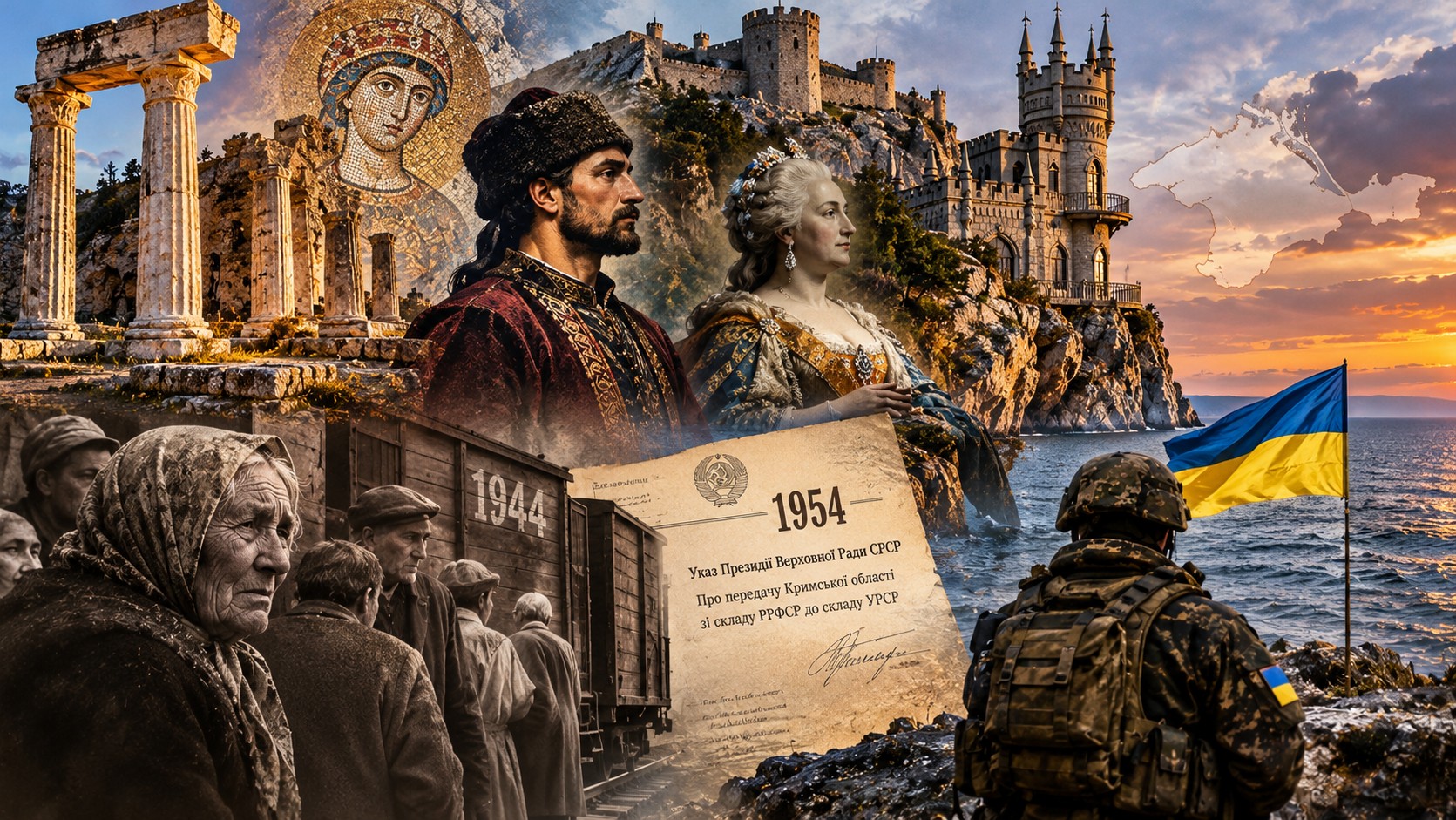
In the eighteenth century, the Russian Empire began actively expanding its influence in the Black Sea region.
One of the main objectives of its foreign policy was to weaken the Ottoman Empire, gain control over the northern Black Sea coast, and secure access to warm-water seas.
The Crimean Khanate found itself at the centre of this confrontation.
The Treaty of Küçük Kaynarca of 1774
During the Russo-Turkish War of 1768–1774, the Russian Empire gained significant military advantages.
On 21 July 1774, the Treaty of Küçük Kaynarca was signed between the Russian and Ottoman empires.
One of its consequences was the declaration of the Crimean Khanate’s independence from the Ottoman Empire.
At first glance, this appeared to create an independent Crimean state capable of determining its own foreign policy.
However, the actual situation was more complicated.
Russia retained considerable military and political influence over the peninsula. Russian troops remained an important factor in the Khanate’s domestic politics, while power struggles between different political groups increased Crimea’s dependence on St. Petersburg.
Formal independence gradually turned into de facto political dependence on the Russian Empire.
Şahin Giray and the Last Attempt to Preserve Statehood
In 1777, Şahin Giray became Khan with Russian support.
He attempted to modernize the state administration, military, and financial system of the Crimean Khanate along European lines.
However, his reforms met resistance from parts of the Crimean Tatar population and political elites.
Russia used internal divisions to strengthen its control over the peninsula.
In 1782, an uprising against Şahin Giray took place in Crimea. Russian troops once again intervened in the Khanate’s internal affairs.
After suppressing the resistance, it became clear that St. Petersburg was no longer interested in preserving even a formally independent Crimean state.
8 April 1783: The Annexation of the Crimean Khanate
On 8 April 1783, Empress Catherine II issued a manifesto announcing the annexation of Crimea, Taman, and Kuban to the Russian Empire.
This marked the end of the Crimean Khanate as an independent state.
The Russian Empire established control over the peninsula, and the Crimean Tatar population came under the authority of a new imperial administration.
In 1784, the Taurida Oblast was established as the administrative basis for governing the newly acquired territories.
Why Did Russia Want Crimea?
The reasons for the annexation were primarily geopolitical and military:
- control over the northern Black Sea coast;
- weakening the Ottoman Empire;
- establishing naval bases;
- expanding imperial territory;
- controlling strategic routes and Black Sea ports.
Following the seizure of Crimea, the Russian Empire began actively developing Sevastopol as a naval base for the Black Sea Fleet.
What Happened to the Crimean Tatars After the Annexation?
Russian imperial policies significantly changed the demographic and social structure of the peninsula.
Some Crimean Tatars left their homeland and migrated to the Ottoman Empire. Migration waves became particularly significant after the annexation and the Crimean War of 1853–1856.
The imperial authorities encouraged the settlement of Russians, Ukrainians, Germans, Bulgarians, Greeks, and other population groups on the peninsula.
At the same time, Crimean Tatars continued to live in Crimea, maintaining their communities, language, religion, and cultural traditions.
It is important to understand: 1783 was not the moment when Crimea became part of Russia because of some ancient and uninterrupted historical belonging. It was the date when the Crimean Khanate was abolished and annexed by the Russian Empire.
Sources:
- Alan W. Fisher, The Russian Annexation of the Crimea, 1772–1783, Cambridge University Press, 1970.
- Kelly O’Neill, Harvard University, Catherine II Annexes the Crimean Khanate.
- Harvard University — Catherine II Annexes the Crimean Khanate.
- Academic study of Russian colonization of Crimea in the eighteenth and nineteenth centuries.
5. Crimea Under the Russian Empire: Colonization, Migration, and Demographic Change
After 1783, Crimea became part of the Russian Empire.
Throughout the nineteenth century, the imperial authorities actively developed military infrastructure, ports, roads, administrative centres, and new settlements.
Sevastopol became the main base of the Black Sea Fleet.
At the same time, people from different regions of the empire and other countries continued to settle on the peninsula.
The Crimean War of 1853–1856
One of the most important events of this period was the Crimean War.
The Russian Empire fought against a coalition consisting of the Ottoman Empire, Great Britain, France, and the Kingdom of Sardinia.
The main military event on the peninsula was the Siege of Sevastopol in 1854–1855.
After a prolonged defence, Russian forces abandoned the city.
The war demonstrated the strategic importance of Crimea and its ports for control over the Black Sea.
Demographic Changes
During the nineteenth century, the size of the Crimean Tatar population changed significantly.
Wars, imperial policies, economic pressure, land reforms, and migration encouraged some Crimean Tatars to leave for the Ottoman Empire.
At the same time, the number of settlers from other parts of the Russian Empire increased, particularly Ukrainians and Russians.
By the beginning of the twentieth century, Crimea already had a complex ethnic composition that included Crimean Tatars, Russians, Ukrainians, Jews, Karaites, Krymchaks, Germans, Greeks, Armenians, Bulgarians, and other communities.
Therefore, claims that Crimea historically had a homogeneous population do not reflect historical reality.
6. Crimea After the 1917 Revolution: The Struggle for Power and the Crimean ASSR
The 1917 Revolution and the collapse of the Russian Empire opened a new chapter in the history of the peninsula.
Various political forces began operating in Crimea, each with its own vision for the region’s future.
One of the most important developments was the formation of the Crimean Tatar national movement.
The Kurultai and the Crimean People’s Republic
In December 1917, the Crimean Tatar Kurultai proclaimed the establishment of the Crimean People’s Republic.
The Kurultai was a representative body of the Crimean Tatar people, seeking political self-government and the realization of their right to self-determination.
It was one of the first attempts to establish democratic national statehood in Crimea.
However, political instability, Bolshevik intervention, and the Civil War prevented this state model from taking root.
In the following years, power on the peninsula changed hands repeatedly. Bolsheviks, representatives of Crimean Tatar political forces, governments connected with Ukrainian statehood, White Army forces, and other military and political structures operated in the region.
The Establishment of the Crimean ASSR
In October 1921, the Bolshevik authorities established the Crimean Autonomous Soviet Socialist Republic (Crimean ASSR) within the Russian Soviet Federative Socialist Republic (RSFSR).
This means that, at that time, the Crimean ASSR was not part of the Ukrainian SSR.
The autonomy formally provided for recognition of the region’s national composition and certain elements of cultural and administrative self-government.
During the 1920s, the Soviet policy of korenizatsiya (indigenization) was implemented. In Crimea, it took the form of so-called Tatarization, which involved expanding the use of the Crimean Tatar language in education, administration, and cultural life.
However, as Stalin’s regime consolidated its power, this policy was gradually dismantled.
Repressions began against Crimean Tatar intellectuals, religious figures, national activists, and representatives of local elites.
Sources:
- Tetiana Bykova, The Establishment of the Crimean ASSR (1917–1921), Institute of History of Ukraine, National Academy of Sciences of Ukraine, 2011.
- National Academy of Sciences of Ukraine — The Establishment of the Crimean ASSR.
- Grégory Dufaud, The Establishment of Bolshevik Power in the Crimea and the Construction of a Multinational Soviet State, Cambridge University Press.
7. 1944: The Deportation of the Crimean Tatars — One of the Most Tragic Chapters in Crimea’s History
On 18 May 1944, the Soviet authorities began the forced deportation of the Crimean Tatars.
This operation became one of the largest forced population deportations in the history of the USSR.
How the Deportation Was Carried Out
In May 1944, after Nazi forces had withdrawn from Crimea, the Soviet authorities accused the Crimean Tatars of widespread collaboration with the occupiers.
On 11 May 1944, the USSR State Defence Committee adopted a resolution ordering the deportation of the Crimean Tatars.
On 18 May, the NKVD operation began.
Military personnel and NKVD officers arrived at people’s homes, informed them that they were being deported, and gave them very little time to pack.
People were forcibly loaded into railway carriages and transported to Central Asia, primarily Uzbekistan, as well as to other regions of the Soviet Union.
According to historical research, approximately 190,000 Crimean Tatars were deported, although figures vary slightly between sources depending on the counting methodology.
Collective Punishment
The Soviet authorities accused an entire people of collaborating with Nazi Germany.
However, collective responsibility based on ethnicity has no legal justification.
Among those deported were children, women, elderly people, and Crimean Tatars who had served in the Red Army or fought against the Nazis.
Some Crimean Tatars serving at the front learned about the deportation of their families only after the fighting had ended.
Transportation conditions were extremely harsh: there was a lack of water, food, and medical assistance, poor sanitation, and prolonged travel in overcrowded railway carriages.
In the special settlements, deportees were placed under administrative supervision and had restricted freedom of movement.
Consequences of the Deportation
The deportation resulted in mass deaths, the destruction of family ties, the loss of homes, and the destruction of cultural heritage.
A large-scale process of removing or renaming Crimean Tatar place names began in Crimea. The ethnic composition of the population changed, and the cultural presence of the Crimean Tatars was deliberately pushed out of public life.
In 1945, the Crimean ASSR was transformed into the Crimean Oblast within the RSFSR.
In 1948, Sevastopol was granted the status of a city of republican subordination within the Soviet administrative system. This status later became the subject of separate disputes concerning its legal position after the transfer of the Crimean Oblast to Ukraine.
Were the Crimean Tatars Rehabilitated?
In 1967, the Soviet authorities formally withdrew the accusation of mass collaboration with the German occupiers against the Crimean Tatars as a people.
However, this did not mean that their rights had been fully restored or that they were free to return to Crimea.
The large-scale return of Crimean Tatars to their historical homeland began in the late 1980s, particularly after 1989.
It was a lengthy process accompanied by bureaucratic restrictions, social difficulties, and problems related to housing and land.
The 1944 deportation remains one of the defining tragedies in the history of the Crimean Tatar people.
Sources:
- Greta Uehling, Beyond Memory: The Crimean Tatars’ Deportation and Return, Palgrave Macmillan.
- Karina Korostelina, Crimean Tatars: From Mass Deportation to Hardships in Occupied Crimea, Genocide Studies and Prevention, 2015.
- Sciences Po — Sürgün: The Crimean Tatars’ Deportation and Exile.
- University of South Florida — Crimean Tatars: From Mass Deportation to Hardships in Occupied Crimea.
8. Why Was Crimea Transferred to Ukraine in 1954? The Date, Reasons, and Legal Procedure
This is one of the questions around which Russian propaganda has created the greatest number of myths.
The most common claims include:
- Nikita Khrushchev personally gave Crimea to Ukraine.
- The transfer was a personal gift marking the 300th anniversary of the Pereiaslav Council.
- Crimea was transferred illegally, without following Soviet law.
- Ukraine received Crimea only on a temporary basis.
Documents and historical research do not support these claims.
What Happened Before the Transfer?
In the early 1950s, the Crimean Oblast was part of the RSFSR.
After the Second World War, the peninsula faced a difficult economic situation. The war, the deportation of the Crimean Tatars, damaged infrastructure, labour shortages, and water supply problems created significant challenges for the region’s economy.
Geographically, Crimea was closely connected to mainland Ukraine.
The main transport, economic, and infrastructure links ran through the territory of the Ukrainian SSR.
The supply of electricity, food, and construction materials, the development of agriculture, and the reconstruction of towns required coordination with mainland Ukraine.
In 1954, the Soviet leadership decided to change the administrative affiliation of the Crimean Oblast.
How Exactly Did the Transfer Take Place?
The process was not a unilateral decision by Khrushchev.
It went through a series of official state procedures.
5 February 1954: The Presidium of the Supreme Soviet of the RSFSR adopted a resolution to transfer the Crimean Oblast to the Ukrainian SSR.
The document cited the commonality of the economy, territorial proximity, and close economic and cultural ties between the Crimean Oblast and Ukraine.
13 February 1954: The Presidium of the Supreme Soviet of the Ukrainian SSR adopted the corresponding resolution, agreeing to accept the Crimean Oblast into the republic.
19 February 1954: The Presidium of the Supreme Soviet of the USSR issued the decree On the Transfer of the Crimean Oblast from the RSFSR to the Ukrainian SSR.
It stated:
“Taking into account the commonality of the economy, territorial proximity, and close economic and cultural ties between the Crimean Oblast and the Ukrainian SSR…”
26 April 1954: The Supreme Soviet of the USSR adopted the law on the transfer of the Crimean Oblast, approved the corresponding decree, and introduced the necessary amendments to the USSR Constitution.
Thus, the decision was formalized through the relevant Union-level and republican state bodies.
Why Was Crimea Transferred Specifically to Ukraine?
The main reasons were economic, geographical, and administrative.
1. Territorial proximity
Crimea was directly connected to mainland Ukraine. The main transport routes supporting the peninsula’s economic life were linked to the Ukrainian SSR.
2. Economic interdependence
The Crimean Oblast had close economic ties with Ukraine’s southern regions. Trade, agriculture, transport, and industrial processes were interconnected.
3. Infrastructure dependence
The reconstruction and development of Crimea required large-scale infrastructure projects, particularly in water supply and transport connections with the mainland.
4. Administrative practicality
Managing Crimea’s economy through the Ukrainian SSR was more practical given its geographical location and existing economic ties.
These were the circumstances identified in the official documents of 1954 as the reasons for the transfer.
Was the Transfer Illegal?
No. Claims that the transfer was illegal are not supported by the documents.
Article 18 of the 1936 USSR Constitution provided that the territory of a Union republic could not be changed without its consent.
During the transfer of the Crimean Oblast, the relevant decisions were adopted by the authorities of the RSFSR and the Ukrainian SSR. The decision was then approved by the Presidium of the Supreme Soviet of the USSR. It was subsequently formalized through a Union law and the corresponding constitutional amendments.
American historian Mark Kramer, Director of the Cold War Studies Program at Harvard University, analysed archival documents relating to the transfer.
In his study, he concluded that the transfer of Crimea was carried out in accordance with the Soviet constitutional procedures in force at the time.
It is also important that, after the dissolution of the USSR, the Russian Federation recognized the borders of independent Ukraine, including through the 1991 Belovezha Accords and the 1994 Budapest Memorandum.
Was Crimea a Gift from Khrushchev?
This is an oversimplified interpretation of historical events.
Khrushchev was indeed one of the influential political figures in the USSR at the time, but the decision to transfer Crimea was not made through his personal decree.
In 1954, the Soviet Union remained a centralized one-party state. Major political decisions were made by the Communist Party leadership and then formalized through state institutions.
The anniversary of the 1654 Pereiaslav Council was used in official Soviet rhetoric as a symbol of the “friendship of peoples.” However, the legal documents concerning the transfer of Crimea explicitly cited economic, territorial, and administrative reasons.
What Is Important to Know About Sevastopol?
The city of Sevastopol became a separate subject of dispute.
In 1948, it was granted the status of a city of republican subordination within the RSFSR. The Russian side later used this fact to claim that Sevastopol had supposedly not been transferred to Ukraine together with the Crimean Oblast.
However, the city’s administrative status did not automatically mean that it had been removed from the territory of the Crimean Oblast.
After 1954, Sevastopol continued to be connected to the administrative system of the Crimean Oblast within the Ukrainian SSR. Its residents participated in elections to the Crimean Regional Council, and Soviet encyclopaedic publications from the mid-1950s described it as a city of republican subordination within the Crimean Oblast of the Ukrainian SSR.
Therefore, the claim that Sevastopol legally remained part of Russia after 1954 is inconsistent with the combined administrative and legal documentation of that period.
The key point: in 1954, the Crimean Oblast was transferred from the RSFSR to the Ukrainian SSR in accordance with Soviet legislative procedures. The documents contained no time limits, temporary-use conditions, or provisions granting Russia the right to reclaim Crimea unilaterally.
Sources:
- Mark Kramer, Why Did Russia Give Away Crimea Sixty Years Ago?, Wilson Center, 2014.
- Wilson Center — The Transfer of Crimea from Soviet Russia to Soviet Ukraine, 1954.
- Original text of the Decree of the Presidium of the Supreme Soviet of the USSR, 19 February 1954.
- National Legal Encyclopedia — USSR Law on the Transfer of the Crimean Oblast, 1954.
9. Crimea as Part of Independent Ukraine: Autonomy and Political Status
In 1991, the Soviet Union began to disintegrate. Ukraine declared independence, and its territorial boundaries became the basis for its internationally recognized state borders.
However, important events concerning Crimea’s political status had taken place even before Ukraine declared independence.
The Referendum of 20 January 1991
On 20 January 1991, a referendum was held in Crimea on the restoration of the Crimean ASSR.
The majority of voters supported restoring the peninsula’s autonomous status within the Ukrainian SSR.
On 12 February 1991, the Supreme Soviet of the Ukrainian SSR adopted a law restoring the Crimean Autonomous Soviet Socialist Republic within the boundaries of the Crimean Oblast.
Thus, Crimea’s autonomous status was restored within the Ukrainian SSR.
The All-Ukrainian Referendum of 1 December 1991
On 1 December 1991, an all-Ukrainian referendum was held to confirm the Act of Declaration of Independence of Ukraine.
The vote took place throughout Ukraine, including Crimea and Sevastopol.
According to the official results:
- Across Ukraine, 90.32% of voters supported independence.
- In Crimea, the figure was 54.19%.
- In Sevastopol, it was 57.07%.
These figures are of fundamental importance.
They refute claims that Crimea supposedly did not participate in the formation of independent Ukraine or that its population unanimously opposed independence.
More than half of the voters in both Crimea and Sevastopol supported Ukraine’s independence.
The Constitutional Status of Crimea
After independence was declared, Crimea remained part of Ukraine with autonomous status.
In 1992, the Verkhovna Rada of Ukraine granted Crimea broad powers to independently address matters concerning its economic, social, and cultural development within the framework of the Constitution and Ukrainian laws.
In 1995, the constitutional status of the autonomy was regulated, and the Constitution of the Autonomous Republic of Crimea was approved by the Verkhovna Rada of Ukraine in 1998.
Under the Constitution of Ukraine, the Autonomous Republic of Crimea is an inseparable part of Ukraine.
It has its own representative and executive authorities but has no right to independently change the state border or declare independence.
Sources:
- Ukrainian Institute of National Remembrance — All-Ukrainian Referendum of 1 December 1991.
- Central Election Commission of Ukraine — Results of the 1991 Referendum.
- Ukrainian Law on the Political Situation in Connection with the Decisions of the Supreme Council of the Republic of Crimea of 5 May 1992.
10. 2014: Russia’s Occupation and Illegal Attempt to Annex Crimea
In February 2014, following the Revolution of Dignity and the flight of Viktor Yanukovych from Ukraine, the Russian Federation launched a military operation to seize the Crimean Peninsula.
How the Occupation Began
In late February 2014, Russian military personnel without identifying insignia seized key administrative and strategic facilities in Crimea.
Ukrainian military units were blockaded, government buildings were seized, and control over transport infrastructure was established.
On 27 February 2014, armed individuals seized the buildings of the Verkhovna Rada and the Council of Ministers of the Autonomous Republic of Crimea.
Under the control of Russian military forces, new Crimean authorities were appointed and a referendum on the peninsula’s status was announced.
Why Was the Referendum of 16 March 2014 Illegal?
On 16 March 2014, a so-called referendum on the status of the peninsula was held in Crimea.
However, it took place under Russian military presence, without Ukraine’s consent, and in violation of the Constitution of Ukraine.
The Constitution of Ukraine provides that questions concerning changes to the country’s territory may be decided exclusively through an all-Ukrainian referendum.
Local authorities had no legal power to independently change the state affiliation of the territory.
Furthermore, the voting process did not meet democratic standards: there were no adequate conditions for free political debate, and Ukrainian and international observers were unable to fully monitor the procedure.
The Position of the United Nations
On 27 March 2014, the United Nations General Assembly adopted Resolution 68/262, Territorial Integrity of Ukraine.
The document reaffirmed Ukraine’s sovereignty, political independence, unity, and territorial integrity within its internationally recognized borders.
The resolution also emphasized that the referendum held on 16 March 2014 in the Autonomous Republic of Crimea and Sevastopol had no legal validity and could not serve as the basis for changing the status of these territories.
One hundred states voted in favour of the resolution, eleven voted against it, and fifty-eight abstained.
This decision became an important international confirmation that Russia’s military operation and the subsequent change of control over Crimea had not altered the peninsula’s internationally recognized status.
Source: United Nations — General Assembly Resolution 68/262: Territorial Integrity of Ukraine.
Why Does the Argument of “Historical Belonging to Russia” Have No Legal Force?
The Russian authorities justified the occupation of Crimea by referring to historical arguments, particularly the peninsula’s incorporation into the Russian Empire in 1783 and its status as part of the RSFSR until 1954.
However, a state’s historical presence in a territory does not automatically give it the right to change modern internationally recognized borders by force.
After the dissolution of the USSR, the Russian Federation recognized Ukraine’s territorial integrity within its internationally recognized borders.
In the Budapest Memorandum of 5 December 1994, Russia, together with the United Kingdom and the United States, reaffirmed its commitments to respect Ukraine’s independence, sovereignty, and existing borders.
In 1997, Russia and Ukraine signed the Treaty on Friendship, Cooperation and Partnership, in which they reaffirmed their respect for each other’s territorial integrity and the inviolability of their borders.
Therefore, references to events in the eighteenth or twentieth centuries cannot provide legal justification for the military seizure of territory in the twenty-first century.
11. Crimea After 2014: Occupation, Human Rights Violations, and the Situation of the Indigenous People
Following the establishment of Russian control over the peninsula, the forced implementation of Russian legislation and administrative structures began.
International organizations have repeatedly reported human rights violations in occupied Crimea.
The Crimean Tatars, who openly opposed the occupation, became one of the most vulnerable groups.
Persecution of the Crimean Tatar People
Since 2014, Crimean Tatar activists, journalists, representatives of the Mejlis, and public figures have faced persecution.
The Russian authorities banned the activities of the Mejlis of the Crimean Tatar People within the Russian Federation and applied repressive measures against some of its representatives.
In 2017, while considering the case of Ukraine v. Russia, the International Court of Justice ordered provisional measures, including requiring Russia to refrain from restricting the ability of the Crimean Tatar community to preserve its representative institutions, including the Mejlis.
Militarization of the Peninsula
Since 2014, Russia has significantly increased its military presence in Crimea.
Additional military units, aircraft, air defence systems, missile systems, and Black Sea Fleet vessels have been deployed on the peninsula.
Crimea has become a major Russian military stronghold in the Black Sea region.
In 2022, Russian forces used the territory of Crimea as a launchpad for the full-scale invasion of Ukraine.
This once again demonstrated that the occupation of the peninsula had not only a territorial dimension but also a significant military and strategic one.
International Recognition of Crimea’s Status
Today, Crimea is internationally recognized as Ukrainian territory under temporary Russian occupation.
United Nations General Assembly resolutions, international organization documents, and the positions of the majority of states confirm that occupation does not change Ukraine’s sovereignty over the peninsula.
Sources:
- United Nations — Resolution 68/262.
- United Nations — Ten Years of Occupation by the Russian Federation in Crimea.
- International Court of Justice — Ukraine v. Russian Federation.
- Human Rights Watch — Crimea.
12. So, Who Does Crimea Belong To? The Historical and Legal Answer
Looking at the history of Crimea without political manipulation reveals several important facts.
First, Crimea has never been a historically homogeneous territory.
At different times, the peninsula was inhabited by the Tauri, Cimmerians, Scythians, Greeks, Sarmatians, Goths, Alans, Khazars, Cumans, Genoese, Crimean Tatars, Ukrainians, Russians, and representatives of many other peoples.
Second, the Crimean Khanate was an independent state.
It existed for more than three centuries and had its own dynasty, political institutions, military forces, and international relations.
Third, the Russian Empire seized Crimea in 1783 following the abolition of the Crimean Khanate.
This was an act of imperial annexation, not the return of a territory that had supposedly always belonged to Russia.
Fourth, the transfer of the Crimean Oblast to Ukraine in 1954 was formalized through official state decisions and corresponding amendments to Soviet legislation.
It was not a personal gift from Khrushchev but an administrative and territorial decision made within the USSR.
Fifth, in 1991, the residents of Crimea participated in the all-Ukrainian referendum and supported Ukraine’s independence.
Thus, Crimea became part of independent Ukraine not as a result of a unilateral decision by Kyiv, but within the broader process of the dissolution of the USSR and the formation of the independent Ukrainian state.
Sixth, in 2014, Russia occupied Crimea, and its attempt to annex the peninsula was not recognized by the international community.
United Nations General Assembly Resolution 68/262 reaffirmed Ukraine’s territorial integrity and the absence of legal validity of the Crimean referendum held on 16 March 2014.
History Does Not Grant the Right to Seize Territory
The history of Crimea does not belong to a single empire or a single state. It is part of the history of many peoples who lived on the peninsula and created cities, states, cultures, and trade networks.
The Crimean Tatar people hold a particularly important place in this history. They are the indigenous people of Crimea, whose historical homeland has been marked by annexation, forced migration, deportation, and prolonged restrictions on their right to return.
Ukraine’s historical connection with Crimea did not begin in 1954. Links between Ukrainian lands and the peninsula existed long before that — through trade, diplomacy, military alliances, Cossack history, and cultural contacts.
However, the modern legal status of Crimea is determined not by who controlled the peninsula centuries ago, but by international law, recognized borders, and the sovereignty of Ukraine.
Crimea is Ukrainian territory, temporarily occupied by the Russian Federation. The history of the peninsula gives Russia no right to change borders by force.
Main Sources and Recommended Reading
This article draws on academic works by foreign and Ukrainian historians, archival documents, legislative acts, and materials published by international organizations.
Academic Works by International Historians
- Alan W. Fisher. The Russian Annexation of the Crimea, 1772–1783. Cambridge University Press, 1970. A study of the abolition of the Crimean Khanate and the annexation of the peninsula by the Russian Empire.
- Kerstin S. Jobst. A History of Crimea: From Antiquity to the Present. Bloomsbury Academic. A comprehensive history of Crimea from antiquity to the present day.
- Brian L. Davies. Crimean Khanate. The Encyclopedia of Empire, 2016. A study of the political role of the Crimean Khanate and its relations with neighbouring states.
- Mark Kramer. Why Did Russia Give Away Crimea Sixty Years Ago? Wilson Center, 2014. An analysis of archival documents concerning the transfer of the Crimean Oblast to the Ukrainian SSR in 1954.
- Greta Uehling. Beyond Memory: The Crimean Tatars’ Deportation and Return. Palgrave Macmillan. A study of the deportation of the Crimean Tatars and their return to their homeland.
- Karina Korostelina. Crimean Tatars: From Mass Deportation to Hardships in Occupied Crimea. Genocide Studies and Prevention, 2015. An analysis of the consequences of deportation and the situation of the Crimean Tatars after 2014.
Ukrainian Academic Sources and Documents
- Tetiana Bykova. The Establishment of the Crimean ASSR (1917–1921). Institute of History of Ukraine, National Academy of Sciences of Ukraine, 2011.
- Martin-Oleksandr Kyslyi. The Return of the Crimean Tatars to Crimea on the Eve of 1989 as a Research Problem. NaUKMA Scientific Notes, 2020.
- Decree of the Presidium of the Supreme Soviet of the USSR of 19 February 1954 on the transfer of the Crimean Oblast from the RSFSR to the Ukrainian SSR.
- USSR Law of 26 April 1954 on the transfer of the Crimean Oblast.
- Constitution of Ukraine, particularly its provisions concerning the territorial integrity of the state and the status of the Autonomous Republic of Crimea.
International Documents and Organizations
- United Nations General Assembly. Resolution 68/262, Territorial Integrity of Ukraine, 27 March 2014.
- International Court of Justice. Ukraine v. Russian Federation, 2017.
- United Nations. Reports and materials concerning ten years of Russian occupation of Crimea and human rights violations.
- Human Rights Watch. Reports on the human rights situation in occupied Crimea.