

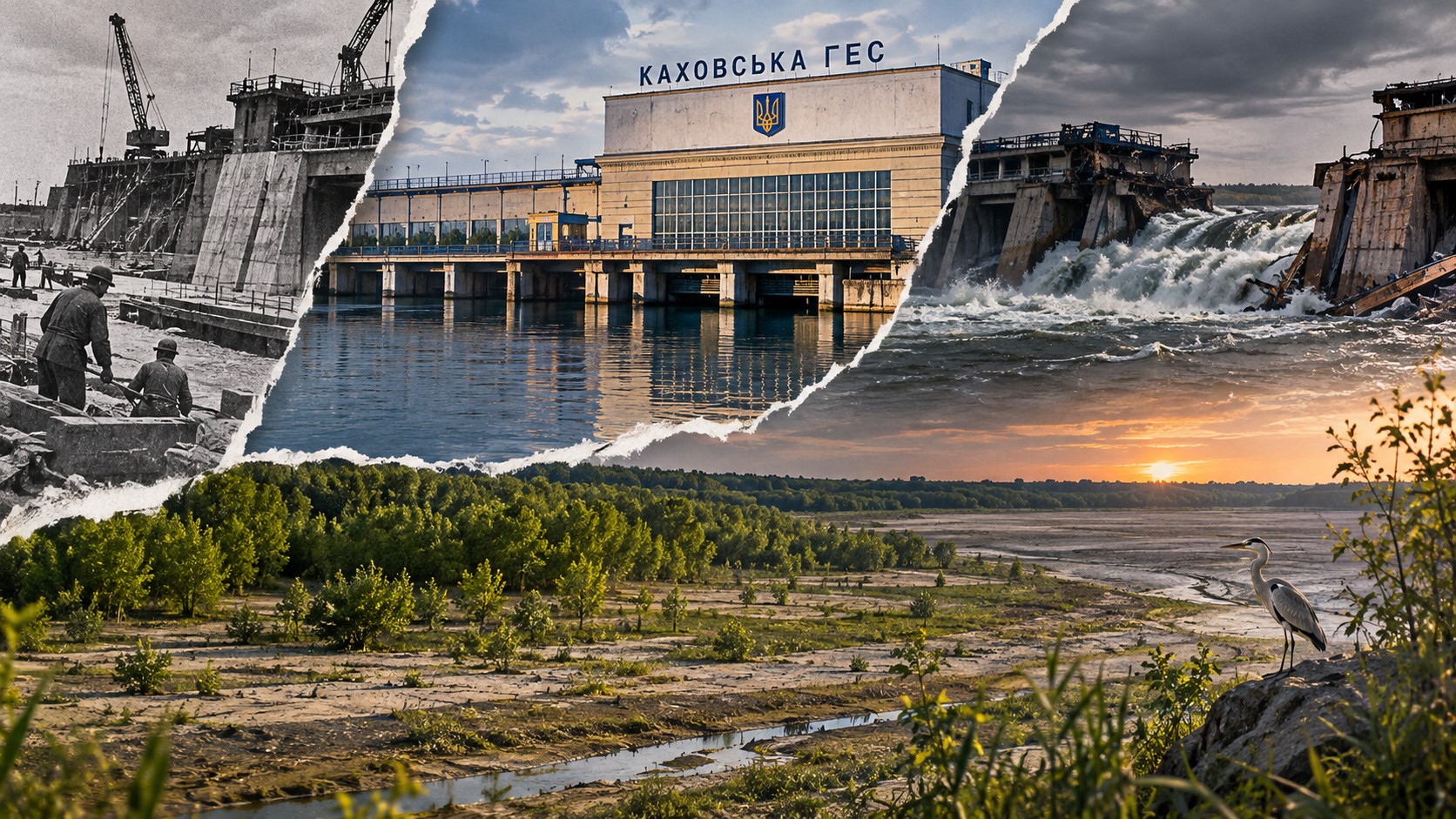
From the creation of the Kakhovka Reservoir in the 1950s to the disaster of 6 June 2023: historical heritage, human losses, environmental consequences, and the impact on Ukraine’s water and energy security. Should the Kakhovka Hydropower Plant be rebuilt — and what should become of the Great Meadow?
Introduction. When More Than a Dam Disappears — An Entire World Is Lost
On 6 June 2023, Ukraine faced one of the largest man-made and environmental disasters in modern European history. Following the destruction of the Kakhovka Hydropower Plant dam, water from the Kakhovka Reservoir began rushing downstream along the Dnipro River. Dozens of settlements were flooded, thousands of people lost their homes, and vast areas of southern Ukraine underwent dramatic changes.
However, the disaster had another dimension, less immediately visible. The reservoir that had supplied water to cities, industry, and agriculture for decades disappeared. Ukraine lost part of its hydropower capacity, a vital component of its water management system, and an enormous artificial freshwater reserve.
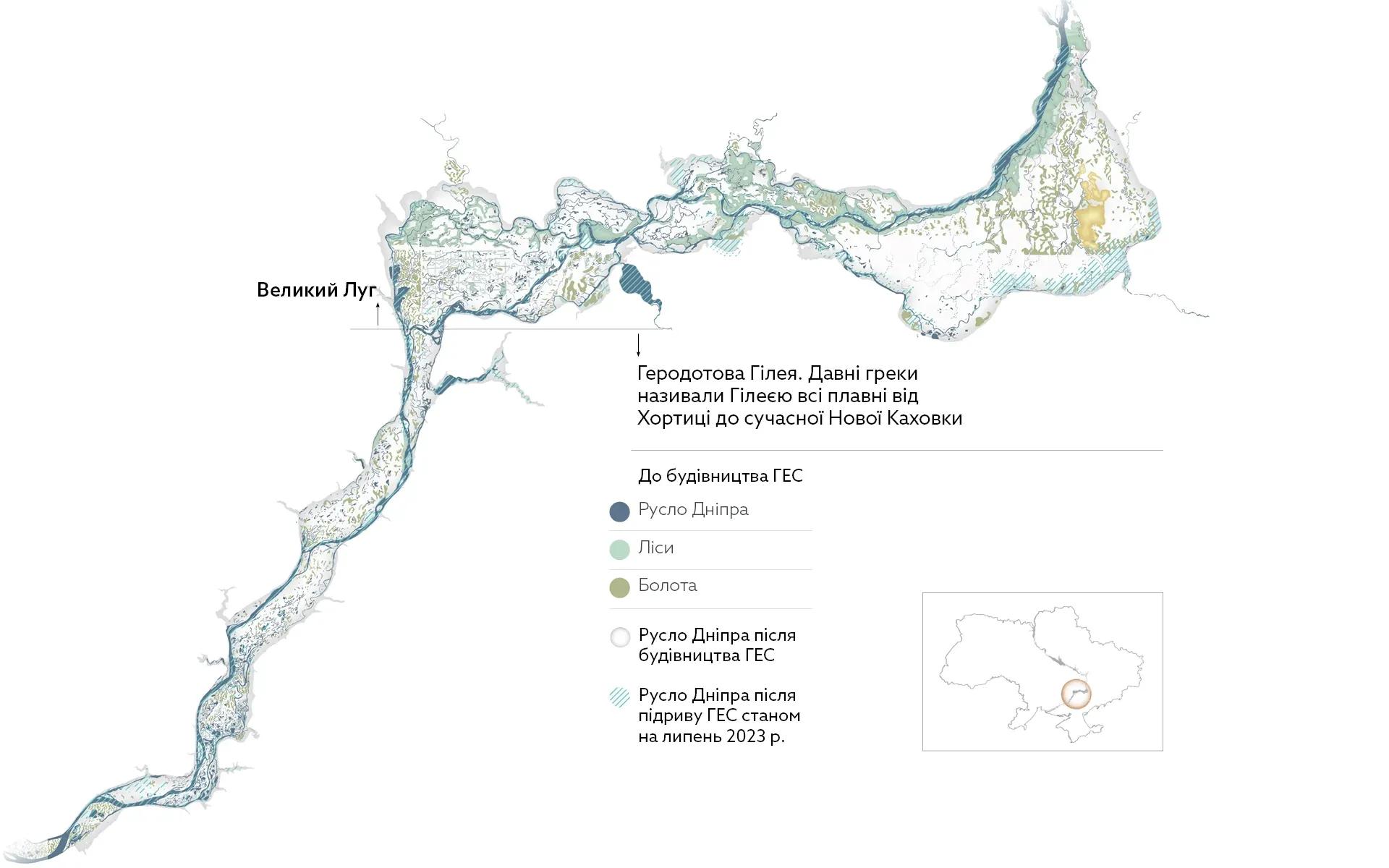
At the same time, as the water receded, the territory of the Great Meadow — Velykyi Luh — re-emerged. This historic and natural landscape had been flooded during the construction of the Kakhovka Hydropower Complex in the 1950s. Along with the water, the remains of ancient settlements, archaeological sites, traces of Cossack history, and landscapes hidden for decades came back into view.
The destruction of the Kakhovka Hydropower Plant was not only a tragedy for the people living along the Dnipro. It also raised difficult questions for Ukraine: how can water supplies to the southern regions be restored? What should be done with the former reservoir bed? Should the artificial sea that existed for almost seven decades be recreated? And how can historical heritage that has been put at risk be preserved?
To understand the scale of this event, we need to return to the beginning of the story — to the decision to build the Kakhovka Hydropower Plant, made in the middle of the twentieth century.
1. How and Why the Kakhovka Hydropower Plant Was Built
A project intended to transform southern Ukraine
On 20 September 1950, the Council of Ministers of the USSR adopted a decision to build the Kakhovka Hydropower Complex and the North Crimean Canal.
The project was part of a large-scale Soviet programme aimed at developing energy, industry, and agriculture. Its purpose was to make comprehensive use of the water resources of the lower Dnipro River.
The Kakhovka Hydropower Complex was designed to perform several functions:
- generate electricity for industry and households;
- supply water to the arid territories of southern Ukraine;
- create conditions for the development of irrigated agriculture;
- provide water to industrial centres;
- improve navigation along the lower Dnipro;
- serve as the foundation for major canals, particularly the North Crimean and Kakhovka canals.
For the Soviet authorities, this project was part of what was known as the “Great Transformation of Nature”. The idea was to use large-scale hydraulic engineering structures to alter the natural water regime, turn dry steppe territories into irrigated agricultural land, and provide industry with additional energy resources.
However, this massive engineering transformation had another side. Creating the reservoir required flooding an enormous area of the Dnipro floodplain, relocating residents of settlements, and leaving a significant part of the historical landscape underwater.
Construction and the scale of the project
The first construction workers arrived at the site of the future power plant in the autumn of 1950. Work began near the village of Kliuchove, which later became the city of Nova Kakhovka.
According to historical materials published by Ukrhydroenergo, approximately 12,000–15,000 workers were involved in the construction. More than a thousand vehicles, dozens of excavators and cranes, bulldozers, dredgers, and railway transport were used at the site.
Ukrainian industrial enterprises played an important role in supplying the construction project. The main equipment was provided by the Kharkiv Turbine Plant, Zaporizhzhia Transformer and Mechanical Plants, and the Elektrovazhmash plant.
This is an important historical point: the Kakhovka Hydropower Plant was not merely a major construction project. It was also the result of the work of Ukrainian engineers, industrial enterprises, and thousands of people who took part in building the hydropower complex.
On 30 March 1952, the first cubic metre of concrete was poured into the foundation of the structure.
In July 1955, the Dnipro riverbed was blocked and the water flow was redirected into a new channel. The filling of the future Kakhovka Reservoir began.
On 18 October 1955, the first generating unit was commissioned. Five more units were brought into operation over the following year. By October 1956, the plant had reached its full design capacity.
In 1959, the hydropower complex was officially accepted for industrial operation.
According to Ukrhydroenergo, the original project envisaged an installed capacity of 312 MW, annual electricity generation of approximately 1.4 billion kWh, and the creation of a reservoir with a surface area of approximately 2,155 km² and a useful storage volume of 6.8 km³. The plant’s installed capacity was subsequently increased to 334.8 MW.
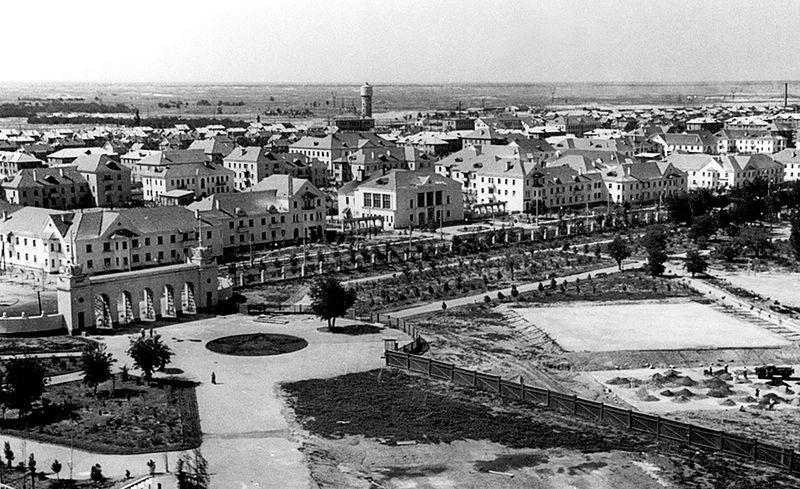
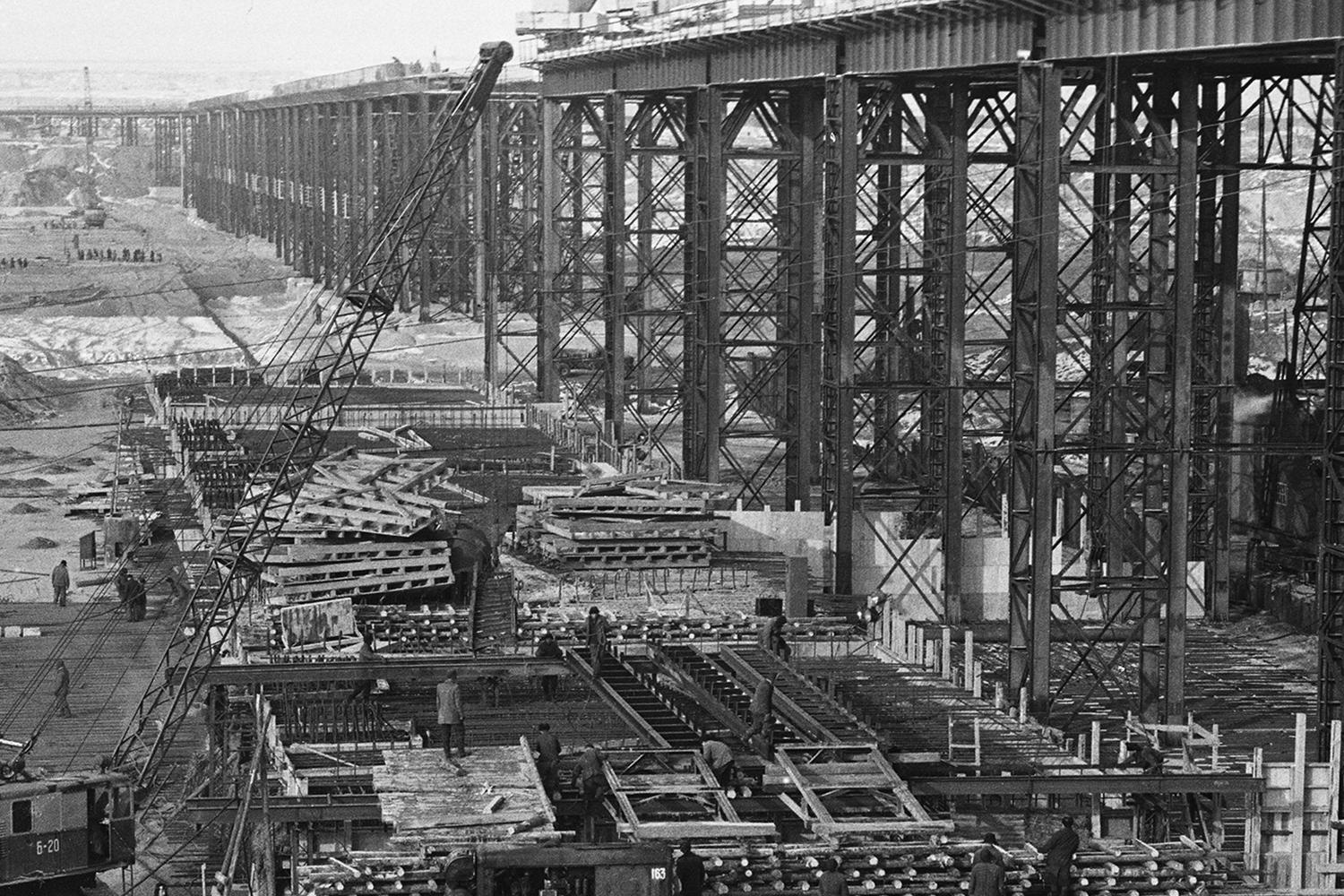
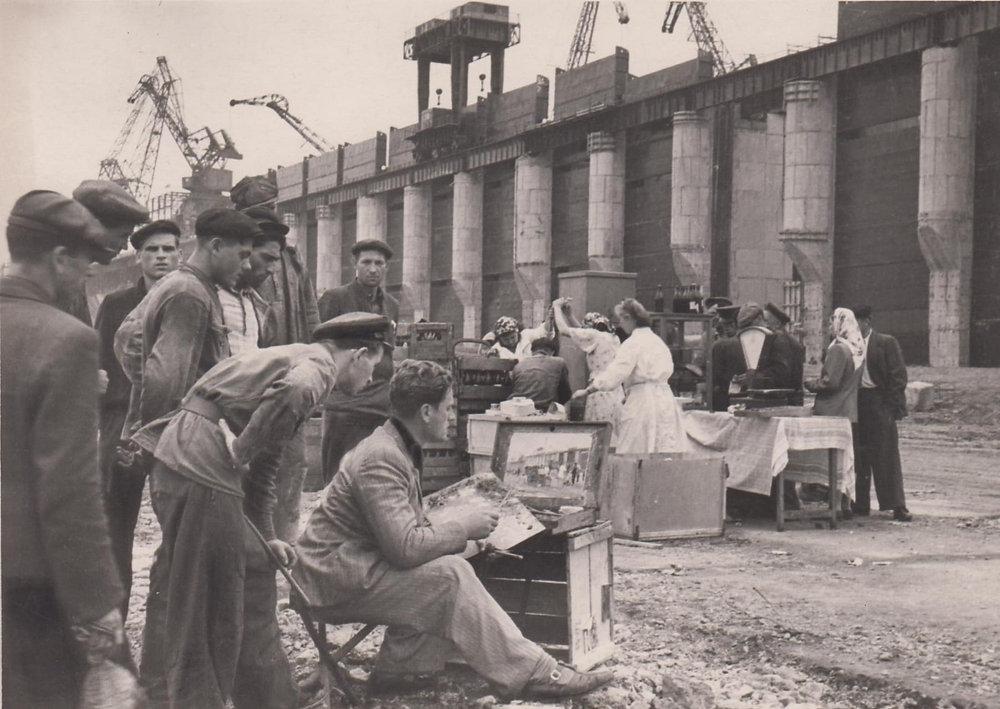
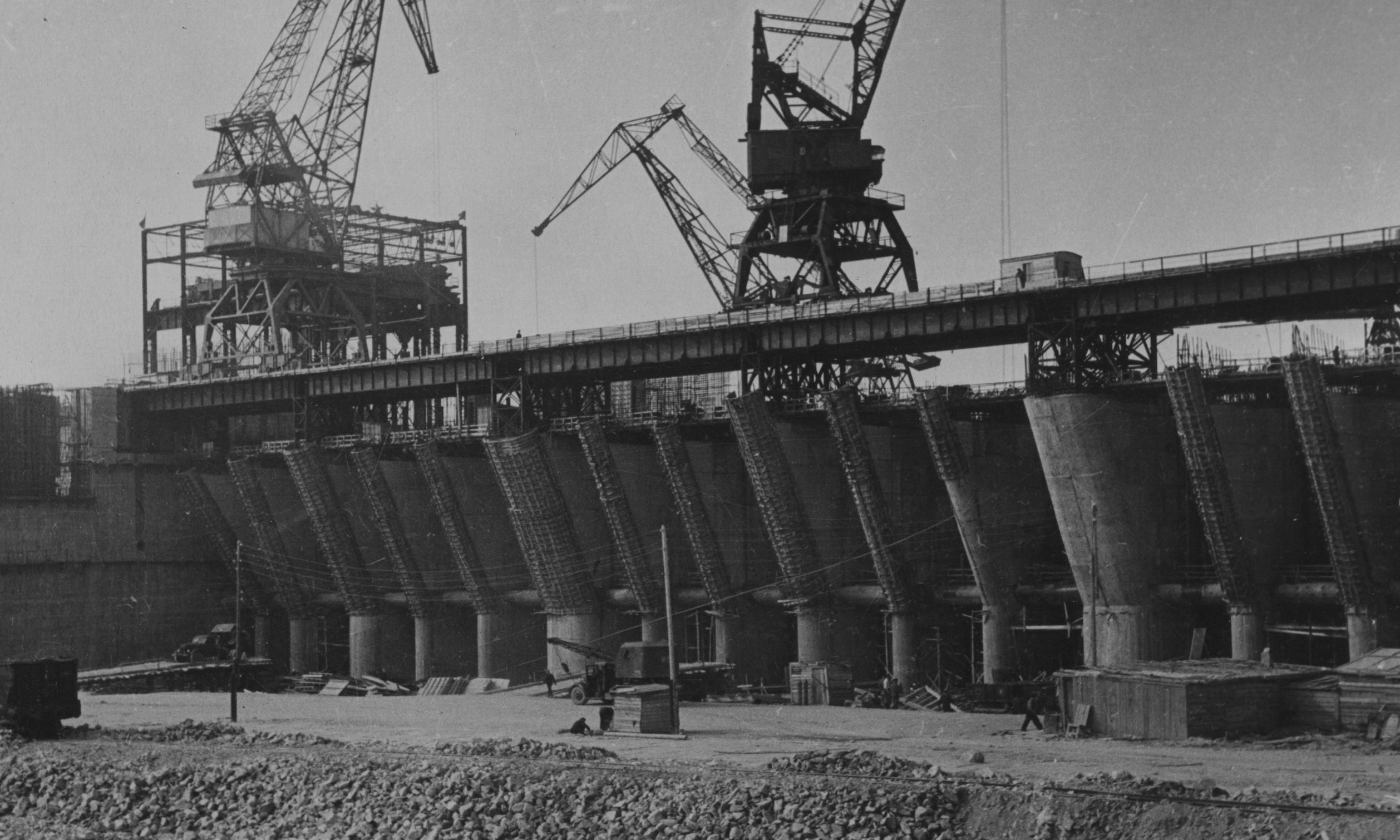
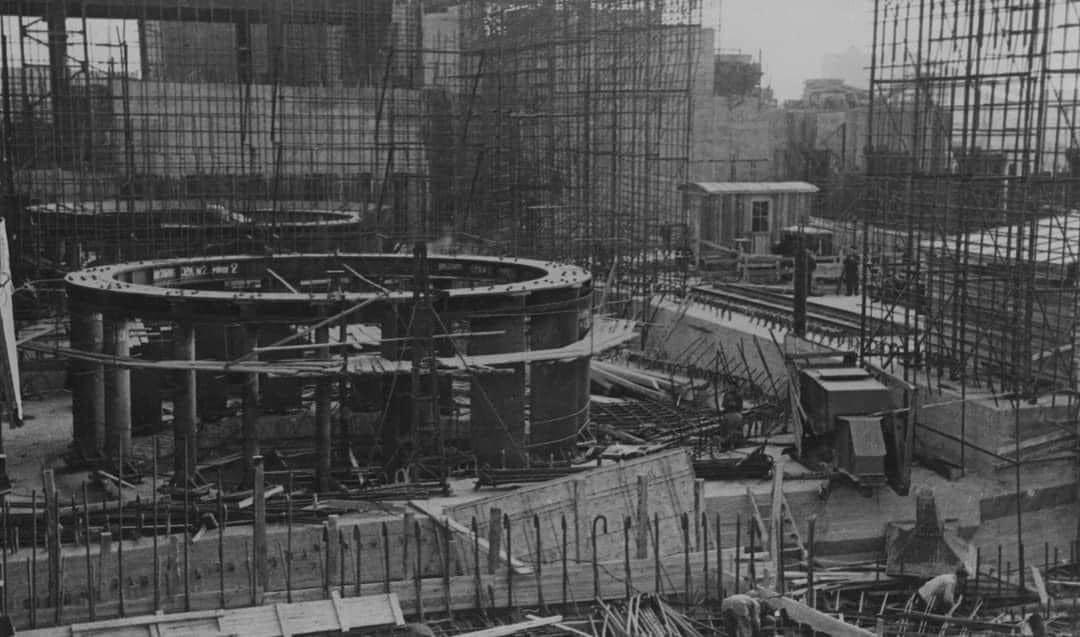
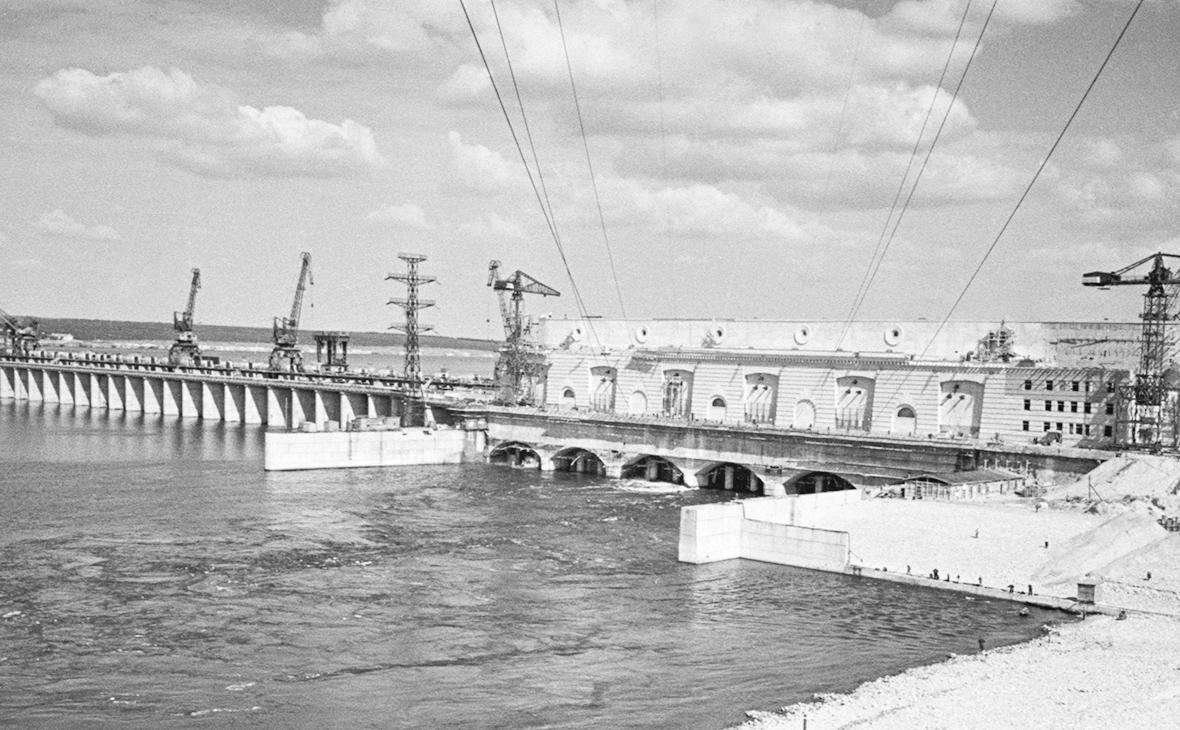
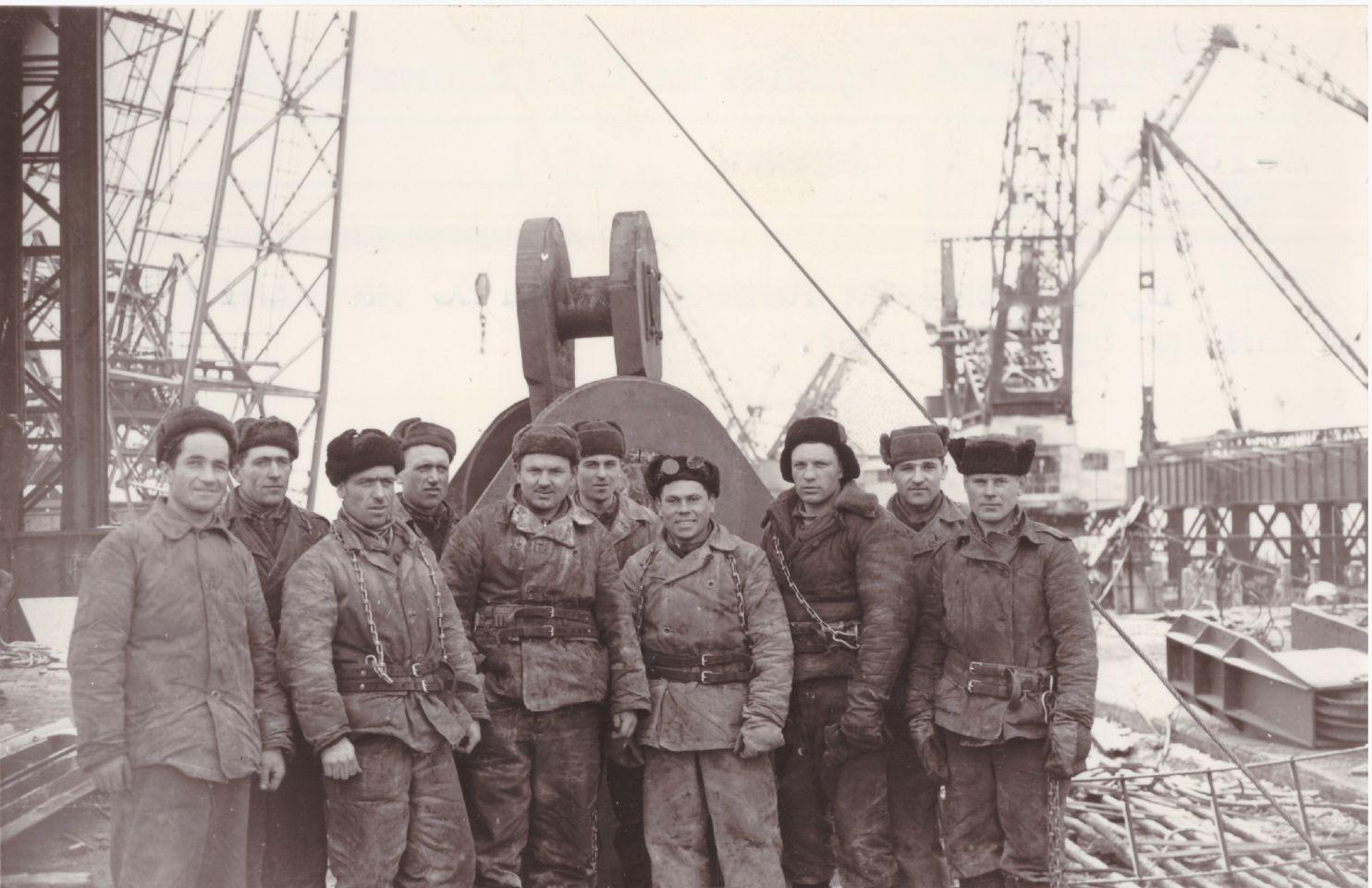
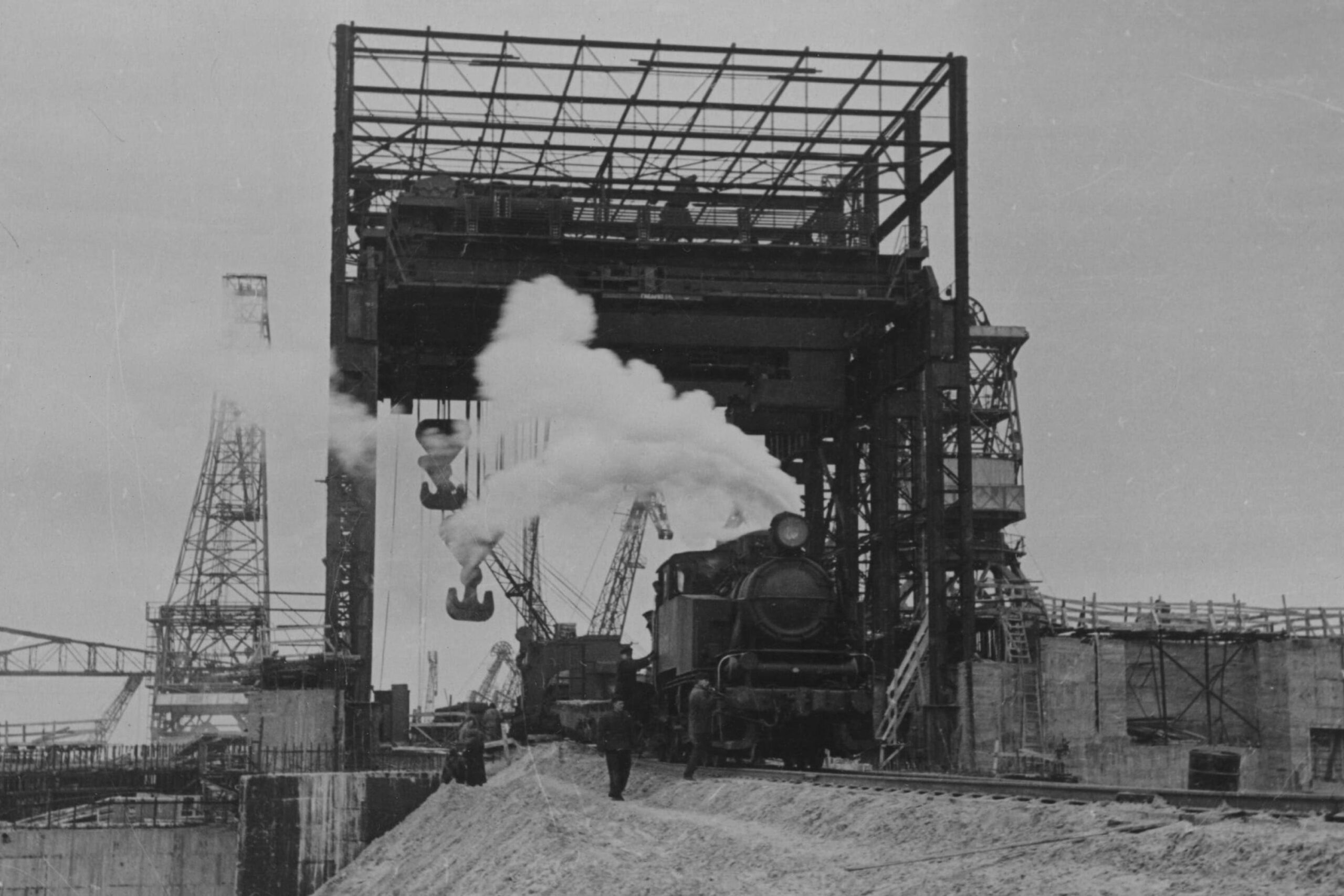
Archival photographs of the construction of the Kakhovka Hydropower Complex. Images used in publications should have verified origins and appropriate reproduction permissions.
2. The Great Meadow: What Existed Where the Reservoir Was Later Built
Before the Kakhovka Reservoir was created, a significant part of this territory was occupied by the Great Meadow — an enormous floodplain system in the lower Dnipro basin.
It was a complex natural environment consisting of numerous channels, lakes, marshes, wetlands, islands, meadows, and floodplain forests. The landscape changed throughout the year under the influence of the Dnipro’s seasonal floods. The water created natural conditions for a wide variety of plant and animal species.
The Great Meadow was not only a natural treasure but also a place of exceptional historical importance.
The land of the Zaporozhian Cossacks
For centuries, the Great Meadow was closely connected with the lives of the Zaporozhian Cossacks. Its natural features had strategic importance: numerous islands, channels, wetlands, and forests provided favourable conditions for defence, movement, and economic activity.
Cossack winter settlements, villages, places of economic activity, and burial grounds were located here. The territory was closely connected with the history of the Zaporozhian Sich and the Cossack way of life in the lower Dnipro region.
The Great Meadow was also an important source of natural resources: fish, timber, pastures, and fertile floodplain land. Its natural landscape directly shaped the way of life of the local population.
It was not simply a forested area near the Dnipro. The Great Meadow was part of the historical environment in which a significant part of Ukrainian Cossack history took shape.
Archaeological heritage from different historical periods
Sites from various historical periods have been discovered in the Great Meadow and the surrounding territories, including:
- ancient human settlements and traces of early human activity;
- Bronze Age settlements and burial sites;
- Scythian burial mounds and other archaeological sites;
- sites dating from the Late Scythian period;
- remains of ancient and medieval cultures;
- Cossack settlements, winter settlements, and burial grounds;
- remains of fortifications and locations connected with the history of the Zaporozhian Sich.
The uniqueness of this region lies in the fact that its history cannot be separated from its natural environment. The river system, islands, floodplains, and natural elevations influenced the location of settlements, defensive capabilities, and people’s economic activities.
That is why the Great Meadow is now regarded as a potential cultural and natural landscape of international significance. The Ukrainian Nature Conservation Group has prepared a concept proposing the possible inclusion of this territory on UNESCO’s Tentative List of World Heritage Sites. This is currently a concept and an assessment of its potential, not an already granted UNESCO status.
3. How Much Historical Land and Heritage Was Flooded During Construction?
This is one of the most difficult questions in the history of the Kakhovka Reservoir. It is also a subject where it is particularly important not to replace scientific data with impressive but unverified figures.
The relocation of people and the disappearance of settlements
The creation of the reservoir required the large-scale relocation of residents from territories that were to be flooded.
According to estimates by the Ukrainian Nature Conservation Group, approximately 37,000 indigenous residents were forcibly relocated from the Great Meadow area in the 1950s, while around 90 villages and hamlets were either submerged or affected by the transformation of the area.
These figures refer to the wider territory of the Great Meadow and the resettlement associated with the construction project. They should not be interpreted as the number of settlements that were entirely submerged. Some settlements were relocated, others were rebuilt, and some disappeared from the map.
Relocation meant more than simply changing one’s address. People lost familiar homes, family farms, cemeteries, natural resources, and their connection with the landscape in which generations of their families had lived.
Archaeological research before the flooding
Before the reservoir was filled, archaeologists carried out what are known as rescue archaeological investigations — surveys of territories threatened with flooding as a result of large infrastructure projects.
In 1951, the first permanent Ukrainian archaeological rescue expedition was established. Its task was to identify, document, and preserve archaeological materials in the area that would become the future reservoir.
The research was conducted under conditions of limited time, funding, and technical resources. Some sites were documented and investigated, but many remained only partially studied or were never included in the scientific archaeological record.
Historian and researcher Nadiia Havryliuk, in her academic article on the first Ukrainian archaeological rescue expedition, analyses archival materials from 1951 and 1957 and demonstrates the scale of the loss to the archaeological environment following the creation of the reservoir.
How many archaeological sites are known today?
In 2023, Vladyslav Moroko, Director of the Department of Culture and Information Policy of the Zaporizhzhia Regional Military Administration, reported that approximately 70 national- and local-level heritage sites in the region remained unexplored.
This was not the total number of all submerged heritage sites. It was an estimate of sites that required further research at that time.
At the same time, the Ukrainian Nature Conservation Group states in its Great Meadow concept that modern researchers know of approximately 500 archaeological sites across the wider territory that require archaeological investigation and preservation.
These figures do not contradict one another: they refer to different categories and different scopes of documentation. The figure of 70 refers to a reported estimate of unexplored national- and local-level heritage sites, while approximately 500 represents the broader body of known archaeological sites in the Great Meadow and surrounding areas.
It is also important to note that not all 500 sites can be described as submerged. Some are located in territories that were not completely underwater, some were affected by shoreline erosion, and others became accessible for research after the water receded.
Therefore, it is currently impossible to establish the exact number of all historical sites that were destroyed or damaged during the creation of the reservoir. Archaeological documentation is ongoing, and the discovery of new sites may change the overall picture.
What re-emerged after the reservoir disappeared?
After the dam was destroyed and the water receded, part of the former reservoir territory once again became accessible for archaeological research.
Remains of settlements, household objects, fragments of pottery, old cemeteries, and other traces of human activity appeared on the surface.
However, this does not mean that all these sites automatically became accessible or safe to investigate. Some areas remain mined, others are located in combat zones or under occupation. In addition, prolonged submersion, erosion, drying, and human interference can damage archaeological sites.
The destruction of the hydropower plant created a unique but extremely difficult opportunity to investigate what had remained hidden underwater for decades. At the same time, this requires a systematic state programme, protection of the territory, and the involvement of archaeologists.
4. What Ukraine Gained from the Kakhovka Hydropower Plant
To assess the consequences of its destruction, it is necessary to understand the role the power plant and reservoir played before June 2023.
Electricity and the stability of the energy system
The Kakhovka Hydropower Plant was the final station in the Dnipro cascade of hydropower plants.
Its installed capacity was 334.8 MW. Its average annual design electricity generation was approximately 1.42 billion kWh.
Over 65 years of operation, the plant generated approximately 87.8 billion kWh of electricity.
Its role was not limited to electricity generation. The hydropower plant could rapidly adjust its output in response to the needs of the energy system, help cover peak demand, regulate frequency and power, and provide emergency reserves.
This is particularly important for an energy system in which electricity consumption changes throughout the day and the balance between generation and consumption must be maintained continuously.
Following the destruction of the plant, Ukraine lost not only 334.8 MW of installed capacity but also a flexible tool for balancing the energy system.
The reservoir as a strategic freshwater reserve
The Kakhovka Reservoir was of enormous importance for the water supply of southern Ukraine.
Its water was used for:
- drinking and household water supply;
- industrial needs;
- irrigation of agricultural land;
- operation of canals;
- maintaining the water regime of certain territories;
- navigation and fisheries.
The reservoir was an important water source for cities and industrial centres, including Kryvyi Rih, Nikopol, and Marhanets.
It was also the foundation for the operation of the North Crimean Canal and the Kakhovka Main Canal, which supplied water to large areas of southern Ukraine.
According to United Nations estimates, before its destruction the Kakhovka Reservoir was the main source of drinking water for more than 700,000 people in southern Ukraine. In the first days after the disaster, the UN warned that up to one million people could lose access to drinking water.
This is particularly important for understanding the consequences of the disaster: the water in the reservoir was not simply a large volume of water behind a dam. It was the foundation of a complex system of water supply, irrigation, and industrial development.
5. 6 June 2023: The Destruction of the Kakhovka Hydropower Plant
During the night of 6 June 2023, the Kakhovka Hydropower Plant dam was destroyed. Water from the reservoir began rushing downstream along the Dnipro, causing large-scale flooding of settlements and territories downstream.
At that time, the area around the power plant was under the control of Russian occupying forces.
Ukrainian authorities stated that the structures of the hydropower plant had been blown up from the inside by Russian military personnel. The President of Ukraine reported that the explosion occurred at approximately 02:50.
It is important to consider not only official statements but also the technical evidence.
What did independent investigations establish?
On 16 June 2023, The New York Times published an extensive investigation analysing engineering drawings of the dam, satellite images, eyewitness accounts, seismic station data, and assessments by specialists in hydraulic engineering and explosives.
According to the experts involved, the most likely cause of the destruction was an internal detonation of an explosive charge in a technical gallery running through the concrete foundation of the dam.
This gallery could be accessed from the turbine hall. Experts explained that an external strike would have had to penetrate a substantial thickness of concrete structures, whereas an explosion inside the foundation could directly damage the load-bearing part of the structure.
The investigation also considered:
- data from seismic sensors in Ukraine and Romania, which recorded signals characteristic of powerful explosions;
- accounts from people who heard explosions in the area of the power plant;
- satellite data indicating thermal anomalies shortly before the destruction;
- the nature of the damage to the concrete foundation of the dam;
- the fact that the facility was under Russian military occupation.
Experts cautioned that a full examination of the destroyed structure would be necessary to establish every detail of the failure mechanism. Nevertheless, the combined technical data and circumstances pointed to an internal explosion as the most substantiated explanation for the disaster.
Why control over the facility mattered
At the time of the destruction, the Kakhovka Hydropower Plant was located in territory occupied by Russia. Ukraine had no opportunity to exercise full control over the plant, access to its premises, or the actions of the people inside it.
This is an important circumstance when assessing the technical possibility of an internal explosion.
At the same time, occupation alone is not sufficient proof of responsibility. It must be considered alongside technical data, satellite observations, eyewitness accounts, and the nature of the destruction.
As of the date this article was prepared, the independent technical data published in The New York Times investigation supported the theory of an internal explosion. However, no complete forensic engineering examination of the entire structure has been made publicly available that would allow every detail of the explosion to be reconstructed.
6. Human Losses: How Many People Were Killed and Injured?
The most devastating consequence of the destruction of the Kakhovka Hydropower Plant was the loss of human life.
Water rapidly flooded homes, streets, roads, and entire settlements. People became trapped on rooftops, upper floors, and in places that ordinary rescue vehicles could not reach.
The situation was particularly difficult on the left bank of the Dnipro in the Kherson region, which was under Russian occupation. The evacuation of civilians was severely complicated, and Ukrainian rescue services did not have full access to the affected territories.
How many deaths have been confirmed?
On 20 July 2023, Ukraine’s Minister of Internal Affairs, Ihor Klymenko, reported that 31 deaths had been recorded in the territory controlled by Ukraine: 29 people in the Kherson region and two in the Mykolaiv region.
Later, according to the Ministry of Internal Affairs’ final report of 31 December 2023, at least 34 people had died as a result of the disaster.
A joint assessment by the Government of Ukraine and the United Nations, published in October 2023, recorded 29 deaths directly associated with the disaster and 28 people injured. This assessment used a different methodology and had been prepared earlier than the subsequent report by the Ministry of Internal Affairs.
These figures should not simply be added together or presented as contradictory evidence. They reflect different reporting dates and accounting methodologies.
It is also important to emphasise that the final death toll across all affected territories could not be established. Due to the Russian occupation of the left-bank part of the Kherson region, Ukrainian authorities and international humanitarian organisations did not have full access to the disaster sites. The United Nations explicitly reported that the Russian side had failed to provide access to the affected population in the occupied territory.
Therefore, the figure of 34 represents the minimum officially reported by Ukrainian authorities, not necessarily the complete number of people who died.
How many people were evacuated and rescued?
According to the Ministry of Internal Affairs of Ukraine, nearly 3,800 people and more than 280 animals were evacuated during the emergency response. Rescuers saved 716 people.
According to the United Nations, approximately 100,000 residents of four regions were directly affected by the flooding.
These figures do not include everyone who experienced indirect consequences, such as the loss of water supplies, destruction of farms, disruption of businesses, and a prolonged deterioration in living conditions.
7. Environmental Disaster: What Happened to Nature After the Dam Was Destroyed?
The environmental consequences of the destruction of the Kakhovka Hydropower Plant were not limited to the flooding of settlements. The disaster simultaneously caused extensive flooding downstream from the dam and the rapid drainage of a vast area upstream.
This double change in the water regime became one of the most complex environmental challenges.
In October 2023, the United Nations Environment Programme (UNEP) published a dedicated assessment of the consequences of the Kakhovka Hydropower Plant’s destruction. Experts from 13 institutions in Ukraine and other countries contributed to its preparation. The analysis used official data, satellite imagery, remote sensing, and the results of field research where access was possible.
The report emphasised that some environmental consequences could be irreversible and that the impact on ecosystems and human health could be felt for decades.
7.1. Large-scale flooding
After the dam was destroyed, water flooded hundreds of square kilometres downstream along the Dnipro River.
According to the joint assessment by the Government of Ukraine and the United Nations, more than 620 km² of territory in the Kherson, Mykolaiv, Dnipropetrovsk, and Zaporizhzhia regions was submerged.
The flooding damaged residential buildings, roads, utility networks, agricultural land, cultural heritage sites, and natural areas.
The consequences were particularly severe for floodplain ecosystems, which are not adapted to sudden, prolonged flooding of such intensity.
7.2. Chemical and biological water pollution
A range of pollutants entered the river along with the floodwater, including:
- petroleum products;
- fuel and lubricant residues;
- domestic and industrial wastewater;
- sewage;
- agrochemicals;
- waste from flooded industrial facilities and farms;
- biological pollutants associated with animal deaths and organic remains.
In the first hours after the disaster, Ukrainian authorities reported that at least 150 tonnes of engine oil had entered the Dnipro, with a risk of a further leak of more than 300 tonnes.
The pollution created risks for aquatic organisms, water intake systems, the sanitary condition of water bodies, and human health.
The World Health Organization warned about risks associated with disruptions to water supply, sanitation, and sewage systems, as well as the possible release of hazardous chemicals into the water.
7.3. The death of fish and other aquatic organisms
The sharp drop in the reservoir’s water level and the change in the Dnipro’s hydrological regime caused significant damage to aquatic ecosystems.
Fish became trapped in isolated water bodies that rapidly became shallower, warmer, and depleted of oxygen. Some aquatic organisms died due to a lack of oxygen, temperature changes, and deteriorating water quality.
The disappearance of the vast water area also changed the conditions for spawning, migration, and feeding for many fish species.
The consequences are particularly important for species that depend on natural floodplains and the complex aquatic systems of the lower Dnipro.
The recovery of fish populations is not a matter of a single season. It depends on water quality, the availability of spawning grounds, the preservation of natural river channels, and the absence of further pollution.
7.4. The drainage of the Kakhovka Reservoir and the loss of its aquatic ecosystem
Equally extensive consequences occurred upstream from the dam.
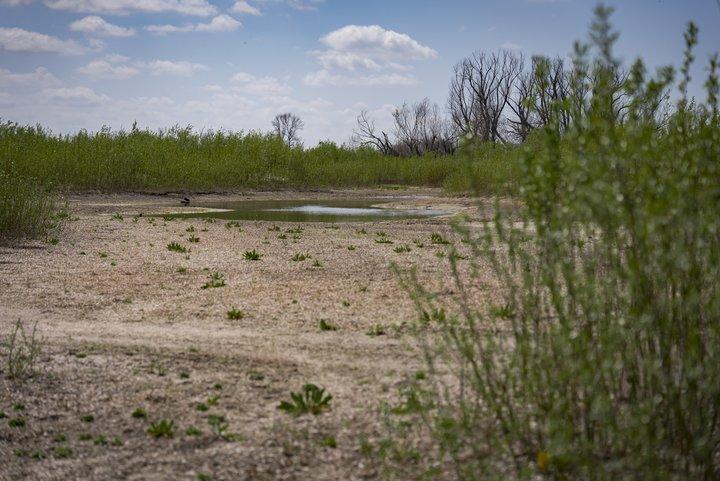
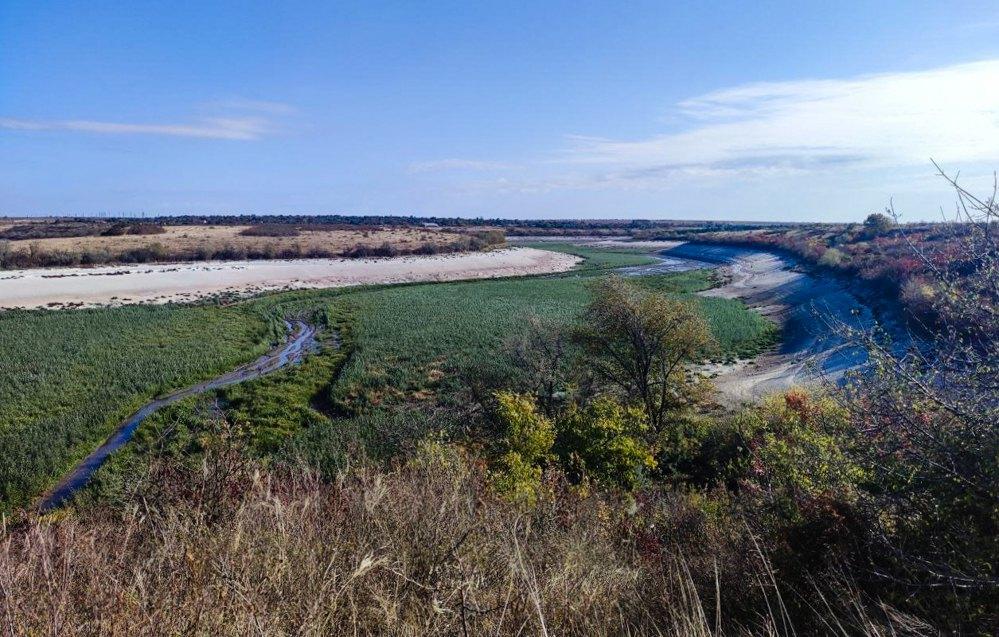
After the structures were destroyed, water from the Kakhovka Reservoir began flowing downstream. The enormous water surface gradually turned into a system of remaining water bodies, channels, and exposed areas of the former reservoir bed.
According to UNEP, thousands of square kilometres of the reservoir and wetlands were drained.
This effectively meant the disappearance of an aquatic ecosystem that had developed over decades and had its own temperature regime, vegetation, fish populations, microorganisms, and food chains.
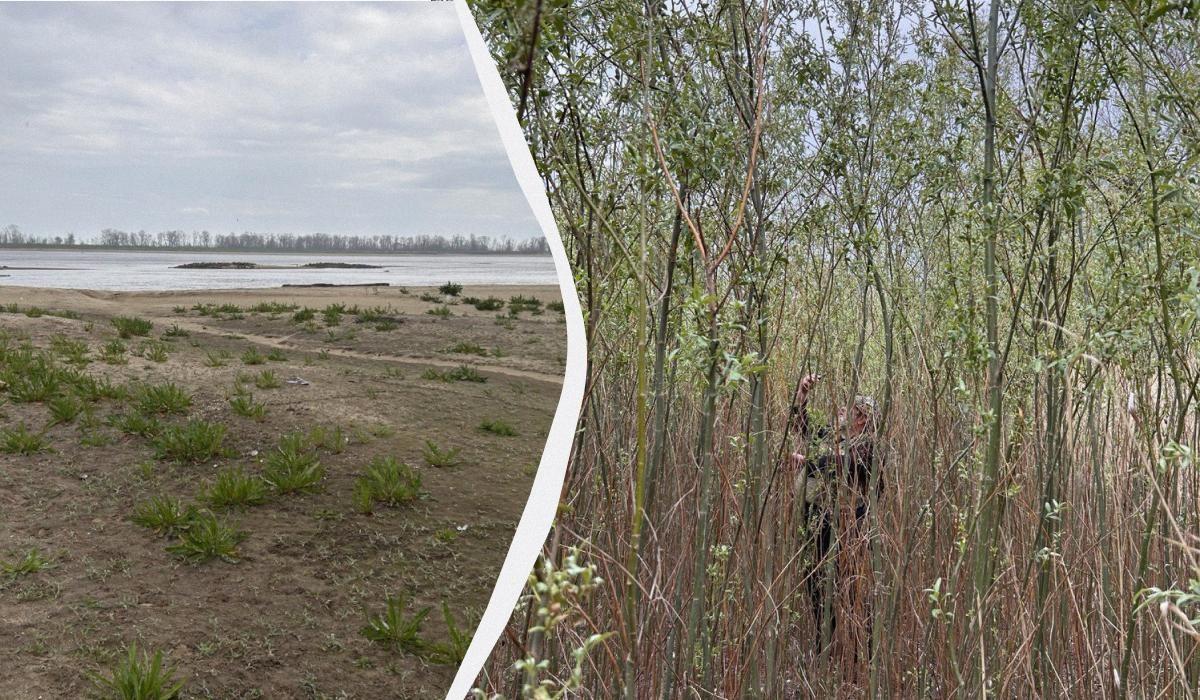
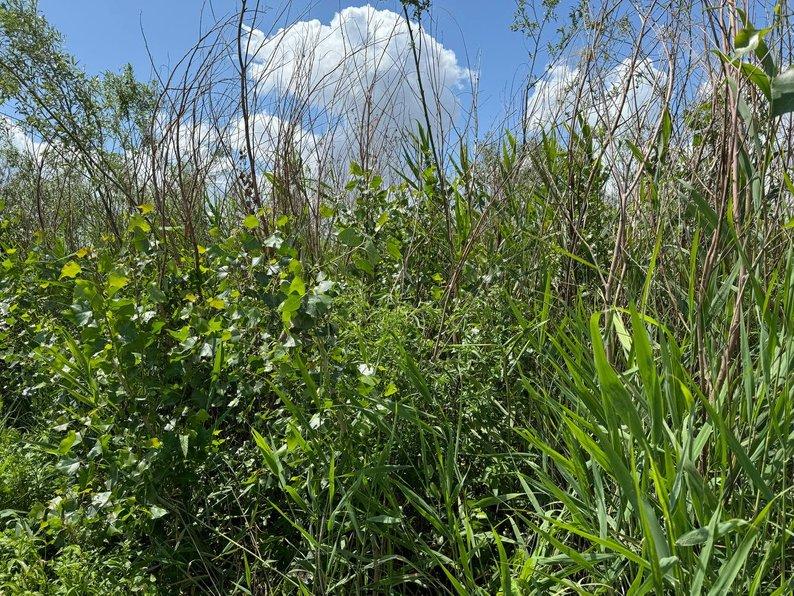
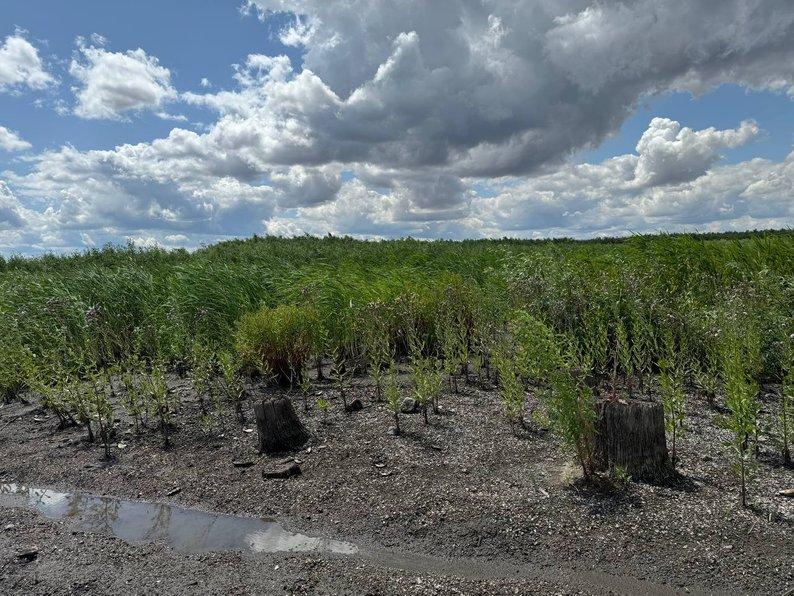
At the same time, the former reservoir bed did not remain lifeless. After the water receded, natural vegetation began to regenerate rapidly in some areas, including floodplain forests dominated by willow trees.
Scientists recorded that, just one year after the disaster, young willows in some locations had grown to more than four metres in height.
This process is an important example of natural succession — the gradual recovery of an ecosystem following a major change in environmental conditions. However, it does not mean that the entire former reservoir ecosystem has automatically returned to its natural state.
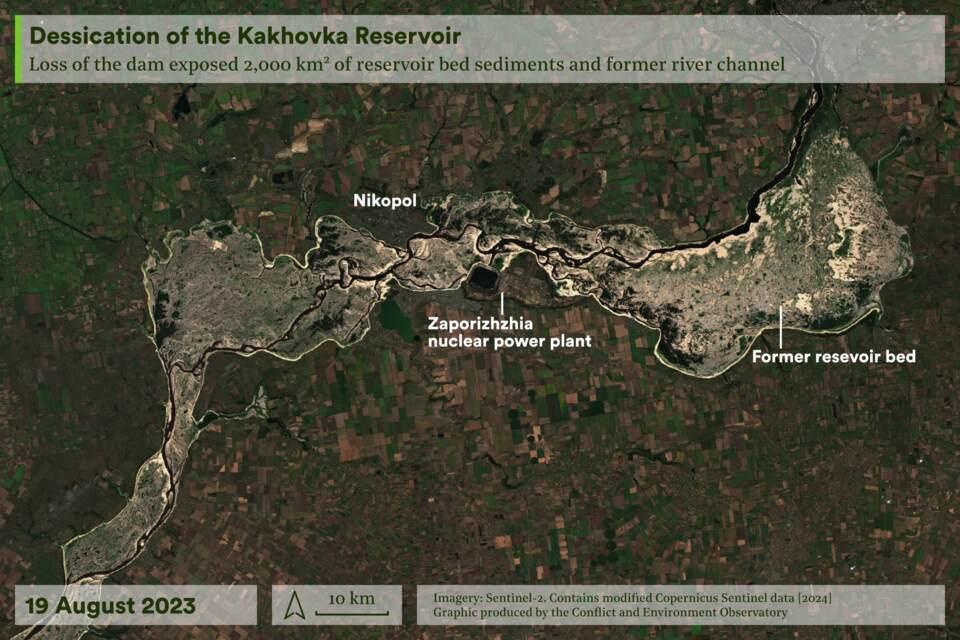
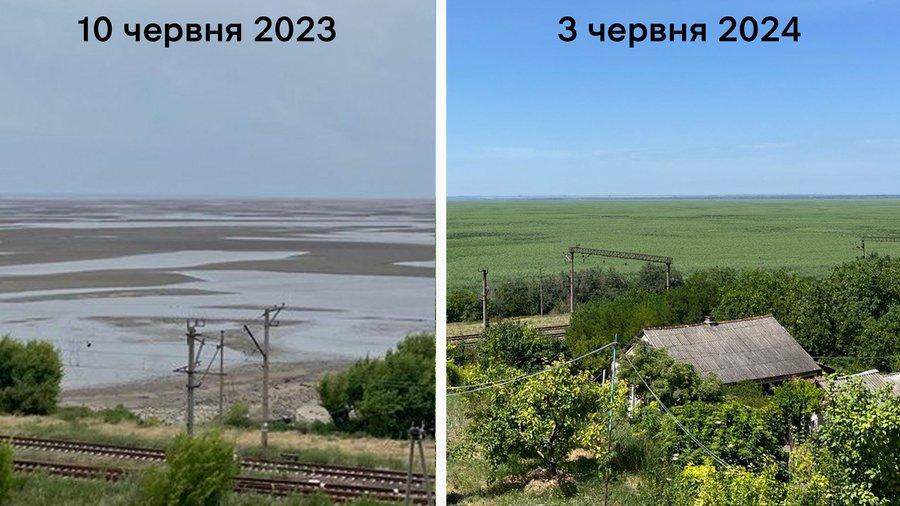
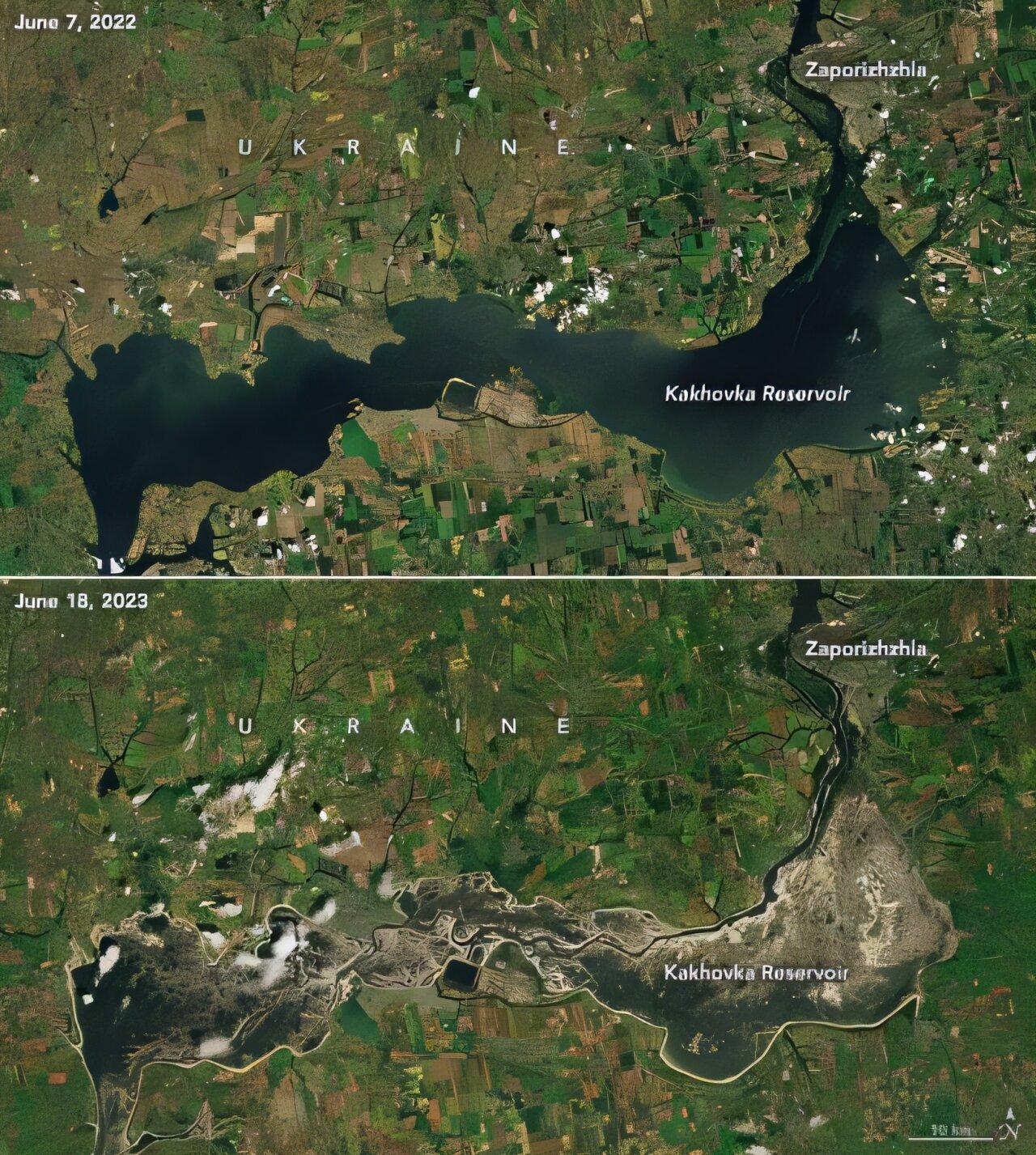
7.5. Damage to protected natural areas
The consequences of the disaster affected protected areas, wetlands, and landscapes important for biodiversity conservation.
Changes in the water regime affected bird nesting sites and the habitats of fish, amphibians, and aquatic invertebrates.
Of particular importance is the fact that, following the drainage of the reservoir, the Great Meadow began to regenerate as a natural floodplain system.
The scientific concept developed by the Ukrainian Nature Conservation Group emphasises that this territory has the potential to become an important natural and cultural site. The restoration of floodplain forests, meadows, and wetlands could be of considerable value for biodiversity throughout the region.
However, reflooding the former reservoir would mean destroying a significant part of this newly developing natural system.
7.6. Soil and agricultural land contamination
Floodwaters that inundated settlements and agricultural areas carried pollutants from industrial, municipal, and agricultural facilities.
After the water receded, some territories were left covered with deposits of silt, organic remains, and contaminated sediments.
The consequences may persist for a long time, affecting soil properties, causing the accumulation of certain chemical substances, and deteriorating water quality in local water bodies.
That is why agricultural use of the affected territories requires preliminary testing of soil, water, and contamination levels.
7.7. Why the environmental consequences did not end when the water receded
At first glance, it may seem that the worst is over: the water has receded, some settlements have dried out, and vegetation has grown on the reservoir bed.
But an environmental disaster does not end when the flood disappears.
Its effects continue through changes in the water balance, soil transformation, disruption of migration routes, changes in species habitats, water quality problems, and the loss of functions previously performed by the reservoir.
This is why UNEP emphasises the need for long-term monitoring and recovery measures. The full scale of the consequences for drinking water supplies, irrigation, industry, and human health requires separate research and was not fully covered by the initial environmental assessment.
8. What Ukraine Lost in Terms of Water Resources
The destruction of the Kakhovka Hydropower Plant resulted not only in the loss of a power station but also in the loss of an enormous artificial freshwater reservoir.
According to estimates, more than 14.7 km³ of water flowed out of the reservoir during the disaster. Within a few days, a significant part of the water reserve previously used to supply the southern regions was lost.
8.1. Drinking water supply
The Kakhovka Reservoir was a source of water for settlements, industry, and municipal systems in southern Ukraine.
After its disappearance, alternative water sources had to be found, and new water pipelines, wells, pumping stations, and other facilities had to be built.
The problem was particularly acute in areas that had depended directly on water intakes from the reservoir.
8.2. Water for Kryvyi Rih, Nikopol, and Marhanets
Kryvyi Rih is one of Ukraine’s largest industrial centres. Its water needs are linked not only to household consumption but also to the operation of mining and processing enterprises, metallurgy, and municipal services.
After the destruction of the Kakhovka Hydropower Plant, securing the city’s water supply became one of the most important infrastructure challenges.
The problem was also particularly significant for Nikopol and Marhanets, as their water supplies were connected to the level of the Kakhovka Reservoir.
The state had to look for alternative water sources, develop new supply routes, and build infrastructure to compensate for the losses.
8.3. The loss of the irrigation system
Before the hydropower plant was destroyed, the Kakhovka Reservoir supplied water to large irrigation systems.
The consequences of the disaster were particularly severe for agriculture in the Kherson, Zaporizhzhia, and Dnipropetrovsk regions.
According to World Bank estimates, following the destruction of the Kakhovka Hydropower Plant, approximately 350 irrigation pumping stations and around 1,100 kilometres of irrigation canals could no longer be used properly.
Before the full-scale war, approximately 738,000 hectares of irrigated land were in operation in Ukraine. Following the loss of the water resource and the destruction of infrastructure, the area under active irrigation decreased sharply.
For southern Ukraine, this means a major change in agricultural conditions.
A region where vegetables, fruit, melons, watermelons, and other produce were grown faced water shortages and the need to reconsider its crop structure.
8.4. Industry and energy
The loss of the reservoir also affected industrial enterprises that used water in their technological processes.
The Zaporizhzhia Nuclear Power Plant deserves particular attention. The Kakhovka Reservoir was connected to the water supply system, including the supply needed to support cooling systems.
After the hydropower plant was destroyed, the water situation at the Zaporizhzhia NPP became an additional risk factor. The International Atomic Energy Agency emphasised the need to monitor the water level in the cooling pond and ensure the availability of alternative water sources.
It is important to clarify that the destruction of the Kakhovka Hydropower Plant did not automatically mean that the reactors immediately lost their cooling capability. The plant had other water reserves, including its cooling pond. However, the disappearance of the reservoir significantly complicated long-term water security and increased risks to nuclear safety.
9. What Energy Losses Did Ukraine Suffer?
The loss of the Kakhovka Hydropower Plant was another blow to Ukraine’s energy system, which was already facing constant Russian attacks.
The plant had an installed capacity of 334.8 MW and an average annual design electricity generation of approximately 1.42 billion kWh.
It was not Ukraine’s largest power plant, but its importance went far beyond the number of kilowatt-hours it generated.
The hydropower plant could rapidly adjust its output, respond to peak consumption, support the balance of the energy system, and provide emergency reserves.
Following its destruction, Ukraine lost:
- 334.8 MW of installed generating capacity;
- potential electricity generation of approximately 1.42 billion kWh per year;
- the ability to use the plant to cover peak demand;
- part of its flexibility in regulating frequency and power;
- an important component of the Dnipro hydropower cascade.
According to the joint assessment by the Government of Ukraine and the United Nations, direct damage to the energy sector was among the largest in certain categories of damaged infrastructure. The overall estimated direct damage and losses resulting from the disaster amounted to almost USD 14 billion, of which USD 2.79 billion represented direct damage to infrastructure and assets, while more than USD 11 billion represented economic and other losses.
These figures refer to the entire disaster, not just the cost of the destroyed power plant.
10. Can the Kakhovka Hydropower Plant Be Rebuilt?
This question has no simple answer. Technically, it is possible to build a new hydropower complex at the site of the destroyed one. But should the same system that existed before 6 June 2023 be recreated?
Economic, energy, environmental, historical, and social interests all intersect here.
Arguments in favour of reconstruction
Supporters of restoring the Kakhovka Hydropower Complex point to several important factors.
1. Water security for southern Ukraine
Without a large reservoir, it is more difficult to supply water to industry, cities, and agriculture.
2. Restoration of irrigation
The return of a water reservoir could create conditions for restoring large irrigation systems and part of the region’s agricultural production.
3. Energy security
A new hydropower plant could restore some of the lost hydropower generation capacity and the ability to balance the energy system.
4. Regional economic development
Restoring water infrastructure could support industry, agriculture, and employment.
Ukrhydroenergo previously estimated that restoring the Kakhovka Hydropower Complex would require approximately USD 1–1.2 billion. The estimated construction period for the power plant itself was five to six years, or approximately seven to eight years when surveys and dismantling works were included. This was a preliminary company estimate, not an approved budget for a future project.
Arguments against restoring the reservoir in its former form
Environmental organisations and some researchers believe that rebuilding the Kakhovka Reservoir according to the old design could cause further damage to nature.
After the reservoir was drained, natural floodplain ecosystems began to regenerate. Forests, wetlands, and habitats for species that had previously lost their natural environment began to reappear in some areas.
Reflooding would mean destroying a significant part of this newly developing ecosystem.
In their analytical materials, the Ukrainian Nature Conservation Group and the international network CEE Bankwatch draw attention to the following risks:
- the renewed loss of the natural Great Meadow;
- the destruction of new floodplain forests and wetlands;
- the flooding of archaeological sites that became accessible after the water receded;
- another major alteration of the natural water regime of the lower Dnipro;
- substantial financial costs associated with reconstruction and the subsequent maintenance of the hydropower complex;
- risks associated with climate change and the water balance.
In their study The Great Meadow vs. the Kakhovka Reservoir: A Modern Perspective, a group of Ukrainian researchers and environmental experts examines possible scenarios for the future of the territory and argues against reproducing the old Soviet model without a comprehensive reassessment of its consequences.
Are there alternatives?
Yes. And these alternatives should become the subject of serious national-level planning.
Possible solutions include:
- creating a system of smaller reservoirs and water storage facilities;
- modernising water pipelines and pumping stations;
- using groundwater where environmentally and hydrogeologically appropriate;
- developing local water supply systems;
- restoring irrigation using more water-efficient technologies;
- building new generating capacity instead of fully recreating the old hydropower plant;
- protecting and restoring natural floodplain ecosystems.
In 2025, specialists from the Ukrainian Hydrometeorological Institute of the State Emergency Service of Ukraine and the National Academy of Sciences of Ukraine published a study proposing that the feasibility of restoring the reservoir should be assessed by comparing long-term consequences, alternative water supply options, and the costs of each scenario.
In 2026, the National Academy of Sciences of Ukraine also reported on its work to scientifically model the future water security of southern Ukraine. This work includes hydrogeological assessments, forecasting geological processes, and developing alternative water supply options.
So, should it be rebuilt or not?
In my opinion, the right question is different. It is not “Should the Kakhovka Reservoir be restored?” but rather “Which model of water and energy security will best meet Ukraine’s needs over the coming decades?”
Rebuilding the hydropower complex may offer economic and infrastructure benefits. However, restoring the reservoir to its former boundaries would mean flooding the Great Meadow again and destroying part of the natural ecosystems that have begun to regenerate.
Therefore, any decision must be based on comprehensive research into:
- The actual water needs of the population, industry, and agriculture.
- The possibilities of alternative water supply.
- The energy-related feasibility of a new hydropower plant.
- The environmental consequences of recreating the reservoir.
- The historical and archaeological value of the Great Meadow.
- The costs of construction, operation, and future risks.
Climate change must also be taken into account. The amount of available water in the Dnipro basin, seasonal precipitation patterns, evaporation, and irrigation needs may all change.
A decision that appears economically beneficial today may not be the best option in 30–50 years.
11. The Kakhovka Hydropower Plant as a Symbol of Two Major Transformations in Ukrainian History
The history of the Kakhovka Hydropower Plant is, in fact, the story of two major transformations of the same region.
The first took place in the 1950s, when the Soviet authorities decided to alter the natural landscape of the lower Dnipro for the sake of energy generation, irrigation, and industrial development.
The second occurred in 2023, when Russia’s destruction of the dam led to the disappearance of the reservoir and initiated a new stage of natural change.
Both events had enormous consequences for people, nature, and historical heritage.
During the construction of the Kakhovka Reservoir, a significant part of the natural Great Meadow was lost, tens of thousands of people were relocated, and historical lands and archaeological sites were submerged.
Following the destruction of the hydropower plant, Ukraine lost an important water reserve, hydropower capacity, an irrigation system, and the stability of water supplies for many settlements.
At the same time, a window of opportunity opened for new scientific research into a territory that had remained hidden underwater for decades.
Today, the Great Meadow is not merely part of Cossack history. It is a territory where archaeology, nature conservation, hydrology, energy, and the future of southern Ukraine intersect.
Its fate should not be determined solely by construction costs or the number of megawatts that could be generated. Decisions must also take into account historical memory, people’s needs, natural processes, and our responsibility to future generations.
Conclusion. The Water May Return. But Can the Lost World Be Restored?
The Kakhovka Hydropower Plant was one of the largest infrastructure projects in the history of southern Ukraine. Its construction changed the water regime of the Dnipro, created new opportunities for energy generation, industry, and agriculture, but also led to the flooding of the Great Meadow — a unique natural and historical landscape.
On 6 June 2023, Russia destroyed the dam, causing a disaster whose consequences will be felt for decades.
Flooded settlements, human casualties, destroyed homes, contaminated land, damaged aquatic ecosystems, water shortages, and the loss of hydropower capacity — all of these became the price of the destruction of the Kakhovka Hydropower Plant.
According to the joint assessment by the Government of Ukraine and the United Nations, the total damage and losses caused by the disaster reached almost USD 14 billion. Yet even this amount cannot fully reflect the cost of lost historical heritage, natural ecosystems, and human lives.
Today, Ukraine faces a difficult choice. Should the hydropower complex be rebuilt? Should a new system of reservoirs be created? Or should the Great Meadow be allowed to recover as a natural floodplain area? Each scenario has its advantages, risks, and long-term consequences.
But one thing is clear: the decision must not be made in haste. It must be based on scientific research, independent expert assessment, open public discussion, and the interests of the people who live in southern Ukraine.
The Great Meadow is not simply a territory that was once flooded and later revealed again by the receding water. It is part of Ukraine’s history, natural heritage, and the collective memory of generations.
And perhaps Ukraine’s greatest responsibility today is not only to restore what has been destroyed, but also to avoid repeating the mistakes of the past.
Sources and Further Reading
- United Nations Environment Programme (UNEP). Rapid Environmental Assessment of Kakhovka Dam Breach, Ukraine, 2023. October 2023. UNEP report.
- Government of Ukraine and United Nations. Post-Disaster Needs Assessment: 2023 Kakhovka Dam Disaster, Ukraine. Full report.
- United Nations in Ukraine. Kakhovka Dam destruction inflicted US$14 billion damage and loss on Ukraine. 17 October 2023. UN article.
- United Nations in Ukraine. Kakhovka Dam destruction, one year on. 6 June 2024. UN article.
- United Nations in Ukraine. Potential Long-Term Impact of the Destruction of Kakhovka Dam. 9 June 2023. UN analytical brief.
- Ukrhydroenergo. Kakhovka HPP: 65 years of energy security. 16 October 2020. Construction history and technical specifications.
- The New York Times. Why the Evidence Suggests Russia Blew Up the Kakhovka Dam. 16 June 2023. Engineering investigation.
- National Academy of Sciences of Ukraine. Materials on modelling the future water security of southern Ukraine, 2026. NAS of Ukraine.
- Ukrainian Nature Conservation Group (UNCG). The Great Meadow vs. the Kakhovka Reservoir: A Modern Perspective. Analytical study.
- Ukrainian Nature Conservation Group. Concept for including the Great Meadow on UNESCO’s Tentative List of World Heritage Sites. UNCG material.
- Nadiia Havryliuk. The First Ukrainian Archaeological Rescue Expedition. Academic article, 2024. Research paper.
- State Archives of Zaporizhzhia Region. The Kakhovka Reservoir: History of Its Creation. Archival documents.
- World Bank. Ukraine Fourth Rapid Damage and Needs Assessment (RDNA4). Assessment of damage and losses to water infrastructure.
- Ukrainian Hydrometeorological Institute of the State Emergency Service of Ukraine and the National Academy of Sciences of Ukraine. Research on the feasibility of restoring the Kakhovka Reservoir, 2025. Academic publication.
- World Health Organization (WHO). WHO steps up its humanitarian response in southern Ukraine following the destruction of the Kakhovka Dam. 13 June 2023. WHO article.
Note on accuracy: This article draws on materials from Ukrainian government institutions, international organisations, academic publications, and independent investigations. Human casualty figures are presented with regard to different reporting dates and methodologies. Due to the Russian occupation of some affected territories, the final death toll remains unknown. Estimates concerning historical heritage distinguish between flooded territories, known archaeological sites, and sites requiring further research.
Reconstruction cost estimates are preliminary and do not replace a new feasibility study.