

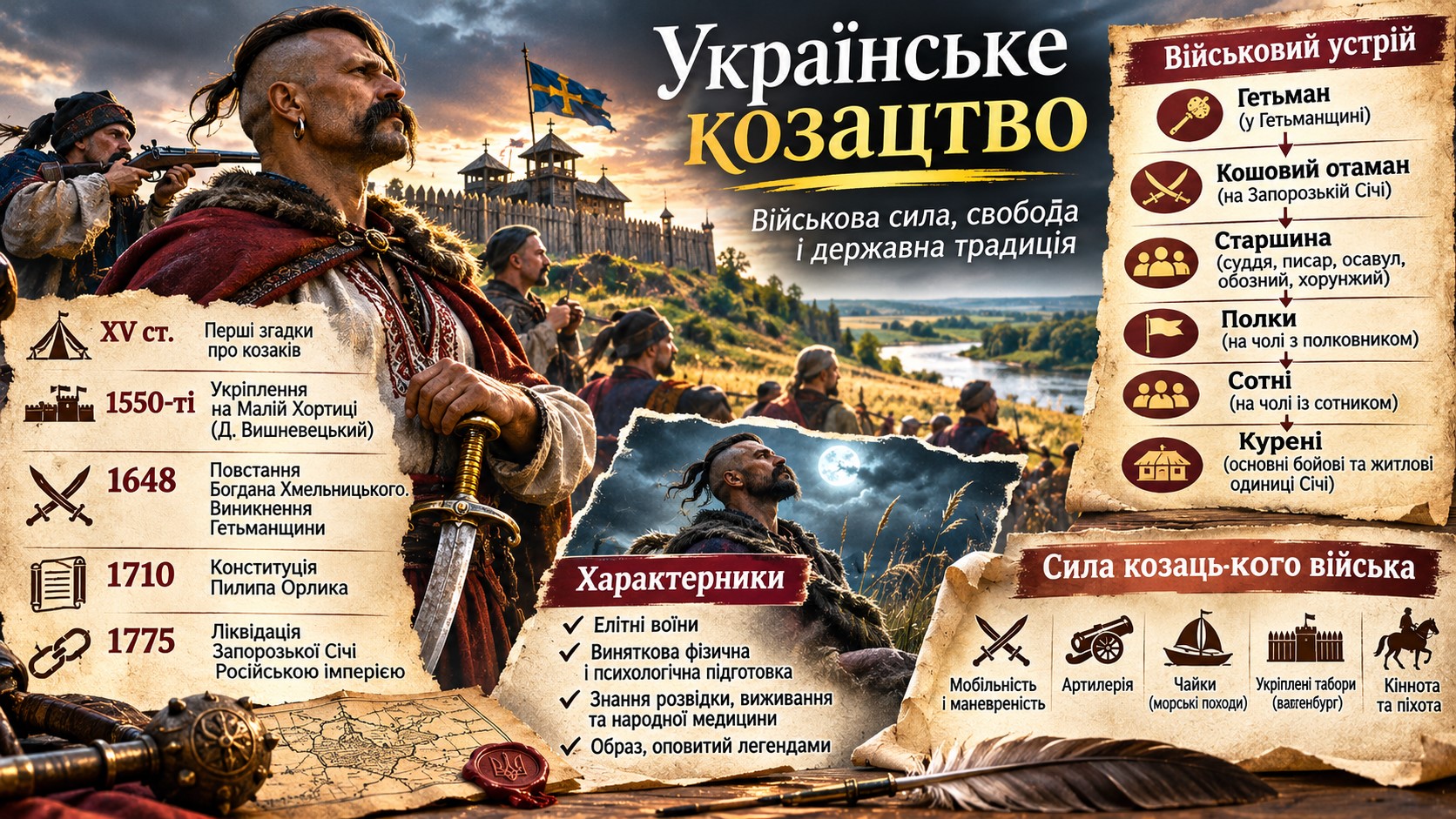
From the frontier detachments of the Wild Fields to the Cossack state: how the Ukrainian military tradition developed, who commanded the Cossack army, and what role the Cossacks played in the history of Ukraine’s defence capabilities.
Introduction. The Cossacks: More Than a Military Force
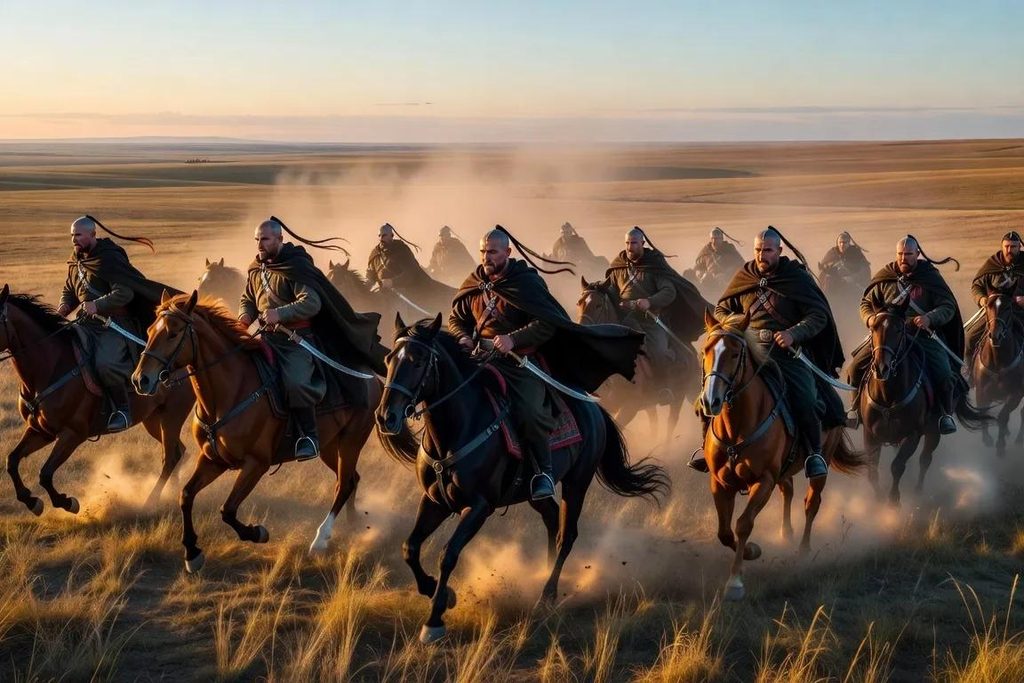
The Ukrainian Cossacks were one of the most significant phenomena in Ukraine’s military, social, and political history. They emerged in territories where the interests of major powers, trade routes, cultural traditions, and military threats intersected. There was no stable frontier here that could simply be marked on a map and peacefully guarded. The steppe was a space of constant movement, danger, economic activity, trade, raids, and military campaigns.
It was in this environment that a community gradually took shape whose way of life was built around personal freedom, the possession of weapons, military mutual assistance, and the ability to organize its own defence.
However, it would be misleading to reduce Cossack history solely to the struggle against Tatar raids or the confrontation with the Polish-Lithuanian Commonwealth. Cossacks fought in different political alliances, concluded agreements with neighbouring states, participated in international military campaigns, and engaged in trade, agriculture, and various forms of economic activity. Over time, they established their own governing bodies, judicial system, military-administrative territorial structure, and state — the Hetmanate.
The Cossacks were not an ideal democratic community, and their history was not made up exclusively of victories. Social inequality, struggles for power, political conflicts, and tensions between the Cossack officer class and ordinary Cossacks existed within their society. Nevertheless, this community became one of the key factors shaping Ukraine’s political tradition in the early modern period.
To understand how this military system emerged, we must return to its origins — to the steppe frontier of Eastern Europe in the fifteenth century.
1. The Origins of the Ukrainian Cossacks: Where Did the First Cossacks Come From?
What does the word “Cossack” mean?
The word Cossack is of Turkic origin. It is associated with the term qazaq or kazak, which in various historical contexts referred to a free person, wanderer, warrior outside established social structures, or someone living independently and not subject to ordinary authority.
The term existed long before the emergence of Ukrainian Cossacks in the form known from the history of the Zaporizhian Sich. References to it can be found in medieval sources, including Turkic and Kipchak texts dating from the thirteenth and fourteenth centuries.
However, it is important to distinguish between the history of the word itself and the history of the Ukrainian Cossack community. The appearance of a term in an early source does not prove that a fully developed Ukrainian Cossack army already existed at that time.
According to the Encyclopedia of the History of Ukraine, the first reliable evidence of Christian Cossack activity on the Ukrainian frontier dates back to the late fifteenth century.
In 1492, Cossacks were recorded attacking a Turkish vessel in the lower Dnipro region near the fortress of Tyahynia. The following year, Bohdan Hlynskyi, the governor of Cherkasy, led a Cossack detachment in an attack on the Tatar fortress of Ochakiv.
These reports indicate that by the end of the fifteenth century, Cossack detachments had already become a notable military presence in the region. At the same time, their organization was not yet unified or fully developed.
Source: Institute of History of Ukraine, National Academy of Sciences of Ukraine, Encyclopedia of the History of Ukraine, “Formation of the Ukrainian Cossacks.” https://resource.history.org.ua/
Why did the Cossacks emerge on the Ukrainian frontier?
The formation of the Cossacks resulted from several historical processes interacting with one another.
1. Geography — the steppe frontier
In the fifteenth and sixteenth centuries, the southern territories of present-day Ukraine were an area of shifting political control. The spheres of influence of the Grand Duchy of Lithuania, the Crimean Khanate, the Ottoman Empire, and other political powers met here.
Large areas of the steppe lacked the dense system of state administration found in the more heavily populated central and western regions. This created opportunities for seasonal economic activities, migration, trade, and military operations.
2. Economic factors — seasonal steppe expeditions
Residents of central Ukrainian lands travelled into the steppe for seasonal economic activities. These people were known as ukhodnyky.
Their activities included:
- hunting;
- fishing;
- beekeeping;
- collecting honey;
- salt extraction;
- saltpetre production;
- trade and the transportation of goods.
Such activities required not only practical economic skills but also the ability to defend oneself. In the steppe, people could encounter armed detachments, face attacks, or lose their property and lives.
Gradually, people began forming groups, organizing mutual protection, establishing fortified winter settlements, and developing their own rules of cooperation.
3. Social factors — the search for freedom
During the sixteenth century, the influence of magnate landownership grew in Ukrainian territories that belonged to the Grand Duchy of Lithuania and later to the Polish-Lithuanian Commonwealth.
The development of the folwark estate economy, oriented towards grain production for sale, was accompanied by restrictions on peasants’ rights and an expansion of labour obligations.
Some peasants, townspeople, minor nobles, and other individuals moved to the more sparsely populated southern territories, where they could gain greater economic and personal freedom.
However, the Cossacks were not composed exclusively of people fleeing serfdom. Their ranks included representatives of various social groups, including nobles, townspeople, experienced soldiers, and people pursuing their own economic interests.
4. Military and political factors — the constant threat from the south
The Crimean Khanate was an important political power in the region and, at the same time, a military opponent of neighbouring states. Alliances, conflicts, and temporary agreements emerged between the Crimean Khanate, the Grand Duchy of Lithuania, Poland, the Muscovite state, and the Ottoman Empire.
Tatar raids into Ukrainian territories involved the capture of prisoners, the plundering of settlements, and the taking of people into captivity. This created a constant need for mobile armed detachments.
The Cossacks not only defended the population but also conducted campaigns into the territories of the Crimean Khanate and the Ottoman Empire.
Thus, the Ukrainian Cossacks did not emerge as a result of a single uprising or a decision by one particular ruler. Their formation was a gradual process shaped by geography, economic activity, social changes, and military threats.
Sources:
- Encyclopedia of Ukraine, Canadian Institute of Ukrainian Studies, University of Alberta, “Cossacks.” https://www.encyclopediaofukraine.com/display.asp?linkpath=linkPath%3DpagesCOCossacks.htm
- Encyclopedia of the History of Ukraine, “Formation of the Ukrainian Cossacks.” https://resource.history.org.ua/
- Larysa Pritsak, The Genesis of the Phenomenon of the Ukrainian Cossacks, Journal of International Eastern European Studies, 2024. https://dergipark.org.tr/en/pub/jiees/article/1507204
2. The Zaporizhian Sich: The Military Centre of the Cossacks
How did the Sich emerge?
During the sixteenth century, Cossack communities in the lower Dnipro region gradually developed a more organized structure.
The area beyond the Dnipro rapids, known as Zaporizhzhia, was particularly important. It was here that the military and political association of the Zaporizhian Cossacks took shape.
One of the key figures in this early period was Prince Dmytro Vyshnevetskyi, known in Ukrainian folk tradition as Baida.
In the 1550s, he organized a fortified settlement on the island of Mala Khortytsia. This site is often associated with the beginnings of the Zaporizhian Sich. However, it would be an oversimplification to identify it unconditionally with all the later Sich centres: Cossack fortified settlements changed location, and the organization itself developed gradually.
Vyshnevetskyi used Cossack forces in military campaigns against the Crimean Khanate and sought to establish an effective defence system along the southern frontier.
His activities marked an important stage in the institutional development of the Cossacks.
What was the Zaporizhian Sich?
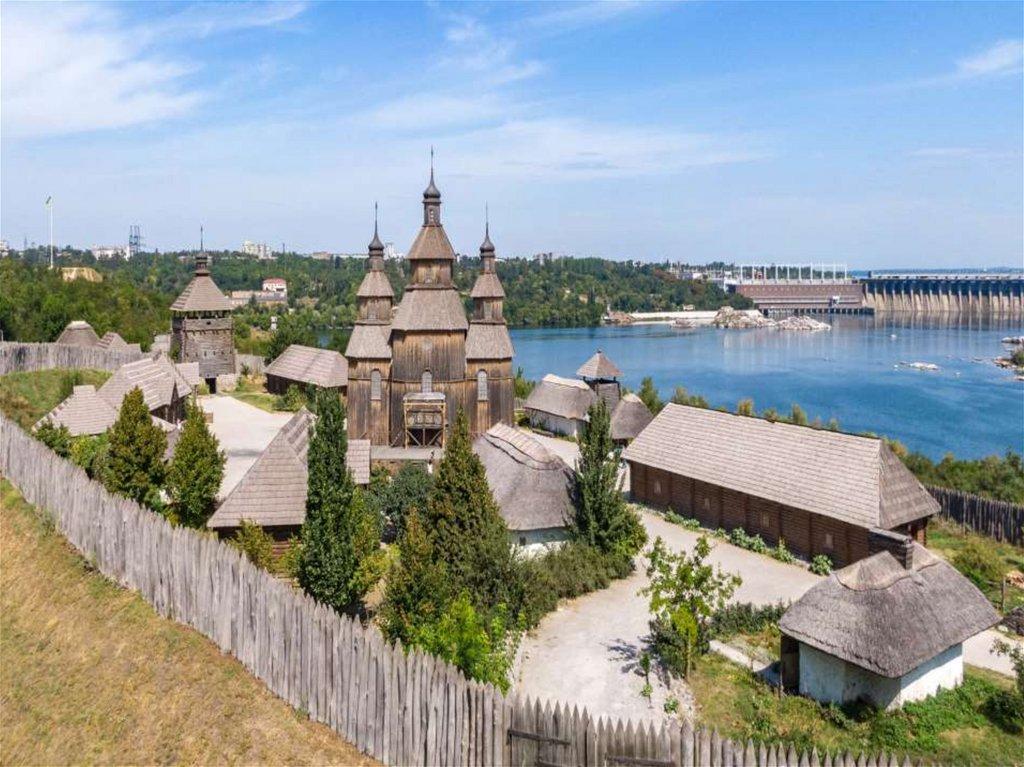
The Zaporizhian Sich was a fortified military centre, an administrative hub, and a place where the Cossack community organized its affairs.
It included:
- defensive fortifications;
- residential buildings;
- kurins — Cossack communal units and quarters;
- military warehouses;
- artillery facilities;
- weapons and supply storage areas;
- administrative and judicial institutions;
- a church;
- a square where military councils were held.
The Sich was not simply a camp where people gathered before a military campaign. It was an organized institution with its own rules, governing bodies, system for electing leaders, and military responsibilities.
The Cossack community had its own traditions of self-government, although actual participation in decision-making depended on a person’s status, the period, and the specific circumstances.
Where were the Sich centres located?
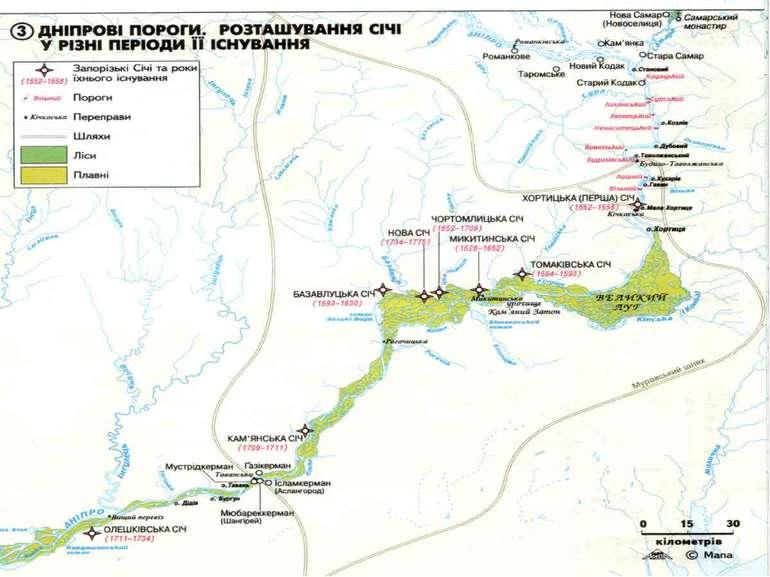
The Zaporizhian Sich did not have one permanent location throughout its existence.
At different times, its centres were situated on Dnipro islands and along the banks of the river.
The best-known Sich centres included:
- Khortytsia Sich;
- Tomakivka Sich;
- Bazavluk Sich;
- Mykytyn Rih Sich;
- Chortomlyk Sich;
- Kamianka Sich;
- Oleshky Sich;
- Nova Sich, also known as Pidpilna Sich.
The relocation of the Sich was associated with military circumstances, political pressure, threats from neighbouring states, and the need to preserve autonomy.
How did Cossack democracy work?
One of the most important features of the Zaporizhian Sich was the military council.
It considered key issues concerning the life of the Cossack community, including:
- the election of the kish otaman;
- the election of military officers;
- the organization of military campaigns;
- the conclusion of alliances;
- major political decisions;
- the resolution of disputes;
- the distribution of military resources.
The council was a form of direct self-government within the Cossack community.
However, it should not be equated with modern democracy. It was a corporate military system in which political rights primarily belonged to full members of the Cossack community. Peasants, townspeople, women, and other residents of the territories did not have the same access to decision-making.
Sources:
- Encyclopedia of Ukraine, “Cossacks.” https://www.encyclopediaofukraine.com/display.asp?linkpath=linkPath%3DpagesCOCossacks.htm
- Encyclopedia of Ukraine, “Hetman state.” https://www.encyclopediaofukraine.com/pages%5CH%5CE%5CHetmanstate.htm
3. The Cossack Army: Structure, Hierarchy, and Administration
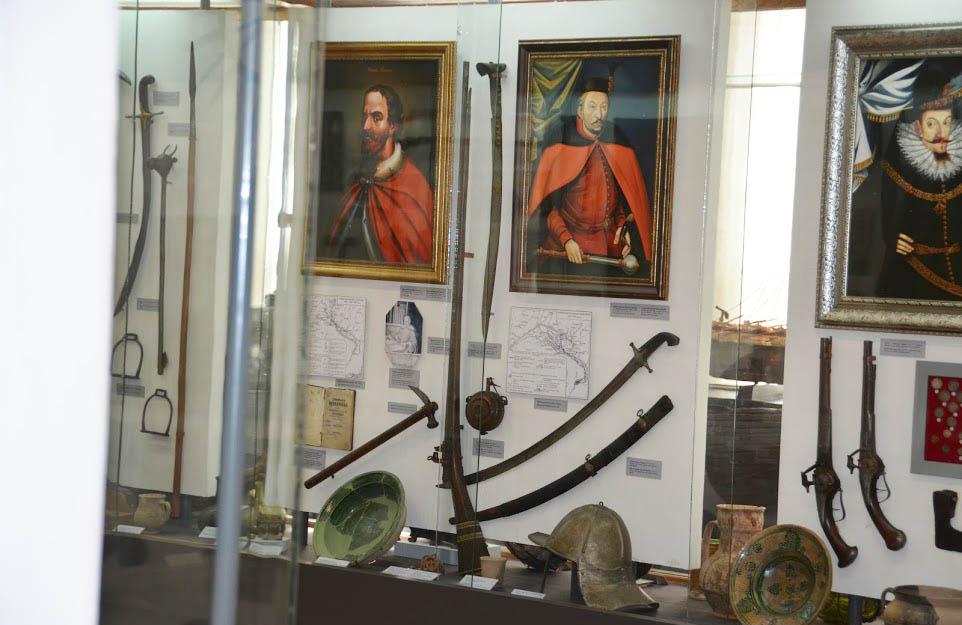
The Cossack military system was not the same throughout its history. The organization of the Zaporizhian Cossack community in the sixteenth to eighteenth centuries differed from the territorial military system of the Hetmanate in the seventeenth and eighteenth centuries.
This distinction is important: the kish otaman of the Zaporizhian Sich and the hetman of the Hetmanate were not simply two names for the same position. They headed different military and political structures.
3.1. The Zaporizhian Sich: Who Was in Command?
The Sich was headed by the kish otaman.
He was elected by the Cossack council. He served as the chief military commander and represented the interests of the Zaporizhian Cossack community in relations with neighbouring states and political figures.
The kish otaman was responsible for:
- commanding the army;
- organizing military campaigns;
- maintaining military order;
- implementing the decisions of the council;
- representing the Sich;
- managing resources within the limits of his authority.
Importantly, his power was not absolute. The council could limit his decisions, reject his proposed policies, or elect another leader.
The term of office was generally one year, although in practice it could vary depending on circumstances.
3.2. The Military Officer Corps of the Zaporizhian Sich
The kish otaman was assisted by the military officer corps, known as the starshyna. Its members were responsible for military administration, judicial matters, documentation, finances, and the organization of everyday life.
The principal positions included:
| Position | Main responsibilities |
|---|---|
| Kish otaman | Chief military commander of the Sich |
| Military judge | Hearings, judicial proceedings, and legal matters |
| Military clerk | Documents, correspondence, and diplomatic communications |
| Military osavul | Organization of service, maintenance of order, and execution of military assignments |
| Military quartermaster (oboznyi) | Army supplies, transport, and artillery administration |
| Military standard-bearer (khorunzhyi) | Safekeeping and protection of the military banner |
| Kurin otamans | Command of individual Cossack kurins |
The composition and number of positions could change depending on the period and the needs of the Sich.
The military officer corps did more than command troops during campaigns. Its members also performed administrative, judicial, financial, and diplomatic functions.
3.3. The Kurin — The Basic Organizational Unit of the Sich
The kurin was one of the principal structural units of the Zaporizhian Cossack community.
It was not merely a residential building but also an organized community of Cossacks.
Each kurin had its own kurin otaman, who was responsible for internal affairs, household management, supplies, discipline, and the organization of its members.
The number of kurins varied. In the first half of the eighteenth century, there were 38.
Kurin otamans were elected at kurin councils. Their work had practical importance: they had to ensure that Cossacks received food, equipment, ammunition, fuel, and other necessary supplies.
The kurin was an important element of military cohesion: Cossacks lived, served, and went on campaigns within their respective organizational communities.
Source: Encyclopedia of Modern Ukraine, “Kurin Otaman.” https://esu.com.ua/article-51950
3.4. Palanka — The Territorial Organization of Zaporizhzhia
Beyond the fortified centre of the Sich were territories controlled by the Zaporizhian Cossacks.
In the eighteenth century, these territories were divided into palankas — military-administrative districts.
The palankas performed important functions:
- local administration;
- territorial protection;
- control of movement;
- maintenance of public order;
- collection of resources;
- provision of military supplies and support.
A palanka was headed by a colonel or another appointed official, assisted by representatives of the local administration.
Thus, the Zaporizhian Sich had not only a central military centre but also a system of territorial administration.
4. The Army of the Hetmanate: From a Cossack Uprising to a State Military Force
In the mid-seventeenth century, the Cossack military system entered a new stage of development.
Following the beginning of Bohdan Khmelnytskyi’s uprising in 1648, the Zaporozhian Host emerged as a military and political organization that became the foundation of a new Cossack state known as the Hetmanate.
This was no longer simply a military community on the frontier. The army became the foundation for governing a substantial territory with its own population, towns, administration, courts, and diplomatic relations.
4.1. The Hetman — Commander-in-Chief and Head of State
The Hetman stood at the head of the Hetmanate.
His powers were considerably broader than those of the kish otaman of the Zaporizhian Sich.
The Hetman:
- commanded the army;
- headed the central administration;
- appointed or approved officials;
- issued official decrees known as universals;
- represented the state in foreign relations;
- concluded agreements;
- exercised important judicial and financial powers;
- granted land for military service.
The Hetman’s authority combined military command with the functions of a head of state.
Formally, Hetmans were elected by the Cossack council. However, electoral practices changed over time, and the influence of the officer class, foreign states, and political factions increased.
4.2. The General Military Officer Corps
The General Officer Corps was the central governing apparatus of the Hetmanate. In terms of its functions, it resembled a military-administrative government.
Its members included:
| Position | Main responsibilities |
|---|---|
| General Quartermaster | Transport, supplies, and artillery |
| General Judge | Highest judicial authority |
| General Clerk | Documents, correspondence, and diplomatic affairs |
| General Osavul | Military assignments and organization of service |
| General Standard-Bearer | Military banners and symbols |
| General Bunchuzhnyi | Protection and ceremonial representation of the Hetman’s bunchuk |
| General Treasurer | State finances and treasury |
The number of positions and the procedures for filling them changed over time.
The General Officer Corps participated in policy development, military planning, territorial administration, and the organization of the state apparatus.
Source: Encyclopedia of Ukraine, “General Officer Staff.” https://www.encyclopediaofukraine.com/display.asp?linkpath=pages%5CG%5CE%5CGeneralOfficerStaff.htm
4.3. The Regiment-and-Company Administrative System
One of the most distinctive features of the Hetmanate was its regiment-and-company system, known as the polk-sotnia structure.
The state’s territory was divided into regiments, and each regiment was divided into companies.
This system served two purposes: military and administrative.
A regiment was a major military-administrative unit.
It was headed by a colonel, who commanded the regiment’s military forces and supervised administration, local judicial matters, and economic affairs within the limits of his authority.
The regimental officer corps included:
- a regimental quartermaster;
- a regimental judge;
- a regimental clerk;
- a regimental osavul;
- a regimental standard-bearer.
A company was a smaller territorial and military unit.
It was headed by a sotnyk (company commander), assisted by company officers.
These could include:
- a company otaman;
- a company clerk;
- a company osavul;
- a company standard-bearer.
At the local level, organization was supported by village and town otamans and other representatives of the Cossack administration.
A Generalized Structure of the Hetmanate’s Military Administration
Hetman
↓
General Military Officer Corps
↓
Colonel and Regimental Officers
↓
Company Commander (Sotnyk) and Company Officers
↓
Cossack units and local military communities
This is a generalized diagram, not a universal staffing structure applicable to every period. The actual organization could change depending on the size of the army, the political situation, and the particular Hetman.
During Bohdan Khmelnytskyi’s time, the number of regiments varied. According to the Encyclopedia of Ukraine, at an early stage there were 10 regiments on the Right Bank and 7 on the Left Bank. Their number and territorial composition changed repeatedly in later years.
Source: Encyclopedia of Ukraine, “Hetman state.” https://www.encyclopediaofukraine.com/pages%5CH%5CE%5CHetmanstate.htm
4.4. Was the Cossack Army a Regular Army?
This question requires clarification.
The Cossack army was not a regular army in the modern sense. It did not have a permanent professional structure, a uniform system of continuous recruitment, a centralized military-industrial base, or modern logistics.
However, it would also be incorrect to describe it as a spontaneous militia.
The Cossack armed forces had:
- a command hierarchy;
- military offices and ranks;
- organizational units;
- a mobilization system;
- rules of military service;
- military discipline;
- a supply system;
- experience in prolonged campaigns;
- artillery and flotillas.
Research by Ukrainian historians describes the Cossack army as a military formation with an established hierarchy — neither a fully regular army nor a random gathering of armed civilians.
Source: Mykhailo Yuriy and Nazar Khrystan, Ukrainian Cossack Armed Forces: Stage of Formation and Decline, 2025. https://doi.org/10.35774/gsip2025.01.112
5. Cossack Weapons: From the Sabre to Artillery
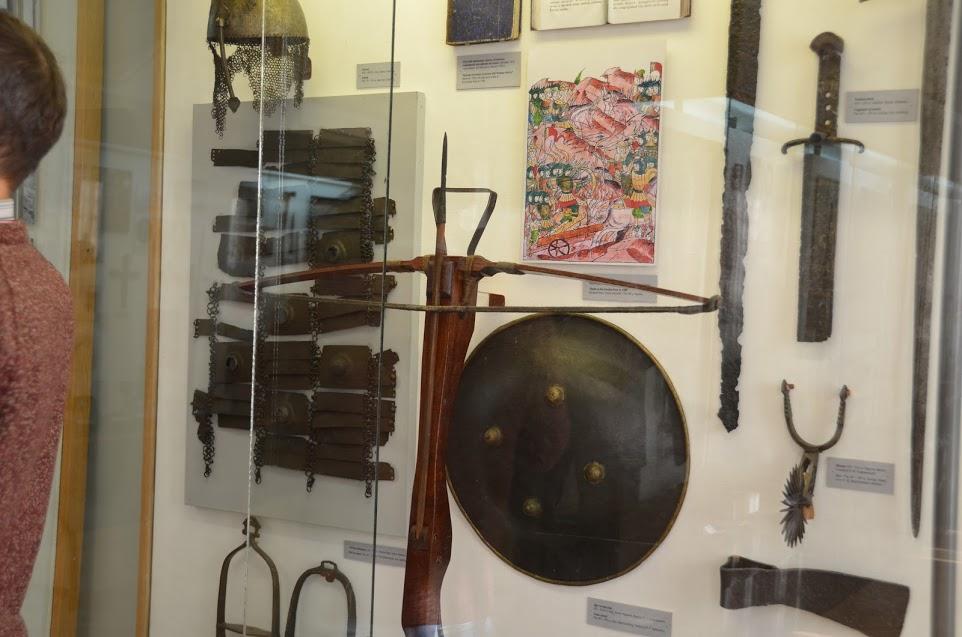
The military effectiveness of the Cossacks depended not only on the individual skills of their warriors but also on their ability to use different types of weapons.
The Cossack army employed edged and firearms, artillery, protective equipment, cavalry, and river vessels.
5.1. Firearms
The Cossack army widely used:
- muskets;
- arquebuses;
- pistols;
- rifles;
- later, various types of flintlock firearms.
Firearms gradually became an important component of Cossack tactics.
Cossacks knew how to organize group firing, use cover, and shoot from behind defensive structures.
However, not every Cossack possessed the same weapons. Equipment depended on personal wealth, the period, the military formation, and the particular campaign.
5.2. Edged Weapons
The sabre became the best-known Cossack weapon.
It was particularly suitable for mounted combat and close fighting.
Other weapons included:
- spears;
- pikes;
- knives;
- daggers;
- battle axes;
- other types of bladed weapons.
The sabre became one of the symbols of the Cossack military tradition, although the actual range of weapons used by Cossacks was much more diverse.
5.3. Artillery
The Cossack army used various types of cannons.
Artillery played an important role in sieges, the defence of fortifications, and field battles.
It required specialized personnel, maintenance, ammunition, transport, and organized supply systems.
Artillery was an integral part of military logistics, not simply a collection of cannons.
5.4. Cossack Boats — The Chaika
A special place in Cossack military history belongs to the flotillas of light vessels known as chaiky.
These were manoeuvrable boats designed for travel along rivers and across the Black Sea.
They were used for:
- reconnaissance;
- transporting military detachments;
- surprise attacks;
- naval campaigns;
- landing operations;
- the liberation of prisoners.
Cossack naval campaigns became an important factor in the military confrontation with the Ottoman Empire and the Crimean Khanate.
They demonstrated that Cossack forces could operate not only on land but also at sea.
Source: A. Poukh, Cossack Weapons and Military Tactics and Their Relationship to the Military Practices of Their Predecessors, Humanitarian Journal, 2012. https://journals.uran.ua/index.php/wissn003/article/view/4936
6. Cossack Military Tactics: Manoeuvre, Fortifications, and Coordination
The Cossack army did not have one fixed tactical doctrine. Its methods depended on the enemy’s strength, the terrain, the availability of cavalry, artillery and infantry, and the possibilities for supplying the troops.
Nevertheless, during the sixteenth and seventeenth centuries, a set of methods developed that became characteristic of Cossack military practice.
6.1. Mobility and Manoeuvrability
Cossack detachments could move quickly across the steppe, use natural cover, launch surprise attacks, and avoid engagements under unfavourable conditions.
This was particularly important when confronting the cavalry forces of the Crimean Khanate.
Cossacks could operate in small groups, conduct reconnaissance, disrupt supply routes, and attack the enemy where an assault was least expected.
6.2. The Wagenburg — A Fortified Wagon Camp
One of the best-known elements of Cossack tactics was the mobile fortified camp formed by wagons.
The wagons were arranged to create a defensive perimeter that could provide cover for infantry, marksmen, and some military supplies.
In the event of danger, the camp could be transformed into a defensive position.
Cossacks could fire from behind the wagons, repel cavalry attacks, and organize counterattacks.
The wagon fort was not an invention unique to the Ukrainian Cossacks: similar defensive methods were used by other armies in Central and Eastern Europe. However, the Cossacks made it an important part of their own tactical practice.
6.3. Infantry and Firepower
Cossack infantry was an important component of the army.
Unlike many military formations in which heavy cavalry played the leading role, the Cossacks made extensive use of marksmen and infantry units.
They could operate from fortified positions, use the terrain, conduct organized fire, and maintain defensive lines.
6.4. Reconnaissance and Knowledge of the Terrain
Knowledge of river crossings, islands, steppe routes, and natural cover gave the Cossacks a significant advantage.
Reconnaissance was an important part of preparing military campaigns.
Without information about the enemy’s numbers, positions, and intentions, even a well-armed army risked falling into a trap.
6.5. Naval Tactics
Cossack chaiky made it possible to conduct operations in the Black Sea.
The small vessels were manoeuvrable and allowed Cossacks to approach the coast, attack ports, intercept ships, and retreat quickly.
Their naval campaigns had a significant political impact, demonstrating that the Ottoman Empire could not exercise complete control over the Black Sea coastline.
6.6. Military Organization as the Foundation of Effectiveness
Tactical advantages did not result solely from weapons or individual bravery.
Important factors included:
- coordinated command;
- reconnaissance;
- discipline;
- mobility;
- supplies;
- cooperation between infantry, cavalry, and artillery;
- effective use of the terrain.
It was the combination of these factors that enabled Cossack forces to operate against enemies who were numerically stronger or better supplied.
Source: Ye. Bondarchuk, Military Tactics of the Cossack Army during the National Liberation War of the Mid-Seventeenth Century, Vasyl’ Stus Donetsk National University. https://jts.donnu.edu.ua/article/view/19955
7. Key Stages in the Military History of the Cossacks
7.1. Cossack Campaigns in the Sixteenth Century
During the sixteenth century, Cossack detachments increasingly participated in military campaigns against Tatar and Ottoman forces.
They conducted raids into the territories of the Crimean Khanate, attacked fortifications, liberated prisoners, and took part in the defence of the southern frontier.
During this period, the Cossacks gradually became a force that neighbouring states had to take into account.
At the same time, Cossacks could enter military service under different rulers, reflecting the complex political situation in the region.
7.2. Registered Cossacks: An Attempt at State Control
In 1572, the Polish king Sigismund II Augustus issued an order establishing a Cossack register.
Registered Cossacks received official recognition of their military status and certain privileges.
They served the state, received payment, and were required to perform military duties.
However, the register was limited. A significant number of Cossacks remained outside it.
This created serious social tensions: some had official status and privileges, while others rejected the restrictions and demanded that Cossack rights be extended to a broader population.
Registered Cossacks became an important element of the military system of the Polish-Lithuanian Commonwealth, but the register also intensified tensions between the Cossack community and the central authorities.
7.3. Cossack Uprisings from the Late Sixteenth to the First Half of the Seventeenth Century
Growing social tensions and attempts to restrict Cossack autonomy led to a series of uprisings.
The most important included:
| Years | Leaders or participants | Main circumstances |
|---|---|---|
| 1591–1593 | Kryshtof Kosynskyi | Conflict with representatives of the noble administration and struggle for Cossack rights |
| 1594–1596 | Severyn Nalyvaiko | A large-scale Cossack and peasant uprising |
| 1625 | Marko Zhmaіlo | Confrontation with the forces of the Polish-Lithuanian Commonwealth |
| 1630 | Taras Fedorovych (Triasylo) | Uprising followed by a compromise agreement |
| 1635 | Ivan Sulyma | Attack on the Kodak fortress |
| 1637–1638 | Pavlo Pavliuk, Dmytro Hunia, Yakiv Ostrianyn | A major wave of Cossack uprisings |
The uprisings had different causes: restrictions on the Cossack register, social tensions, conflicts with landowners, religious disagreements, and the struggle for military and political rights.
After the defeat of the rebels in 1638, the authorities of the Polish-Lithuanian Commonwealth strengthened their control over the registered Cossack army. Cossack self-government was substantially restricted.
This period is sometimes referred to as the “Golden Peace”, but it did not mean that Cossack discontent had disappeared. On the contrary, tensions continued to accumulate.
Sources:
- Encyclopedia of Ukraine, “Cossacks.” https://www.encyclopediaofukraine.com/pages/C/O/Cossacks.htm
- Great Ukrainian Encyclopedia, “History of Ukraine: Early Modern Period.” https://vue.gov.ua/
7.4. Petro Konashevych-Sahaidachny: Military Organization and Political Influence
One of the most important figures of the early modern Cossack period was Petro Konashevych-Sahaidachny.
He was Hetman of the Zaporozhian Host, a military organizer, and a political leader.
Sahaidachny was known for campaigns against Tatar and Ottoman forces, including operations near Ochakiv and Perekop, as well as naval expeditions along the Black Sea coast.
In 1618, the Cossack army under his command participated in the campaign of the Polish prince Władysław against Moscow.
In 1621, Cossacks played a significant role in the Khotyn War against the Ottoman Empire. The Cossack army fought alongside the forces of the Polish-Lithuanian Commonwealth.
Sahaidachny also supported Orthodox educational and religious institutions. In 1620, the Zaporozhian Host joined the Kyiv Brotherhood, an important event for the Ukrainian Orthodox movement.
His activities demonstrate that the Cossack army was gradually becoming not only a military force but also an influential political actor in regional affairs.
Source: Encyclopedia of Ukraine, “Konashevych-Sahaidachny, Petro.” https://www.encyclopediaofukraine.com/display.asp?linkpath=pages%5CK%5CO%5CKonashevych6SahaidachnyPetro.htm
8. Bohdan Khmelnytskyi and the Creation of the Cossack State
In 1648, an uprising led by Bohdan Khmelnytskyi began and developed into a large-scale war against the Polish-Lithuanian Commonwealth.
Its causes were complex:
- restrictions on Cossack rights;
- conflicts with magnates;
- social tensions;
- religious disagreements;
- political struggles for autonomy;
- the Cossack elite’s desire for greater political power.
The uprising quickly grew beyond a purely Cossack movement. Large sections of the Ukrainian population joined it.
The Military Campaigns of 1648
The Cossack army won important victories over the forces of the Polish-Lithuanian Commonwealth:
- at Zhovti Vody;
- at Korsun;
- at Pyliavtsi.
These victories changed the military and political situation in the region and opened the way for a new system of governance in Ukrainian territories.
The Emergence of the Hetmanate
As a result of the war, a Cossack state known as the Hetmanate emerged.
It had its own governing bodies, army, administrative system, judiciary, and diplomatic relations.
During Bohdan Khmelnytskyi’s rule, its territory covered a significant part of central Ukraine.
The Hetmanate was not a modern nation-state with a constitution and a clearly defined separation of powers. Its political system combined elements of elected military leadership, the Cossack officer council, and strong Hetman authority.
Nevertheless, it possessed real features of statehood and its own political agency.
The Pereiaslav Council of 1654: What Is Important to Understand
In 1654, the Pereiaslav Council took place, followed by agreements between the Zaporozhian Host and the Muscovite state.
This event marked the beginning of a new stage in Ukrainian-Muscovite relations.
Its historical interpretation remains a subject of debate, particularly because of differing views on the content of the agreements, the extent of the Hetmanate’s autonomy, and the nature of its relationship with the Muscovite monarch.
It is important not to replace historical documents with later imperial formulas describing the event as a simple “reunification” of two peoples.
The agreements of 1654 had a specific military and political context and did not automatically mean the disappearance of the Cossack state.
In the following decades, Muscovite authorities increasingly interfered in the internal affairs of the Hetmanate, and its autonomy was gradually reduced.
Sources:
- Encyclopedia of Ukraine, “Hetman state.” https://www.encyclopediaofukraine.com/pages%5CH%5CE%5CHetmanstate.htm
- Władysław A. Serczyk, “The Commonwealth and the Cossacks in the First Quarter of the Seventeenth Century,” Harvard Ukrainian Studies. https://husj.harvard.edu/articles/the-commonwealth-and-the-cossacks-in-the-first-quarter-of-the-seventeenth-century
9. The Ruin: Internal Conflicts and the Division of the Cossack State
After Bohdan Khmelnytskyi’s death in 1657, the Hetmanate faced a profound political crisis.
Different groups within the Cossack officer class held differing views on the state’s future, its foreign alliances, and its system of governance.
The situation was complicated by interference from neighbouring states, territorial struggles, and conflicts between rival candidates for the Hetman’s position.
This period became known as the Ruin.
The Hetmanate gradually divided into Right-Bank and Left-Bank territories, which came under different political spheres of influence.
In 1667, the Truce of Andrusovo between the Muscovite state and the Polish-Lithuanian Commonwealth formalized the division of Ukrainian lands along the Dnipro River.
In 1686, this division was confirmed by the so-called Eternal Peace.
The Ruin was one of the most difficult periods in the history of the Cossack state. It demonstrated that even a strong military organization cannot guarantee political stability without coordinated institutions, a legitimate mechanism for transferring power, and the ability to resist external interference.
Source: Encyclopedia of Ukraine, “Hetman state.” https://www.encyclopediaofukraine.com/pages%5CH%5CE%5CHetmanstate.htm
10. Ivan Mazepa and the Attempt to Preserve Autonomy
One of the best-known Hetmans was Ivan Mazepa, who led the Left-Bank Hetmanate from 1687 to 1708.
His rule was marked by the development of education, church construction, culture, and the strengthening of the Cossack officer class.
At the same time, the political dependence of the Hetmanate on the Muscovite state was increasing.
During the Great Northern War between the Tsardom of Muscovy and Sweden, Mazepa formed an alliance with the Swedish king Charles XII.
His aim was to change the political position of the Hetmanate and preserve its autonomy.
This decision ended in the defeat of the Swedish-Cossack forces at the Battle of Poltava in 1709.
After the defeat, part of the Cossack officer class and army went into exile. Among them was Hetman Pylyp Orlyk, who in 1710 concluded the document known as the Constitution of Pylyp Orlyk.
In 1708, on the orders of Peter I, Baturyn — the Hetmanate’s capital — was destroyed. In 1709, Russian forces destroyed the Chortomlyk Sich.
These events marked important stages in the restriction of the Hetmanate’s political autonomy.
11. The Abolition of the Hetmanate and the Destruction of the Zaporizhian Sich
During the eighteenth century, the Russian Empire gradually dismantled the autonomous institutions of Ukrainian territories.
This was not a single event but a gradual process involving the elimination of political, military, and administrative rights.
Key Stages in the Abolition of Autonomy
1708 — Destruction of Baturyn
After Mazepa’s alliance with the Swedish king, Russian forces destroyed the Hetmanate’s capital.
1709 — Destruction of the Chortomlyk Sich
Russian forces destroyed one of the main centres of the Zaporizhian Cossacks.
1722 — Establishment of the Little Russian Collegium
The Russian authorities introduced an additional institution to supervise the Hetmanate.
1764 — Abolition of the Hetman’s office
During the reign of Catherine II, the position of Hetman was abolished, and the administration of Ukrainian territories was increasingly subordinated to imperial institutions.
1775 — Destruction of the Zaporizhian Sich
After the end of the Russo-Turkish War of 1768–1774, the Russian army surrounded and dismantled the New Sich.
In August 1775, an imperial manifesto announcing the liquidation of the Zaporizhian Sich was issued.
1781 — Abolition of the regimental-company administrative system
The traditional Cossack system was replaced with an imperial territorial administrative division.
1783 — Transformation of Cossack regiments into regular imperial military units and the legal extension of serfdom to the Left Bank and Sloboda Ukraine
By the end of the eighteenth century, the main institutions of Cossack autonomy had been abolished.
However, the disappearance of the Sich did not mean the complete disappearance of the Cossack tradition. Some Zaporizhians moved beyond the Danube, others joined new military formations, while Cossack families and descendants of the officer class preserved the memory of their former state and military organization.
Sources:
- Central State Historical Archives of Ukraine, “240 Years Since the Liquidation of the Zaporizhian Sich.” https://cdiak.archives.gov.ua/v_Likvidaciia_Sichi.php
- Encyclopedia of Ukraine, “History of Ukraine” and “Hetman state.” https://www.encyclopediaofukraine.com/
12. What Happened to the Cossacks after the Liquidation of the Sich?
The liquidation of the Zaporizhian Sich did not destroy all Cossack communities. Some Cossacks remained in Ukrainian territories, while others sought opportunities to preserve their military organization outside the Russian Empire.
One such centre was the Danubian Sich, established by Cossacks who moved to territories under Ottoman rule.
The Danubian Cossacks existed from 1775 to 1828.
Other former Zaporizhians took part in the formation of new Cossack military forces, including the Black Sea Cossack Host, established in the late eighteenth century.
The Black Sea Cossack Host was later relocated to the Kuban region.
These formations existed in a different political environment. Some were incorporated into the military system of the Russian Empire and used in its wars.
Therefore, the Cossack military tradition of the eighteenth century should not automatically be equated with all later imperial Cossack forces. Their political status, missions, and organization could differ significantly.
Source: Yu. Fihurnyi, Ukrainian State-Building Processes in the Second Half of the Eighteenth Century: On the Issue of Cossack Military Formations, 2015. https://ir.kneu.edu.ua/items/0541de1d-cdbc-47e5-a5e7-5f8bd709ee45
13. Cossack Kharakternyky: History, Folklore, and the Boundary Between Fact and Legend
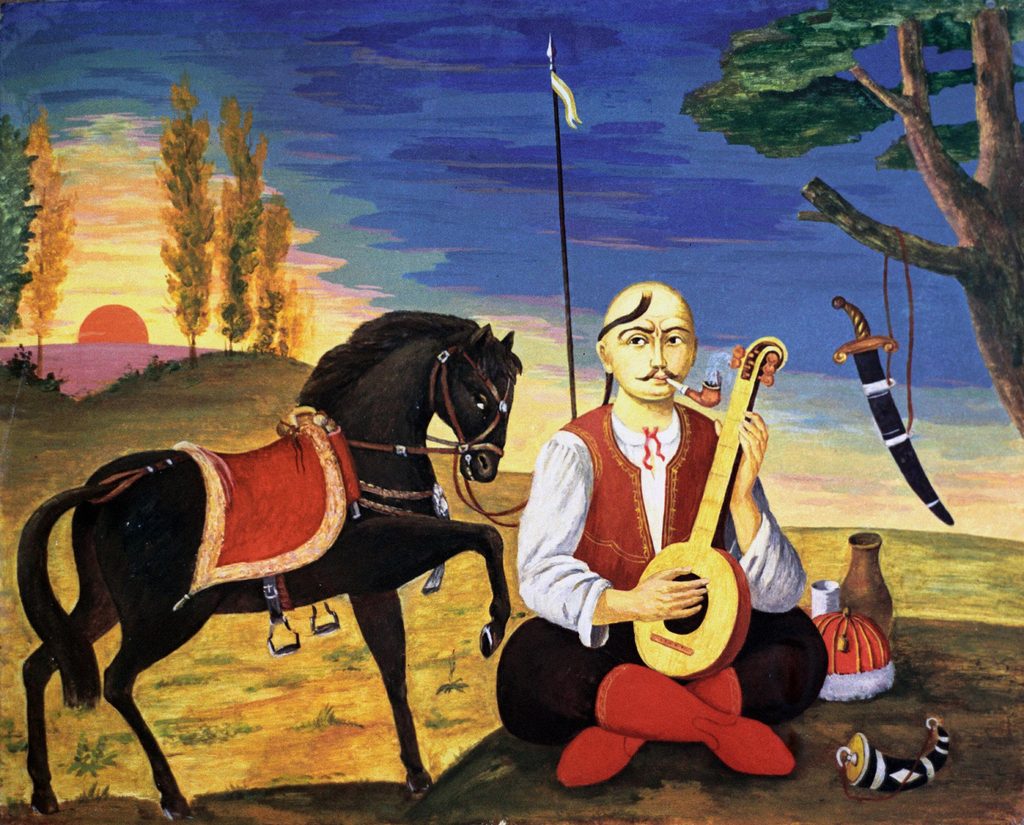
A separate chapter in Cossack history concerns the phenomenon of the kharakternyky.
In popular memory, kharakternyky are portrayed as extraordinary warriors who supposedly possessed supernatural abilities. They were said to be able to evade bullets, influence the minds of their enemies, foresee danger, heal wounds, and even transform into animals.
These images have become firmly embedded in Ukrainian culture. However, historical research requires a distinction between the folkloric image and documented historical reality.
Where Did the Image of the Kharakternyk Come From?
According to Mykhailo Hrymych’s article in the Encyclopedia of the History of Ukraine, published by the National Academy of Sciences of Ukraine, kharakternyky are primarily a folkloric and post-folkloric image of Zaporizhian Cossacks endowed with extraordinary or supernatural abilities.
It is noteworthy that references to kharakternyky began appearing in Ukrainian folklore collections mainly from the 1850s onwards.
This means that many of the stories known today were recorded after the liquidation of the Zaporizhian Sich.
This does not mean that all stories about kharakternyky were invented from nothing. Folklore often preserves memories of real people, events, military skills, and the distinctive characteristics of particular communities.
However, it reinterprets them, adding exaggeration, symbolism, and fantastical elements.
What Abilities Were Attributed to Kharakternyky?
According to folk legends, kharakternyky could:
- catch bullets with their hands or clothing;
- remain unharmed after battles;
- hypnotize their opponents;
- emerge from water completely dry;
- appear and disappear in unexpected places;
- foresee danger;
- possess secret knowledge;
- heal the wounded;
- use extraordinary military tricks.
These stories have parallels with folkloric images of heroic warriors, traditional healers, sorcerers, and legendary strongmen.
In some accounts, a kharakternyk was not necessarily a person with magical abilities. Instead, he was an exceptionally experienced warrior whose intelligence, physical conditioning, agility, and knowledge of tactics enabled him to do things that seemed impossible to others.
Did Kharakternyky Really Exist?
Historical sources do not provide sufficient grounds to claim that there was a separate official military category of kharakternyky with its own hierarchy, initiation rituals, or supernatural abilities.
There is no reliable documentary evidence that Cossacks could catch bullets with their bare hands, become invisible, or physically transform into animals.
However, individuals with exceptional military skills certainly existed.
The Cossack environment required:
- scouts;
- experienced marksmen;
- people with detailed knowledge of the terrain;
- trackers;
- military reconnaissance specialists and guides;
- people with survival skills;
- people familiar with medicinal plants and traditional methods of treating the wounded.
The military expertise of such individuals could appear extraordinary to those without similar experience.
Over time, real skills, memories, and stories could develop into legends about extraordinary warriors.
Why Did Kharakternyky Become Part of Ukrainian Cultural Memory?
The image of the kharakternyk reflects more than beliefs about magic. It embodies an ideal of a warrior who combines physical strength, endurance, intelligence, knowledge, self-control, and the ability to act under dangerous circumstances.
This is an important cultural image that helps us understand how society interpreted military skill and heroism.
Therefore, kharakternyky should be studied as a phenomenon of Ukrainian folklore, historical memory, and popular culture, without presenting fantastic stories as documented historical facts.
The main conclusion: Kharakternyky are a real part of Ukrainian cultural tradition, but their supernatural abilities belong to the realm of legends and folklore rather than established historical fact.
Source: M. Hrymych, “Kharakternyky,” Encyclopedia of the History of Ukraine, Institute of History of Ukraine, National Academy of Sciences of Ukraine, 2021. https://resource.history.org.ua/cgi-bin/eiu/history.exe?C21COM=S&I21DBN=EIu&P21DBN=&S21CNR=20&S21COLORTERMS=0&S21FMT=eiu_all&S21P01=0&S21P02=0&S21P03=TRN%3D&S21REF=10&S21STN=1&S21STR=kharakternyky&Z21ID=
14. The Historical Significance of the Cossacks for Ukraine’s Defence Capabilities
The Ukrainian Cossacks represented an important stage in the development of military organization in Ukrainian territories.
Their contribution was not limited to individual battles or military campaigns. The Cossack tradition created military, administrative, and political institutions that influenced the development of Ukrainian society over a long period.
1. Self-Organization and Local Governance
The Cossacks developed a system in which military communities could elect their own leaders, make decisions, and organize their defence.
This became an important form of self-organization for the population of frontier territories.
2. Military Specialization
The Cossack army developed various military capabilities, including:
- infantry;
- cavalry;
- artillery;
- naval operations;
- reconnaissance;
- territorial protection;
- military logistics and supply.
This specialization made it possible to employ different military capabilities depending on the conditions of a campaign.
3. Adaptability to the Conditions of War
The Cossacks knew how to adapt to different opponents and types of terrain.
Steppe campaigns, the defence of fortified camps, naval operations, and sieges all required different approaches.
The ability to change tactics was one of the important characteristics of Cossack military practice.
4. Military Diplomacy
Cossack Hetmans and officers negotiated with the Polish-Lithuanian Commonwealth, the Crimean Khanate, the Ottoman Empire, the Muscovite state, Sweden, and other political powers.
Military strength became an instrument of foreign policy, while diplomacy offered a way to preserve or expand political opportunities.
5. The Formation of State Institutions
The Hetmanate demonstrated how a military organization could become the foundation of a broader system of state administration.
It had territorial administration, courts, financial institutions, diplomatic structures, and its own system of political leadership.
This is one of the most important aspects of the Cossack historical legacy.
15. The Cossacks in Historical Memory: Between Documents, Myths, and Politics
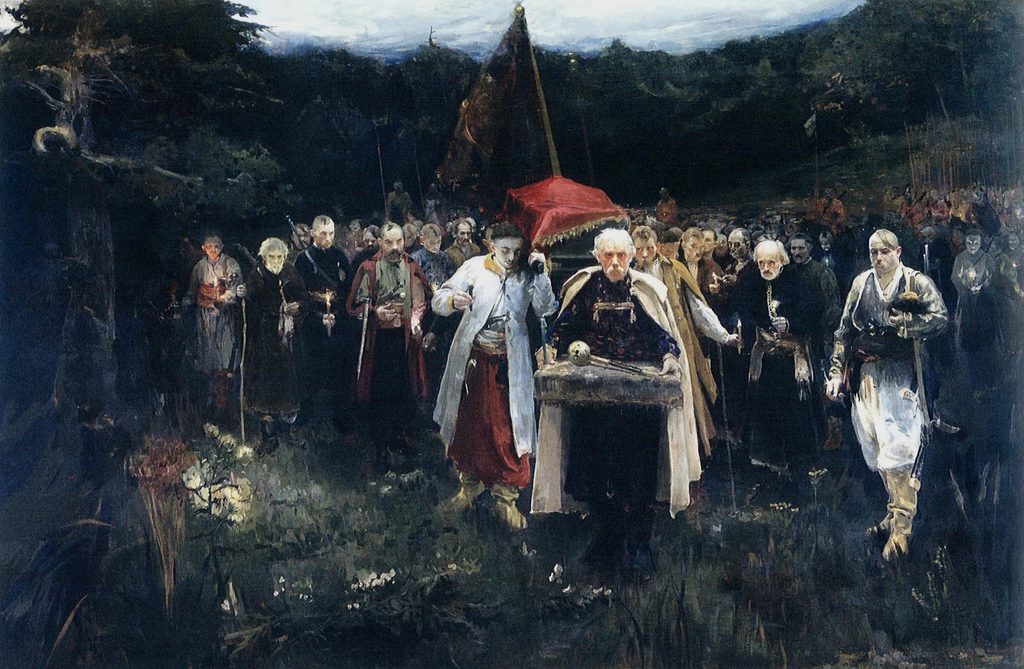
Throughout the centuries, the history of the Ukrainian Cossacks has been used by different political forces to shape their own interpretations of the past.
In Polish historiography, the Cossacks have often appeared as a military challenge to the Polish-Lithuanian Commonwealth, participants in uprisings, or a frontier military community.
In Russian imperial historiography, Cossack history was frequently interpreted through the lens of the integration of Ukrainian lands into the empire. The autonomous institutions of the Hetmanate could be presented as temporary or secondary.
During the Soviet period, Cossack history was often interpreted through the framework of class struggle, while its political independence was given limited attention.
Modern historiography seeks to examine the Cossacks within the broader context of early modern Europe, taking into account military history, social processes, diplomacy, economics, and the development of state institutions.
The international perspective is also important. Research by Polish, Turkish, British, Canadian, and other historians helps us understand the Cossacks not in isolation, but as part of the international relations of their time.
For example, research by W. A. Serczyk, published in Harvard Ukrainian Studies, examines Cossack society as a complex community with diverse social, cultural, and religious backgrounds. This is an important corrective to the simplified idea of the Cossacks as a homogeneous group.
In 2026, Özgür Türker examined how the image of the Cossack transformed from that of a military frontier community into one of the central symbols of Ukrainian national identity in the journal Studies in Ethnicity and Nationalism.
This does not diminish the historical role of the Cossacks. On the contrary, it demonstrates why real historical institutions must be distinguished from the symbolic image that developed across different historical periods.
Sources:
- Władysław A. Serczyk, The Commonwealth and the Cossacks in the First Quarter of the Seventeenth Century, Harvard Ukrainian Studies, 1978.
- Özgür Türker, From Military Frontier Force to National Symbol: The Transformation of Cossack Identity in Ukrainian Historiography, Studies in Ethnicity and Nationalism, 2026. https://onlinelibrary.wiley.com/doi/10.1111/sena.70021
- Vitalii Shcherbak, Ukrainian Cossacks of the Sixteenth and First Half of the Seventeenth Centuries in Historiography, Scientific Notes of the National University of Kyiv-Mohyla Academy, 2005. https://ekmair.ukma.edu.ua/items/a4420a13-6607-4ae2-bb30-490f12b6a0fd
Conclusion. From a Military Community to a State Tradition
The Ukrainian Cossacks followed a complex path from small frontier detachments and communities of steppe workers to a powerful military and political force that established its own state.
Their history encompasses not only battles and military campaigns but also the development of self-government, administration, judicial institutions, diplomacy, and military organization.
The Cossack army was neither perfect nor unchanging. It experienced internal conflicts, political defeats, struggles for power, and the gradual loss of autonomy. Yet its history gave rise to important elements of Ukraine’s military and state-building traditions.
The Zaporizhian Sich demonstrated the possibility of self-organization within a military community. The Hetmanate showed how a military structure could become the foundation of state administration. Cossack campaigns demonstrated the importance of mobility, reconnaissance, coordination, and adaptation to the conditions of war.
The history of the kharakternyky reminds us of another aspect of this legacy: the cultural memory of a warrior who combines knowledge, skill, endurance, and ingenuity.
Studying the Cossacks today means more than honouring the past. It also offers an opportunity to understand how traditions of military self-organization, political agency, and the struggle for the right to determine one’s own future developed in Ukrainian lands.
The history of the Ukrainian Cossacks is not only a history of weapons. It is a history of people who, under constant threat, learned to organize themselves, defend their communities, and create their own institutions.
Main Sources and Further Reading
Ukrainian Academic and Encyclopedic Sources
- Institute of History of Ukraine, National Academy of Sciences of Ukraine. Encyclopedia of the History of Ukraine — articles “Formation of the Ukrainian Cossacks” and “Kharakternyky.” https://resource.history.org.ua/
- Encyclopedia of Modern Ukraine — “Kurin Otaman.” https://esu.com.ua/article-51950
- Great Ukrainian Encyclopedia — “History of Ukraine: Early Modern Period.” https://vue.gov.ua/
- Central State Historical Archives of Ukraine — “240 Years Since the Liquidation of the Zaporizhian Sich.” https://cdiak.archives.gov.ua/v_Likvidaciia_Sichi.php
- Shcherbak, V. O. Ukrainian Cossacks of the Sixteenth and First Half of the Seventeenth Centuries in Historiography. Scientific Notes of the National University of Kyiv-Mohyla Academy, 2005.
- Bondarchuk, Ye. Military Tactics of the Cossack Army during the National Liberation War of the Mid-Seventeenth Century.
- Poukh, A. Cossack Weapons and Military Tactics and Their Relationship to the Military Practices of Their Predecessors, 2012.
International Academic Sources
- Internet Encyclopedia of Ukraine, Canadian Institute of Ukrainian Studies, University of Alberta — articles “Cossacks,” “Hetman state,” “Cossack starshyna,” “General Officer Staff,” and “Petro Konashevych-Sahaidachny.” https://www.encyclopediaofukraine.com/
- Serczyk, W. A. The Commonwealth and the Cossacks in the First Quarter of the Seventeenth Century. Harvard Ukrainian Studies, 1978.
- Pritsak, L. The Genesis of the Phenomenon of the Ukrainian Cossacks. Journal of International Eastern European Studies, 2024.
- Türker, Ö. From Military Frontier Force to National Symbol: The Transformation of Cossack Identity in Ukrainian Historiography. Studies in Ethnicity and Nationalism, 2026.
- Yuriy, M., and Khrystan, N. Ukrainian Cossack Armed Forces: Stage of Formation and Decline. Humanitarian Studies: History and Pedagogy, 2025.
Principles of Source Verification
This article draws on academic encyclopedias, university research publications, materials from the Institute of History of Ukraine of the National Academy of Sciences of Ukraine, the Central State Historical Archives of Ukraine, and international research.
Preference was given to sources with identifiable authorship, publishers, bibliographic details, and verifiable origins.
Russian state propaganda resources were not used as an evidentiary basis. At the same time, the country of origin of a publication is not, by itself, sufficient reason to reject it. Authorship, methodology, references, context, and the possibility of independent verification are what matter.
Particular care was taken when addressing the origins of the Cossacks, the Pereiaslav Council, the kharakternyky, and the liquidation of the Sich — topics that are frequently subject to political manipulation and myth-making.