


On 4 November 2026, the National Anti-Corruption Bureau of Ukraine (NABU) and the Specialized Anti-Corruption Prosecutor’s Office (SAPO) announced the completion of the pre-trial investigation in the Midas case — one of the largest anti-corruption proceedings in Ukraine’s energy sector. According to investigators, between 2020 and 2025, members of an organised group systematically received illicit payments from contractors of state-owned energy companies. A separate back office and various financial instruments, including cryptocurrency, securities and a foreign investment fund, were allegedly used to move and launder the money.
According to NABU, more than USD 111 million and EUR 12 million in cash from the energy sector were accumulated and transferred to this office.
These figures attract attention not only because of their scale. The case concerns a strategic sector whose stable operation is essential to Ukraine’s energy security, particularly during the full-scale war.
However, to understand the case correctly, it is important to distinguish established procedural facts from the prosecution’s allegations and not to confuse the completion of an investigation with proof of any individual’s guilt.
1. What happened on 4 November 2026?
The National Anti-Corruption Bureau of Ukraine and the Specialized Anti-Corruption Prosecutor’s Office officially announced the completion of the pre-trial investigation in the Midas case.
The criminal case materials were made available to the defence for review.
According to NABU, the investigation concerns the activities of a high-level criminal organisation which, according to law enforcement authorities, established a mechanism for influencing the operations of strategic state-owned enterprises, including JSC “National Nuclear Energy Generating Company Energoatom”, obtaining illicit benefits and laundering illegally obtained funds.
The key figures released by the anti-corruption authorities are:
- 10–15% — the amount of illicit benefit allegedly demanded systematically from contractors under their contracts.
- More than USD 111 million — the volume of cash from the energy sector accumulated and transferred to a separate office between 2020 and 2025.
- EUR 12 million — an additional amount in euros specified in NABU’s announcement.
- 2020–2025 — the period during which investigators identified the movement of these sums.
- Cryptocurrency, securities and a foreign investment fund — instruments allegedly used to launder the funds.
An important clarification: NABU also reported that funds from other sources came under the organisation’s control. Therefore, the figures above should not automatically be regarded as the total amount of money the alleged participants may have handled.
Nor should these amounts be equated with direct losses to the state budget. Establishing the amount of damage requires separate financial calculations and evidence. The published figures describe financial flows identified by investigators, not a final amount of damage determined by a court.
Source: NABU — Operation Midas: Case Materials Opened, 4 November 2026.
2. How Did the Corruption Scheme Allegedly Work?
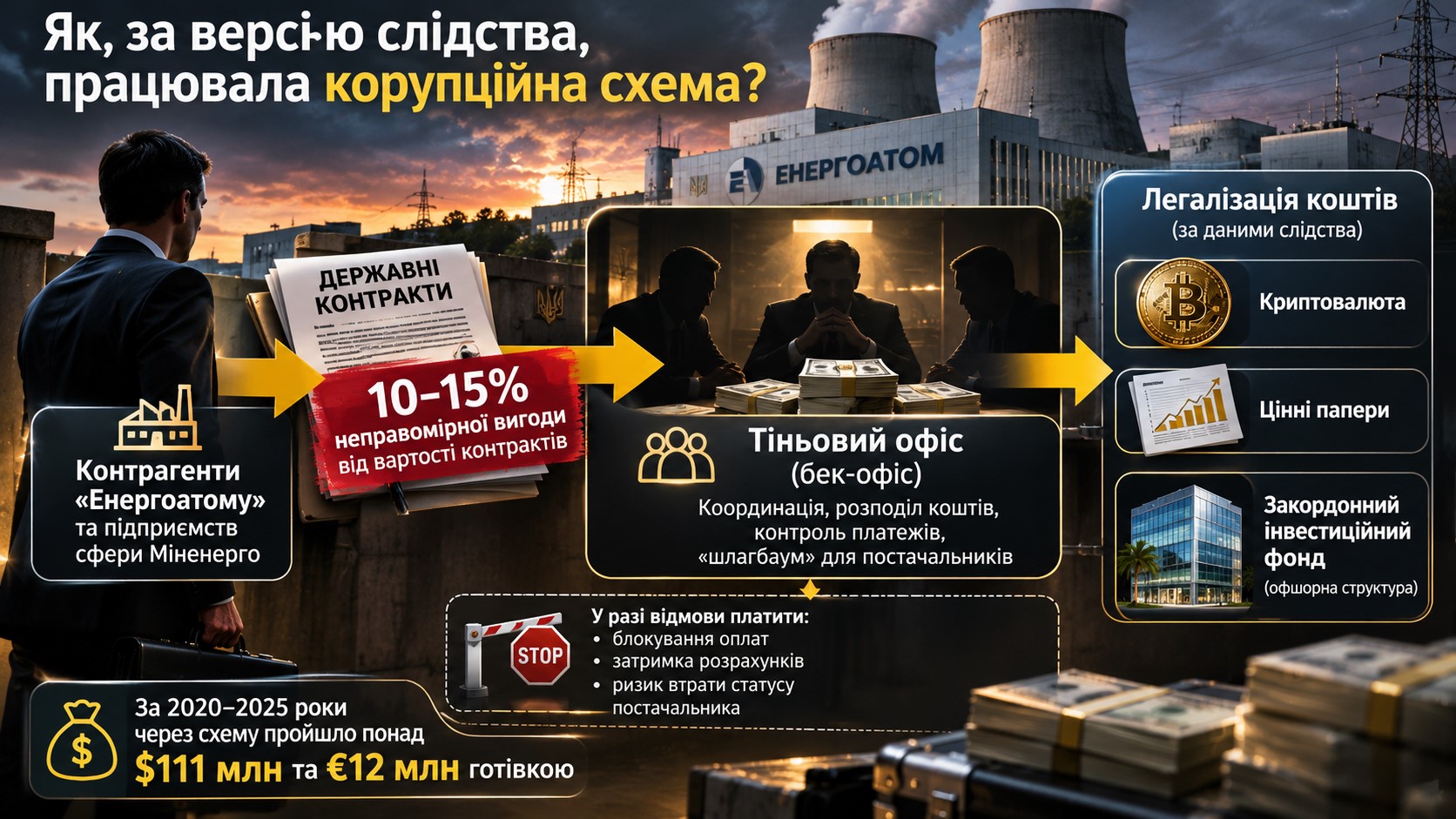
At the centre of the case is what investigators refer to as the “turnstile” mechanism.
According to NABU and SAPO, members of the organisation used their influence over state-owned enterprises to obtain illicit benefits from companies doing business with them.
This was allegedly not a matter of isolated bribes for individual decisions. Investigators describe a systematic mechanism connected with contracts, payments and the ability of companies to continue doing business with state-owned enterprises.
What did the “turnstile” mechanism mean?
According to information released by the anti-corruption authorities, contractors were allegedly required to pay between 10% and 15% of the contract value.
The case materials indicate that companies refusing to pay the illicit benefit could have payments for services already provided or products already delivered blocked. They could also lose their supplier status.
If this model is proven in court, it would indicate that administrative and managerial influence within a state-owned enterprise was used as an instrument to pressure businesses into making illegal payments.
For businesses, such a system creates a situation in which fulfilling a contract does not guarantee payment. A contractor is effectively forced to choose between complying with an unlawful demand and risking its own commercial operations.
This is why the case matters not only for anti-corruption policy but also for assessing the competitive environment and protecting the rights of suppliers working with state-owned enterprises.
Why was a separate back office needed?
According to NABU, a separate office existed to handle and launder the illegally obtained funds.
When announcing the exposure of the operation in November 2025, NABU described this office as a place where funds were accounted for, so-called “black accounting” was maintained, and money laundering was organised through a network of non-resident companies.
According to the anti-corruption authorities, a significant portion of the transactions, including cash withdrawals, took place outside Ukraine.
In its subsequent announcement of 4 November 2026, NABU separately confirmed the use of cryptocurrency, securities and a foreign investment fund.
It is important to understand the difference between two concepts:
- Obtaining an illicit benefit means receiving money as a result of unlawful demands or agreements.
- Money laundering refers to transactions intended to conceal the illegal origin of funds or make them appear to be legitimate income.
These are different stages and different legal aspects of criminal proceedings. They must be proven separately, even when they are connected.
Source: NABU — Operation Midas: High-Level Criminal Organisation in the Energy Sector Exposed.
3. Who Is Implicated in the Midas Case?
Four names are most frequently mentioned in public discussions: Timur Mindich, Oleksandr Tsukerman, Oleksii Chernyshov and Herman Halushchenko.
However, this is not a complete list. NABU and SAPO have reported suspicions against other individuals within the proceedings, while additional criminal proceedings have been separated from the original case.
The information below is based on statements by the anti-corruption authorities and publicly available information about the investigation. A description of an allegation does not constitute a finding of guilt.
Timur Mindich — “Karlson”
Businessman Timur Mindich is one of the central figures in the case.
According to investigators, he was the alleged organiser of the criminal organisation and played an important role in establishing the mechanism for obtaining illicit benefits.
His name became widely known after NABU released recordings documenting conversations between individuals involved in the case, in which the code name “Karlson” appeared.
Procedural measures have been taken in relation to him, including court consideration of preventive measures and special pre-trial investigation procedures.
Oleksandr Tsukerman — “Sugarman”
Oleksandr Tsukerman is a businessman whom investigators link to the alleged co-organisation of the scheme.
The code name “Sugarman” appears in the case materials. According to information published in connection with the proceedings, his alleged role is being examined in the context of organising and financially supporting the group’s activities.
Court decisions concerning preventive measures and procedural status do not establish this individual’s guilt.
Oleksii Chernyshov — “Che Guevara”
Oleksii Chernyshov is a former Deputy Prime Minister of Ukraine.
NABU and SAPO reported suspicions against the former senior official concerning illicit enrichment, abuse of office and receiving an illicit benefit on an especially large scale.
According to investigators, detectives documented the transfer of more than USD 1.2 million and nearly EUR 100,000 in cash to him and a person he trusted.
These circumstances form part of the prosecution’s evidentiary case and must be examined by the court.
Source: NABU — Unlawful Enrichment of a Former Deputy Prime Minister.
Herman Halushchenko — “Professor”
Herman Halushchenko served as Ukraine’s Minister of Energy from 2021 to 2025 and subsequently headed the Ministry of Justice.
In February 2026, NABU and SAPO announced suspicions against the former Minister of Energy in a case involving the alleged laundering of funds and participation in a criminal organisation.
According to investigators, in February 2021 a foreign investment fund was registered on the island of Anguilla with the aim of attracting approximately USD 100 million in investment. Investigators link the fund’s establishment to members of the organisation and are examining whether it was used to launder funds.
On 15 February 2026, the former senior official was detained while attempting to leave Ukraine. NABU reported that it was cooperating with 15 countries worldwide in investigating these circumstances.
This does not mean that all the fund’s assets are automatically criminal proceeds. Their origin, movement and purpose must be established through evidence.
Source: NABU — Operation Midas: Suspicion Against Former Energy Minister.
Are there other individuals involved in the case?
Yes. According to the criminal case record maintained by the Anti-Corruption Action Centre on its “HACC Decided” platform, the circle of suspects also includes former Energy Minister adviser Ihor Myroniuk, former Energoatom Executive Director for Physical Protection and Security Dmytro Basov, Oleksandr Fursenko, Lesia Ustymenko, Liudmyla Zorina and others.
Andrii Yermak, the former Head of the Office of the President, and other individuals were also mentioned in subsequent episodes of the proceedings.
It is important not to combine all these episodes into one indistinguishable story. Each suspicion has its own subject of proof, and the procedural status of each individual must be checked separately.
The full list and chronology of procedural decisions are available in the case record:
Anti-Corruption Action Centre — Operation Midas: Criminal Organisation Case in the Energy Sector.
4. How the Investigation Developed: From Exposure to Completion
Operation Midas did not emerge overnight. According to NABU, the documentation of the organisation’s activities lasted more than 15 months, beginning in the summer of 2024.
This is important because large-scale corruption investigations require the collection of financial documents, recording communications, examining transactions, conducting searches and engaging in international cooperation.
The main stages were as follows:
Summer 2024. According to NABU, the documentation of the organisation’s activities began.
21 August 2025. The criminal case record specifies this date as the date the criminal proceedings were registered.
10–11 November 2025. NABU and SAPO publicly announced the exposure of a high-level organisation. More than 70 searches were conducted, five people were detained, and seven individuals were notified of suspicion.
November 2025. Materials documenting conversations between individuals involved in the case appeared in the public domain. Courts began considering motions concerning preventive measures.
2025–2026. The circle of suspects expanded. The anti-corruption authorities reported new episodes involving alleged illicit enrichment, money laundering and the use of assets.
15–17 February 2026. The detention of the former Minister of Energy and the imposition of a preventive measure were reported.
10 July 2026. NABU announced a new suspicion against a former Energoatom executive director concerning the laundering of more than UAH 30 million allegedly obtained through the “turnstile” scheme.
4 November 2026. NABU and SAPO announced the completion of the pre-trial investigation and opened the case materials to the defence.
This timeline shows that the proceedings did not end with the initial searches and first suspicions. Investigators continued examining financial transactions, potential assets and additional episodes.
Sources:
- NABU — Criminal Organisation in the Energy Sector Exposed.
- NABU — New Suspicion in the Midas Case, 10 July 2026.
- HACC Decided — Case Timeline.
5. Why Does the Midas Case Matter for Ukraine’s Energy Security?
Corruption in the energy sector has consequences that extend far beyond financial misconduct.
Energy is critical infrastructure. Its operation supports industry, hospitals, transport, communications, water supply, defence enterprises and residential services.
During wartime, the resilience of the energy system has a direct impact on national security.
If the mechanism described by investigators really operated on the scale reported by NABU and SAPO, it could have created several systemic risks.
1. Higher Costs for Public Procurement
If suppliers are forced to include illegal payments in contract prices, this may lead to inflated costs or reduced quality of goods and services.
Ultimately, additional expenses may be passed on to the state-owned enterprise and, indirectly, to the state and taxpayers.
2. Undermining Competition
Companies that refuse to make illegal payments may find themselves at a disadvantage compared with those willing to accept such conditions.
This distorts the competitive environment and creates advantages not for the most efficient supplier, but for the one able or willing to participate in unlawful arrangements.
3. Risks to Supply Reliability
If decisions about supplier approval, contract payments or continued cooperation depend on informal payments, this may affect delivery schedules and the reliability of essential goods and services.
Such risks are particularly dangerous for the energy sector during wartime.
4. Loss of Trust in State Institutions
Corruption scandals in strategic sectors undermine public confidence in government.
They also create additional reputational risks for Ukraine in its relations with international partners supporting the country’s recovery, energy resilience and European integration.
At the same time, it is important not to conclude that all Energoatom operations or all its employees were involved in the scheme. The investigation concerns specific individuals, decisions and financial transactions. Responsibility must be individualised and proven.
6. The International Dimension: Why Does the Case Matter Beyond Ukraine?
The Ukrainian anti-corruption case has an international dimension for at least two reasons.
The first is the alleged use of foreign financial structures to move and launder funds.
The second is the importance of anti-corruption policy for international confidence in Ukraine.
International Financial Transactions
According to NABU, a foreign investment fund was used in the case, and investigating certain financial episodes required cooperation with other countries.
In its announcement concerning the former Minister of Energy, NABU stated that it was cooperating with 15 countries worldwide.
This matters because financial schemes involving foreign companies, funds, bank accounts and digital assets cannot be fully investigated within a single jurisdiction.
Establishing the origin of funds and identifying their ultimate beneficial owners may require international legal assistance, financial information from foreign institutions, examination of corporate structures and the freezing of assets abroad.
However, the mere registration of a fund in a foreign jurisdiction is not proof of a crime. What matters is the origin of the funds, the actual transactions, the purpose of the transfers and the role of specific individuals.
The European Context
Ukraine continues its European integration process, and the fight against corruption is an important part of fulfilling its commitments to the European Union.
In its reports on Ukraine, the European Commission assesses, among other things, the independence of anti-corruption bodies, the effectiveness of investigations, the prosecution of corruption offences and the enforcement of court decisions.
For international partners, therefore, the important issue is not merely whether a corruption scheme has been exposed. It is also whether the state can ensure an independent investigation, a fair trial and the actual recovery of illegally obtained assets.
International media coverage has also drawn attention to the case. In November 2025, Reuters reported on the filing of suspicions in connection with an alleged corruption scheme involving state-owned energy companies, describing its scale and the response of the Ukrainian authorities.
Reuters — Ukraine Charges Seven in $100 Million Energy Graft Scandal, 11 November 2025.
On 4 November 2026, Reuters also mentioned the completion of the energy-sector investigation in an article covering another anti-corruption investigation in Ukraine.
This international coverage confirms that the case matters for assessing anti-corruption mechanisms and public administration in Ukraine. However, international media reports do not replace court evidence and do not establish the guilt of those involved.
7. What Does Completion of the Pre-Trial Investigation Mean, and What Happens Next?
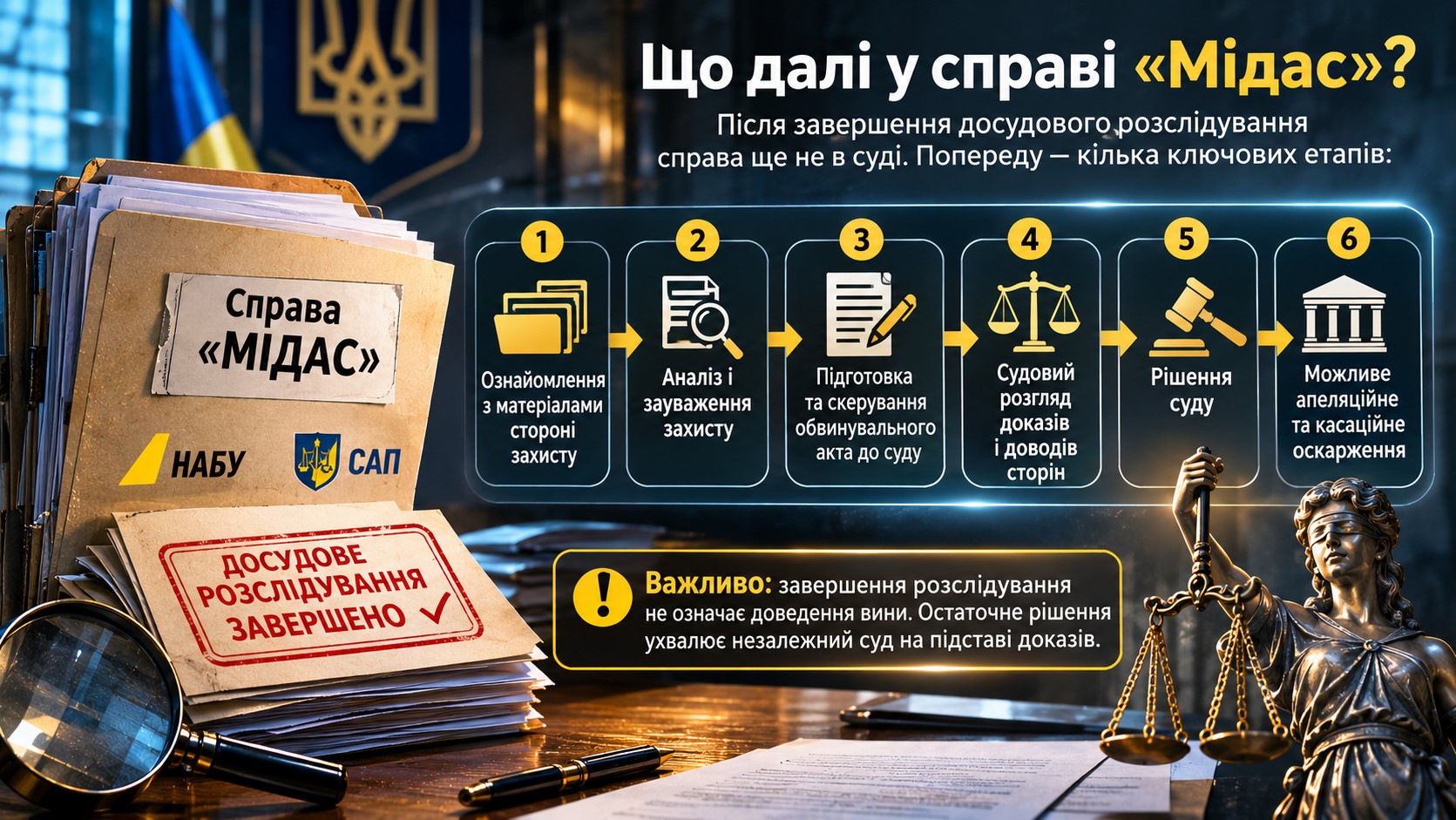
The announcement of 4 November 2026 does not mean that a court has already found anyone guilty.
Under Ukrainian criminal procedure, the completion of a pre-trial investigation and the opening of case materials to the defence are separate procedural stages.
Under Article 290 of the Criminal Procedure Code of Ukraine, once the completion of the investigation has been announced, the defence is granted access to the materials collected during the criminal proceedings.
This right is an essential part of a fair trial.
The defence has the opportunity to:
- Review the evidence presented by the prosecution.
- Examine the investigation materials.
- Study recordings, documents and expert examination results.
- Identify inconsistencies or procedural violations.
- Draw attention to evidence that may refute the allegations or mitigate responsibility.
The law requires the prosecution to disclose not only materials supporting its position but also those that may support the suspect’s defence.
After the defence has completed its review, the prosecutor may prepare and submit an indictment to the court.
The court must then independently assess the admissibility and sufficiency of the evidence, hear both parties and issue a decision.
Therefore, several important stages still lie ahead:
- The defence reviews the case materials.
- Any procedural steps necessary for submitting the case to court are completed.
- The indictment is submitted to the court, if the prosecutor considers the evidence sufficient.
- The court examines the evidence and arguments presented by both parties.
- The court delivers its decision.
- The decision may be appealed through the appellate and cassation procedures provided by law.
Important: As of NABU’s announcement on 4 November 2026, the case materials had been opened to the defence. This is not the same as an indictment having actually been submitted to court.
Legal basis: Criminal Procedure Code of Ukraine, Articles 290–293.
8. What Should Society Demand from This Case?
After a high-profile exposure, public attention often focuses on names, amounts of money and sensational recordings. However, the real result of anti-corruption work is not measured by the number of high-profile announcements.
There are several specific questions that need answers.
First — will every episode be proven?
The prosecution must establish specific actions, the role of each participant, the origin of the funds and the connection between financial transactions and decisions made by officials.
Second — will the illegally obtained funds be recovered?
Freezing assets is an important step, but it is not the same as confiscating them or returning them to the state. This requires the appropriate procedural decisions and legal grounds.
Third — will the full chain of responsibility be established?
It is important to determine not only who received the money, but also who demanded the payments, who ensured that decisions were made, who organised the financial transactions and who helped conceal the origin of the assets.
Fourth — will the systemic causes be addressed?
Even convictions do not guarantee that a similar scheme will not happen again. Transparent procurement, payment controls, effective mechanisms to protect suppliers from unlawful pressure, independent audits and genuine accountability for the management of state-owned enterprises are necessary.
Fifth — will the independence of anti-corruption bodies be preserved?
NABU and SAPO must be able to operate without political interference, while the courts must be able to consider the case without external pressure.
This is essential not only for this case but also for confidence in the entire justice system.
9. Information Manipulation Around the Case: How to Distinguish Facts from Propaganda

Corruption scandals in Ukraine provide convenient material for information operations. Russian propaganda may use real facts, remove them from their context or attach false conclusions to them.
It is therefore important to distinguish evidence-based criticism of Ukrainian state institutions from manipulation intended to discredit the entire country.
In the Midas case, several common techniques deserve particular attention.
Manipulation 1. “All International Aid to Ukraine Is Being Stolen”
The case concerns an alleged corruption scheme in the energy sector and the movement of funds that investigators associate with the activities of state-owned enterprises and their contractors.
The information published by NABU does not provide grounds for claiming that all, or any specific amount of, international military assistance was stolen through this scheme.
Such a claim would require separate evidence concerning funding sources, specific budget programmes and the movement of the relevant funds.
Manipulation 2. “Corruption Has Been Exposed — Therefore, the Entire State Is Criminal”
Exposing corruption demonstrates the existence of a serious problem. At the same time, it shows that state institutions are operating and that there are authorities capable of investigating it.
The focus should be on the specific actions of officials, the effectiveness of the investigation and the results of the court proceedings — not on transferring the responsibility of particular individuals to all citizens or every state institution.
Manipulation 3. “If a Suspect Has Connections to the Government, the Verdict Is Already Obvious”
Political, business or personal connections may be relevant when establishing possible influence, conflicts of interest or motives. However, connections alone do not prove that a crime has been committed.
Likewise, proximity to political leadership cannot be grounds for immunity from investigation or accountability if the evidence establishes involvement in an offence.
Manipulation 4. “Once the Investigation Is Complete, Everyone Has Already Been Found Guilty”
This is legally incorrect.
The presumption of innocence applies until a conviction becomes final and legally binding. Completion of a pre-trial investigation does not abolish this principle.
How Can Information Be Verified?
- First, look for announcements from NABU, SAPO, the High Anti-Corruption Court (HACC) and official court decisions.
- Check publication dates and do not present old materials as new developments.
- Distinguish official statements from information published by anonymous Telegram channels.
- Do not treat identical texts appearing on multiple websites as independent confirmation.
- Check whether journalists refer to the original source or simply reproduce another publication’s report.
- Do not share videos, audio recordings or documents without establishing their origin and context.
It is also important to remember networks of websites that mass-copy or automatically generate articles. The mere presence of an article in search results does not confirm its reliability.
Establishing that a particular publication is of Russian origin requires evidence about its owner, infrastructure, the source of its text or other verifiable indicators. Without such evidence, it would be incorrect to label a particular material as a Russian information operation.
Critical thinking does not mean rejecting uncomfortable facts. It means verifying them and refusing to let others manipulate the conclusions. Corruption must be investigated regardless of the positions, connections or political affiliations of those involved. But justice must not be replaced by an information-driven verdict.
Conclusion: Exposure Is the Beginning, Not the End of Accountability
The Midas case demonstrates how serious the risks of corruption in strategic sectors of the state can be.
According to NABU and SAPO, a mechanism for systematically obtaining illicit benefits from contractors operated in Ukraine’s state energy sector for several years, while a separate financial infrastructure was allegedly used to move and launder the funds.
More than USD 111 million and EUR 12 million in cash are figures that require not only public attention but also thorough examination in court.
At the same time, it is important not to replace legal procedure with emotional conclusions. Every episode, every financial transaction and the role of every suspect must be established through proper evidence.
For Ukraine, this case is a test of several institutions at once: anti-corruption authorities, the judicial system, public administration and mechanisms for overseeing strategic state-owned enterprises.
Society has the right to demand transparency, an independent investigation, a fair trial and the recovery of illegally obtained assets.
Because the fight against corruption is not about the number of high-profile revelations. It is about the state’s ability to bring a case to a lawful conclusion, ensure that those found guilty are held accountable and prevent similar mechanisms from operating again.
Sources and Documents
Primary Sources — Ukrainian Anti-Corruption Authorities
- NABU — Operation Midas: Case Materials Opened, 4 November 2026.
- NABU — Operation Midas: High-Level Criminal Organisation in the Energy Sector Exposed.
- NABU — Unlawful Enrichment of a Former Deputy Prime Minister.
- NABU — Operation Midas: Suspicion Against Former Energy Minister.
- NABU — Operation Midas: New Suspicion, 10 July 2026.
Judicial Procedure and Analysis
- Criminal Procedure Code of Ukraine — Articles 290–293.
- Anti-Corruption Action Centre — HACC Decided: Midas Case.
International Sources
- Reuters — Ukraine Charges Seven in $100 Million Energy Graft Scandal, 11 November 2025.
- Reuters — Ukraine’s Anti-Graft Police Target Senior Officials in Major Fraud Probe, 4 November 2026.
- Ukrainska Pravda — Ukraine’s Anti-Corruption Bureau Completes Investigation into High-Profile Midas Case, 4 November 2026.