

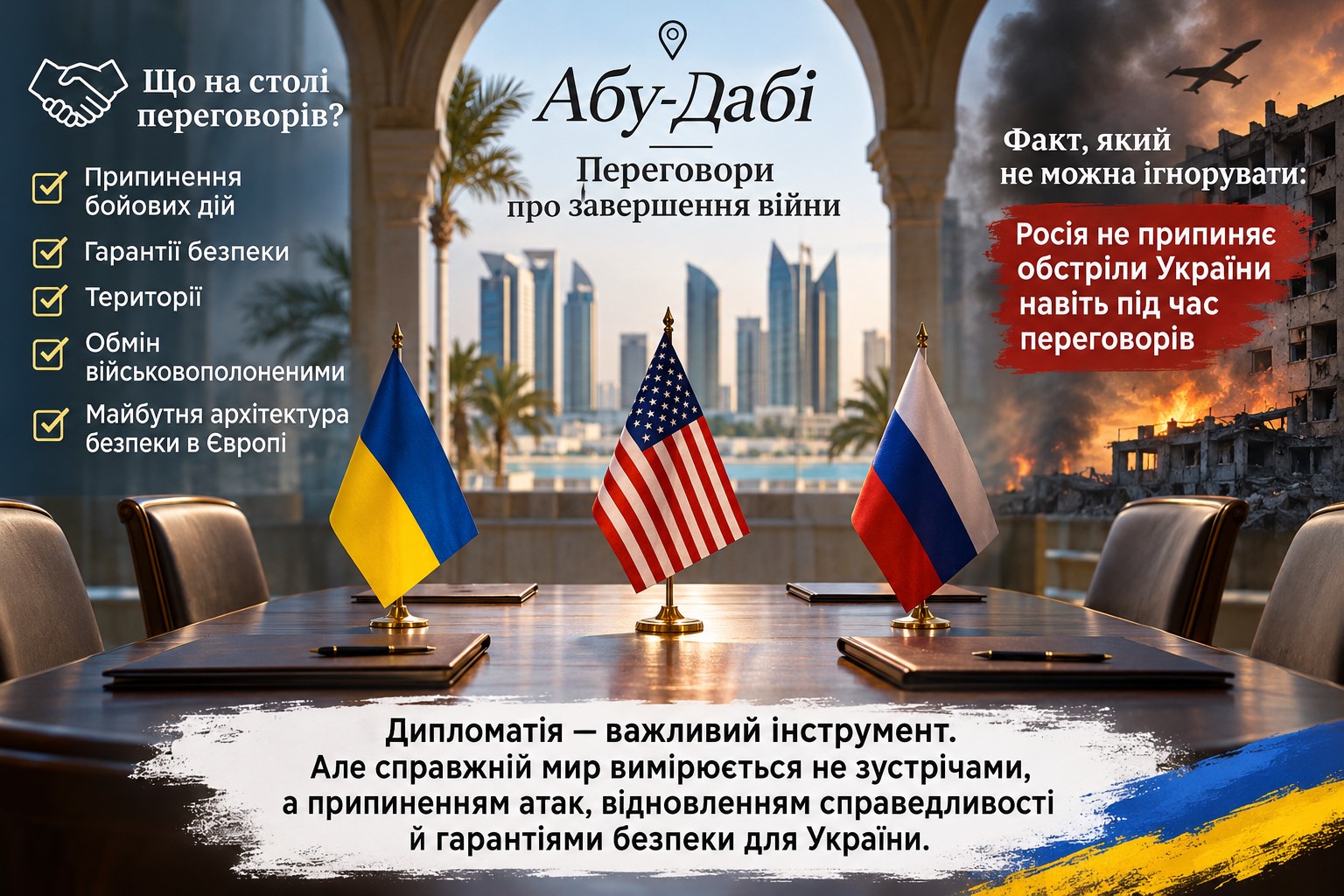
Negotiations to end the war are about much more than diplomatic meetings, political statements, and the wording of future agreements. They concern territorial integrity, state sovereignty, the security of millions of people, and the future of the entire European security architecture.
On November 10–11, 2026, another round of trilateral talks involving Ukraine, the United States, and Russia took place in Abu Dhabi. These were the first direct trilateral talks in this format in nine months. The meeting ended with an agreement in principle to pursue a large-scale prisoner exchange. However, no breakthrough was achieved on the central issues: ending the war and resolving territorial disputes.
Ukraine insists on ending hostilities, securing reliable security guarantees, and preserving its sovereignty. Russia continues to demand territorial concessions and broader restrictions on the Ukrainian state. Meanwhile, military attacks did not stop even while diplomatic meetings were taking place.
To understand whether the Abu Dhabi talks could become a step toward genuine peace, it is necessary to examine not only the parties’ latest statements, but also the history of Russia’s demands, the principles of international law, and the Kremlin’s actual conduct throughout the years of war.
1. What Happened in Abu Dhabi on November 10–11, 2026?
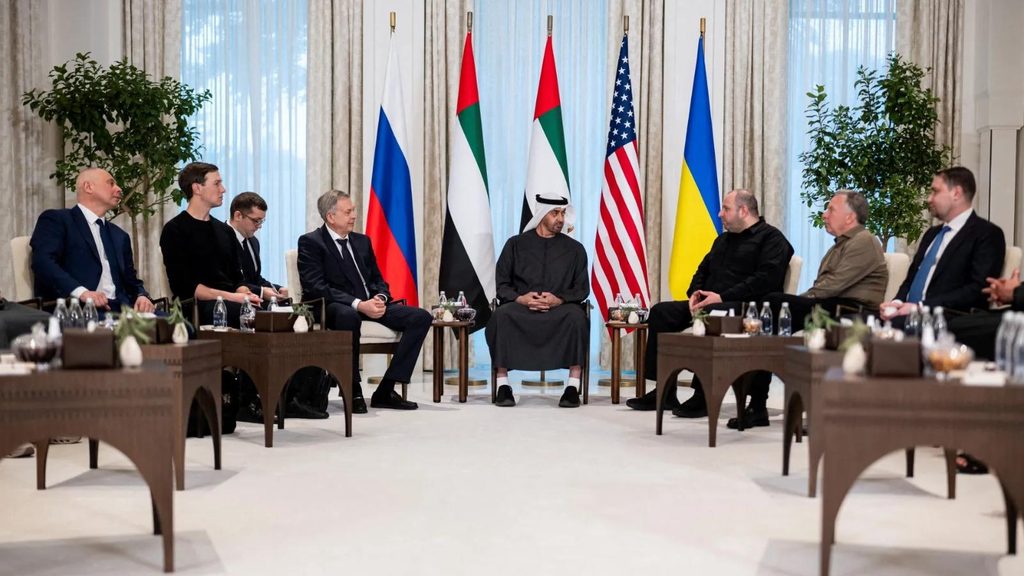
Representatives of Ukraine, the United States, and Russia took part in the negotiations. The American delegation included, among others, special envoy Steve Witkoff and Jared Kushner. Ukraine’s delegation was led by Rustem Umerov, Secretary of the National Security and Defense Council of Ukraine. Russia was represented by negotiators authorized by the Kremlin.
One of the few concrete outcomes was an agreement in principle on a large-scale prisoner exchange. Ukrainian President Volodymyr Zelenskyy said that a substantial exchange was expected. However, by the end of the meeting, the final number of people to be exchanged, the date, and the arrangements still required further coordination.
This is an important humanitarian outcome. The return of Ukrainian service members matters enormously to their families and to the entire country. However, an agreement on a prisoner exchange should not be mistaken for progress toward a political peace settlement.
According to reports from participants in the negotiation process, the parties remained fundamentally divided over territorial issues. Ukraine refuses to accept Russia’s demand to hand over the entire Donbas region. Russia continues to insist on territorial claims extending far beyond the areas it actually controls.
Russian negotiator Vladimir Medinsky stated that Russia intended to regain control of every inch of territory Moscow considers its own. This position effectively confirms that the Kremlin has not abandoned its claims to Ukrainian lands that Russia has declared annexed.
The Ukrainian side also reported that the Russian delegation lacked the authority to agree to the proposed ceasefire in the energy sector. President Zelenskyy emphasized the need to involve European partners in further negotiations.
Thus, Abu Dhabi produced a certain humanitarian result, but it did not demonstrate Russia’s readiness to abandon its main political and territorial demands.
2. What Conditions Is Ukraine Putting Forward?
Ukraine’s position is not limited to simply stopping the shooting. For Ukraine, it is essential not only to halt hostilities but also to prevent Russia from launching another aggression several years later.
The key priorities voiced by the Ukrainian side before the talks and during diplomatic contacts cover several areas.
Cessation of Hostilities
Ukraine is interested in a ceasefire as the first practical step toward a political settlement. However, the ceasefire must be genuine and must not be used by Russia to regroup its forces, replenish weapons stocks, or prepare a new offensive.
Previous Ukrainian proposals, including those presented during the Istanbul talks in June 2025, called for a full and unconditional ceasefire on land, in the air, and at sea for at least 30 days, with the possibility of extension. An international monitoring mechanism was also envisaged.
This was a specific public proposal made by Ukraine. It should not be taken as proof that precisely the same document became Kyiv’s final position during the November 2026 negotiations.
Reliable Security Guarantees
Ukraine does not want to find itself in a situation where, after another agreement is signed, Russia simply rebuilds its military capabilities and launches a new offensive.
That is why any settlement must include security guarantees providing for:
- Clearly identified guarantor states;
- Specific commitments in the event of renewed Russian aggression;
- Rapid-response mechanisms;
- Long-term military and financial support for Ukraine;
- Opportunities to develop and modernize Ukraine’s Defense Forces;
- International mechanisms to monitor compliance with the agreements.
Political assurances alone are not enough. Ukraine already has experience with the 1994 Budapest Memorandum, which contained security assurances but did not establish an automatic military defense mechanism in the event of an attack.
Preserving Sovereignty and the Right to Determine Its Own Future
Ukraine does not accept Russia dictating its foreign policy, restricting the development of its Armed Forces, or prohibiting cooperation with international partners.
Previous Ukrainian proposals emphasized the right of a state to choose its own security arrangements and determine its European and Euro-Atlantic direction.
This is a fundamental issue. Ukraine is an independent state, not a territory over which a neighboring country has veto power.
Humanitarian Issues
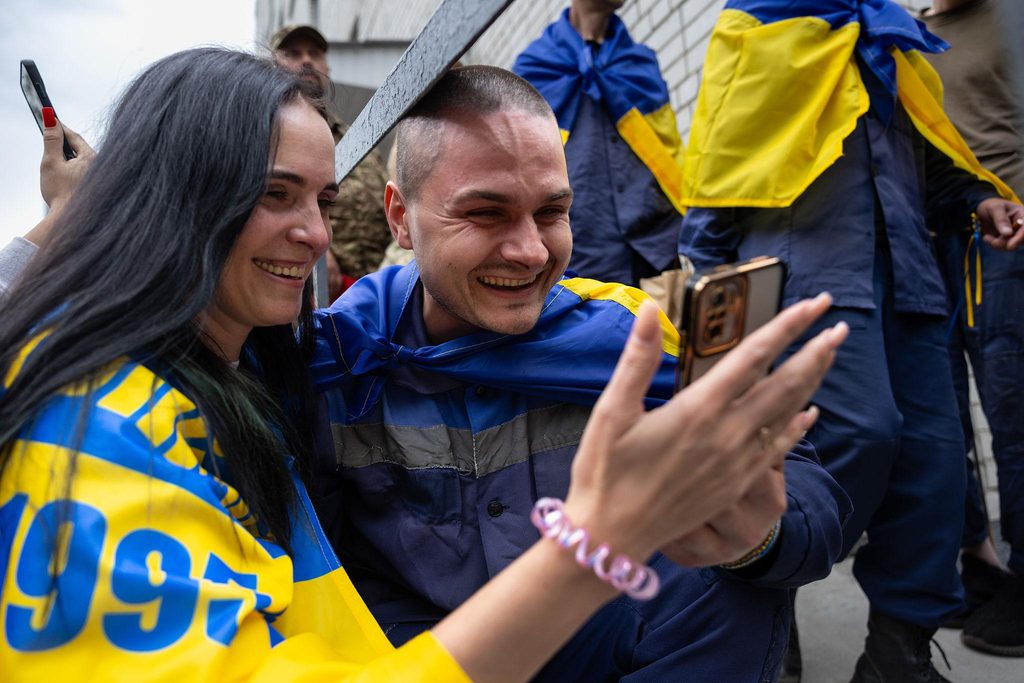
Ukraine’s key humanitarian demands include:
- The return of prisoners of war;
- The release of unlawfully detained civilians;
- The return of deported Ukrainian children;
- Efforts to locate missing persons;
- Family reunification;
- Access for international humanitarian organizations to places where people are being held.
These issues must not become bargaining chips in political negotiations.
Ukraine’s Reconstruction and Compensation for Losses
Russian aggression has caused massive destruction to housing, energy infrastructure, industry, transport networks, medical facilities, and educational institutions.
Ukraine has the right to demand compensation for the damage caused. One potential source of compensation is Russian state assets frozen abroad. At the same time, the legal mechanisms for using these assets remain a complex matter under international law.
3. What Does Russia Demand?
Russian demands should be assessed not only on the basis of the Kremlin’s latest statements but also in the context of previous negotiation processes.
Throughout the war, Moscow has repeatedly changed its wording, but its main objectives have remained relatively consistent: territorial concessions from Ukraine, restrictions on its defense capabilities, and influence over the country’s foreign policy.
The 2021 Demands: Restricting Ukraine’s Freedom of Choice
In December 2021, Russia published draft agreements on so-called security guarantees with the United States and NATO.
Among the key demands were:
- No further NATO enlargement;
- Effectively blocking Ukraine’s prospects of joining the Alliance;
- Restrictions on NATO military cooperation with states that were formerly part of the Soviet Union;
- A reduction in NATO’s military presence in Eastern Europe;
- Restrictions on NATO military activities and infrastructure near Russia’s borders.
These demands went far beyond bilateral relations between Russia and Ukraine. In effect, Moscow was attempting to obtain the right to influence the security policies of other independent states.
The 2022 Demands: Neutrality and Restrictions on the Ukrainian Armed Forces
After the full-scale invasion began, the parties held negotiations, including in Belarus and Istanbul.
The discussions addressed Ukraine’s neutrality, international security guarantees, the status of Crimea, control over occupied territories, the size of Ukraine’s Armed Forces, and other issues.
Ukraine’s proposal presented in Istanbul on March 29, 2022, envisaged the possibility of a neutral status in exchange for effective international security guarantees. The issue of Crimea was proposed for separate negotiations rather than resolution through force.
However, the parties did not conclude a final peace treaty. Claims that a peace agreement was already practically ready in 2022 and that it was prevented from being signed exclusively by external forces do not reflect the full complexity of the negotiation process. The draft documents contained substantial differences, while key issues concerning security and territory remained unresolved.
The Russian Memorandum of 2025
The demands set out in the Russian memorandum submitted during the Istanbul talks on June 2, 2025, were particularly revealing.
According to analyses by the Institute for the Study of War (ISW) and Poland’s Centre for Eastern Studies (OSW), Russia demanded, among other things:
- International recognition of Russian control over Crimea and all territories of the Donetsk, Luhansk, Zaporizhzhia, and Kherson regions;
- The complete withdrawal of Ukrainian troops from these regions, including areas Russia does not actually control;
- Neutral status for Ukraine;
- Ukraine’s renunciation of NATO membership;
- Restrictions on or the termination of Ukraine’s military cooperation with Western countries;
- A ban on the deployment of foreign troops and military infrastructure;
- A range of domestic political and legislative changes.
The Russian memorandum also included conditions Moscow wanted Ukraine to fulfil before a ceasefire could even begin. These included the withdrawal of Ukrainian troops from territories claimed by Russia and other restrictions on Ukraine’s military activities.
This distinction is crucial: the proposal was not simply about stopping hostilities along the actual line of contact. It demanded that Ukraine give up a substantial part of its own territory and limit its ability to defend itself.
Why These Demands Cannot Be Considered an Ordinary Compromise
A compromise involves mutual concessions by the parties. However, demands that require one state to surrender territory, restrict its own Armed Forces, and grant another state influence over its foreign policy create an entirely different situation.
This is not merely a dispute over the location of a border. It is a question of whether Ukraine will remain a fully independent subject of international relations.
4. Are Russia’s Demands Legal Under International Law?
It is necessary to distinguish between two things: a state’s right to raise concerns about its own security and its right to impose political decisions on another state through military force.
Russia, like any other country, may raise issues concerning arms control, military transparency, exercises, missile systems, and mechanisms for reducing mutual risks.
However, this does not give it the right to determine Ukraine’s foreign policy, annex its territory, or use force to achieve political objectives.
The UN Charter and the Prohibition of Aggression
The Charter of the United Nations establishes the principle of the sovereign equality of states and prohibits the threat or use of force against the territorial integrity or political independence of any state.
Article 2(4) of the UN Charter explicitly prohibits the use of force against the territorial integrity and political independence of states.
This means that Russia cannot legalize the seizure of Ukrainian territories through so-called referendums held under occupation or by simply declaring annexation.
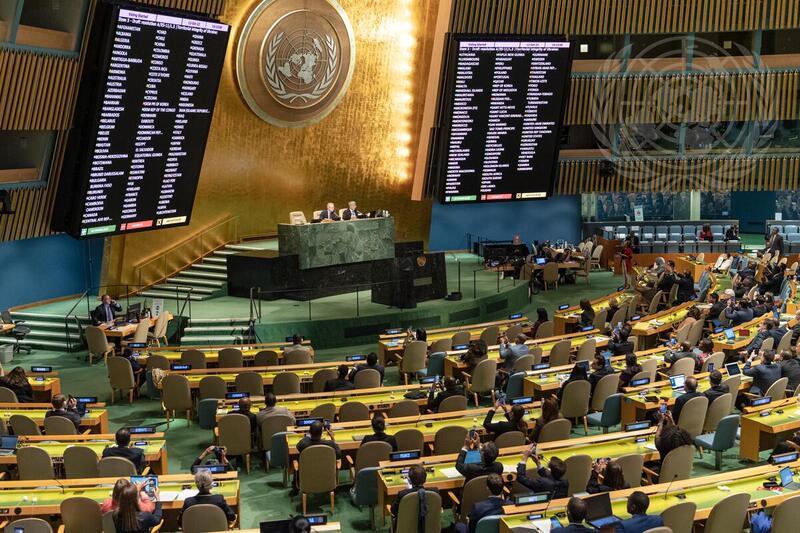
In 2014, the UN General Assembly adopted Resolution 68/262, affirming Ukraine’s territorial integrity within its internationally recognized borders and emphasizing that the so-called referendum in Crimea had no legal validity.
In October 2022, UN General Assembly Resolution ES-11/4 condemned the illegal so-called referendums and Russia’s attempted annexation of parts of the Donetsk, Luhansk, Zaporizhzhia, and Kherson regions. The resolution was supported by 143 states.
Therefore, international recognition of Russia’s annexations cannot be considered a lawful demand justified by the mere fact of occupation.
Can Russia Demand Ukraine’s Neutrality?
Neutrality is not inherently illegal. A state may voluntarily choose a neutral status if it serves its national interests and provides for its security.
The crucial distinction, however, is that such a decision must be voluntary.
Russia has no right to impose neutrality on Ukraine by force or prohibit it from joining international organizations.
The Organization for Security and Co-operation in Europe (OSCE) Charter and related OSCE documents affirm the right of every state to freely choose or change its own security arrangements, including participation in alliances.
This principle does not mean that the security concerns of neighboring states cannot be discussed. However, it does not allow one country to establish its own sphere of influence at the expense of another country’s sovereignty.
Can Ukraine Agree to Territorial Concessions?
International law does not prohibit states from concluding border agreements by mutual consent. However, such consent must be freely given and must not result from the unlawful use of force or coercion.
Occupation does not create ownership rights over a territory. Likewise, military control over an area does not automatically transfer sovereignty.
Ukraine may discuss practical mechanisms for ending hostilities, a line of separation, international monitoring, and other temporary arrangements. But this is not the same as legally recognizing Russia’s annexation.
The key distinction is this: ending hostilities along a particular line does not mean recognizing that line as an international border.
5. Negotiations Under Fire: Russia Has Never Stopped the War Even While Talking About Peace
There is another circumstance without which any assessment of negotiations with Russia would be incomplete.
Throughout all the years of the Russian-Ukrainian war, Moscow has repeatedly pursued negotiation processes while continuing military pressure on Ukraine.
This applies to the period following the beginning of Russian aggression in 2014, the Minsk agreements, negotiations in the Normandy Format, contacts after the full-scale invasion in 2022, and subsequent diplomatic initiatives.
Even when the parties agreed to ceasefires, shelling, violations of ceasefire arrangements, and military operations did not disappear. Ceasefire agreements were repeatedly left unfulfilled.
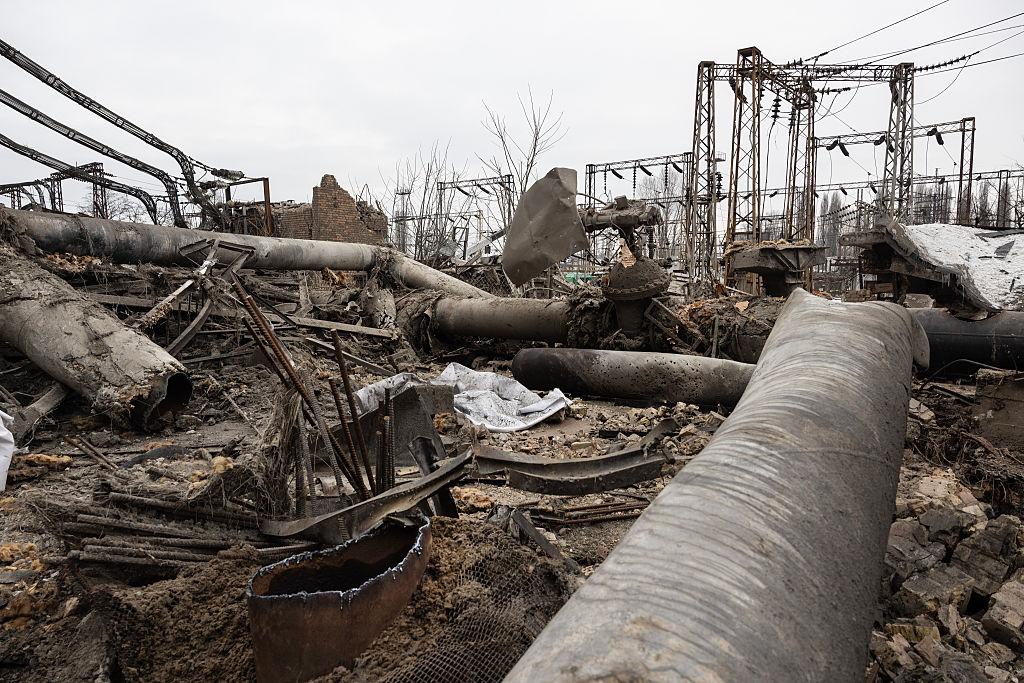
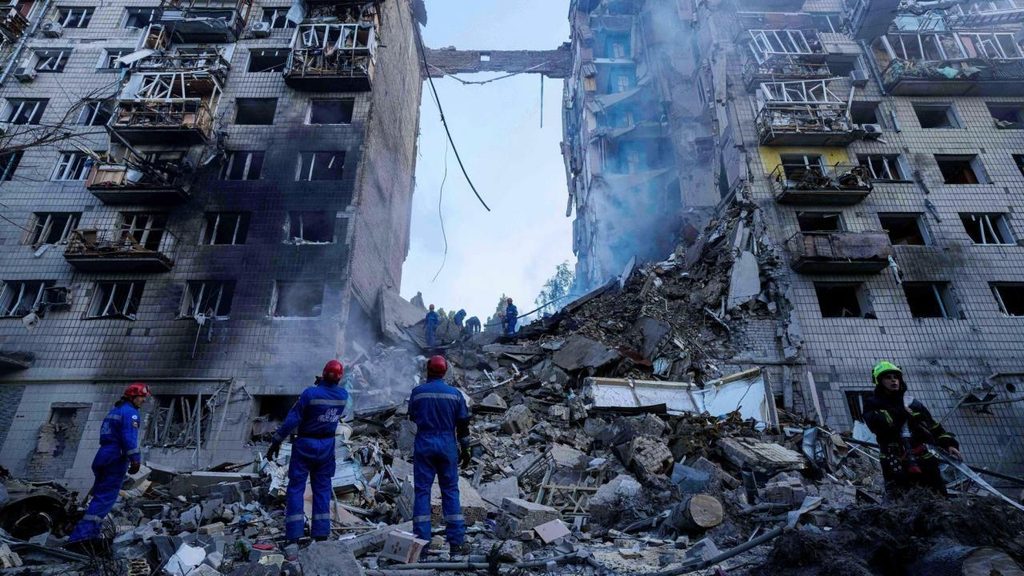
After February 24, 2022, this pattern escalated significantly. Russian forces continued missile and drone attacks, strikes on cities, energy infrastructure, ports, industrial facilities, and civilian areas even during periods of active diplomatic engagement.
The Istanbul negotiations in the spring of 2022, subsequent diplomatic initiatives, agreements concerning grain exports, and numerous international efforts to secure a ceasefire did not mean that Russian attacks had stopped.
This must also be taken into account when assessing the Abu Dhabi talks. Russian attacks continued during the meetings on November 10–11, 2026. According to Ukrainian authorities, Russia attacked energy facilities during this period, including substations in central Ukraine. A Russian strike on a market in Odesa also killed people.
The mere presence of a Russian delegation at the negotiating table is not proof that the Kremlin is ready to stop its aggression. When diplomatic meetings take place alongside missile strikes, drone attacks, and continuing offensive operations, this indicates that military pressure remains part of Russia’s strategy.
Ukraine Has Also Changed the Nature of Its Response
At the same time, Ukraine’s response has changed in recent years.
At the beginning of the full-scale invasion, Ukraine was largely forced to respond to Russian attacks and defend its own territory. Over time, however, the Ukrainian state developed the capabilities to strike military, logistical, fuel, and other facilities on Russian territory that are important to Russia’s war machine.
Ukrainian operations on Russian territory had taken place before, so it would be inaccurate to claim that Ukraine only began responding in the last two years. However, the scale, frequency, and range of Ukrainian strikes have increased significantly in recent years, particularly due to the development of long-range drones and other strike capabilities.
This does not mean that the two sides have equivalent capabilities, resources, or approaches to warfare. Ukrainian strikes against military targets on the territory of the aggressor state form part of Ukraine’s right to self-defense under Article 51 of the UN Charter.
At the same time, every individual operation must comply with international humanitarian law, including the principles of distinction between military and civilian objects, proportionality, and precaution.
That is why negotiations must be assessed not only by the statements made by diplomats but also by the actions of the parties.
Is Russia stopping its attacks? Is it agreeing to a monitored ceasefire? Is it abandoning demands that would effectively deprive Ukraine of the right to determine its own future?
As long as the answers to these questions remain negative, talks about peace cannot automatically be interpreted as genuine progress toward ending the war.
Peace is not measured by the number of negotiating meetings or the forcefulness of diplomatic statements. It is measured by the end of killings, shelling, and occupation.
6. Is Russia Really Ready for Peace?
This question cannot be answered honestly by simply declaring that Russia will never agree to peace or, conversely, that its participation in negotiations already proves its readiness to end the war.
We cannot know all the internal intentions of the Russian leadership with certainty. However, we can assess its public demands, concrete actions, and willingness to compromise.
It is important to distinguish between three different things:
- Willingness to participate in negotiations.
- Willingness to reach agreements on individual issues.
- Willingness to abandon maximalist war aims and accept a peace that preserves Ukraine’s sovereignty.
Russia has demonstrated the first two. In particular, the Abu Dhabi talks provided grounds to speak of the possibility of a large-scale prisoner exchange.
But the third question remains open.
What Indicates Russia’s Willingness to Negotiate?
Russia participates in diplomatic meetings, discusses humanitarian issues, and agrees to certain arrangements.
This should not be dismissed. Prisoner exchanges save lives, and any mechanism that reduces the number of casualties matters.
In addition, negotiations can help test the parties’ positions, identify the limits of possible compromises, and establish communication channels to prevent escalation.
What Raises Doubts About the Kremlin’s Readiness for Genuine Peace?
At the same time, several circumstances make it impossible to conclude that Russia has genuinely abandoned its aggressive objectives:
- Continued missile and drone attacks during negotiations;
- Insistence that Russia be given territories it does not control;
- Demands to restrict the size and capabilities of the Ukrainian Armed Forces;
- Attempts to deprive Ukraine of the right to choose its own international alliances;
- Unwillingness to accept security guarantees strong enough to prevent another invasion;
- Attempts to discuss a broader European security architecture in a way that accommodates Russia’s claims to a special role in the region.
It is also significant that Russia is trying to link the end of the war in Ukraine to broader demands concerning Europe’s security architecture.
Moscow may discuss arms control and risk reduction. However, such negotiations must not become a mechanism through which one state obtains the right to determine how other countries organize their own security.
Negotiations as an Instrument of Pressure
For Russia, negotiations may be not only a path toward ending the war but also a way of pursuing political objectives through other means.
When one side continues offensive operations and shelling while making demands that require unilateral concessions from the other side, the diplomatic process can become an extension of the war by political means.
This does not mean that all negotiations with Russia are pointless. On the contrary, diplomatic channels are necessary. But they must be assessed soberly — by their results, not merely by the fact that meetings take place.
At this stage, the publicly known results of the Abu Dhabi talks indicate limited progress on humanitarian issues. They do not provide grounds to claim that the Kremlin has abandoned its principal territorial and political demands.
7. Are the Demands of Ukraine and Russia Equally Justified?
In diplomacy, one often hears calls to “take both sides’ interests into account” or “find a compromise between the parties’ positions.”
Seeking compromise is a normal diplomatic instrument in itself. However, it does not mean that all demands automatically carry equal legal or moral weight.
Ukraine is defending its internationally recognized territory against a state that launched aggression and is attempting to consolidate its consequences.
Russia, for its part, demands recognition of territorial seizures, restrictions on Ukraine’s defense capabilities, and influence over the foreign policy of a neighboring state.
These are fundamentally different positions.
Ukraine has the right to self-defense under Article 51 of the UN Charter. It has the right to demand an end to aggression, the withdrawal of Russian troops, the release of prisoners, and the return of deported children.
Russia has the right to participate in negotiations and raise questions concerning its own security. However, it has no right to demand that the results of aggression be legitimized as a lawful reward for ending the war.
This does not mean that every Ukrainian proposal is automatically perfect or that its practical implementation requires no difficult decisions. The Ukrainian government will have to take military, economic, demographic, and international circumstances into account.
However, the principles of sovereignty and territorial integrity cannot be placed on the same level as the demands of an aggressor state seeking to legitimize the seizure of another country’s territory.
8. What Are Ukraine’s Prospects?
Ukraine’s prospects depend on several interconnected factors: the situation on the battlefield, economic resilience, the development of domestic defense production, support from international partners, and the ability of diplomacy to secure real security guarantees.
Military Capabilities
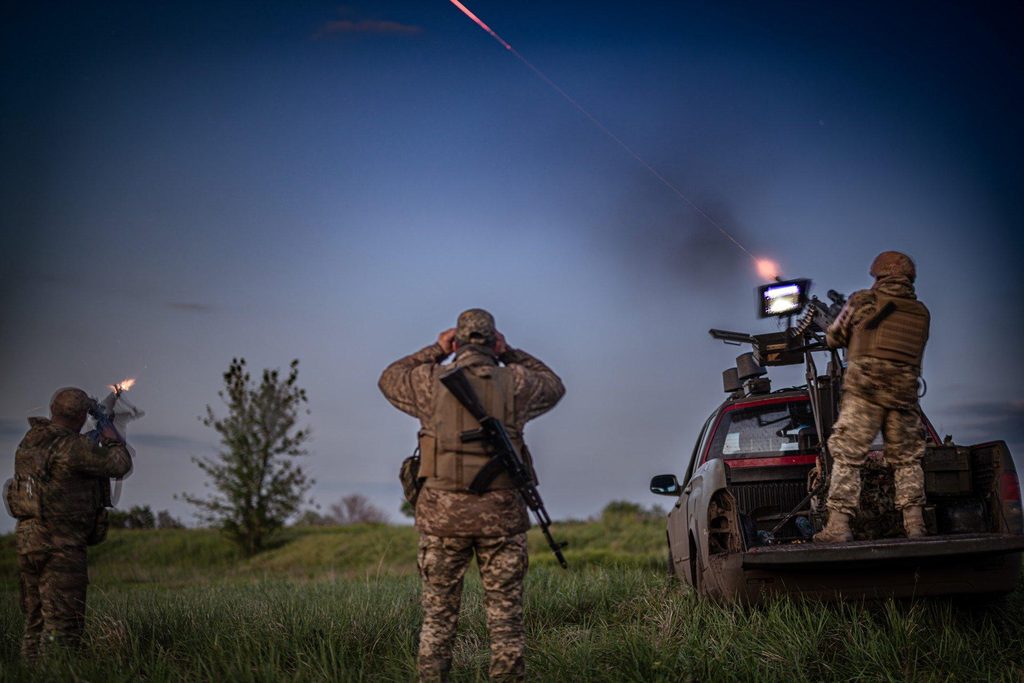
Ukraine must preserve its ability to defend itself regardless of the outcome of negotiations.
This requires developing its domestic defense industry and producing drones, missile systems, air defense systems, artillery ammunition, and electronic warfare equipment.
Any peace agreement that leaves Ukraine without sufficient defensive capabilities creates the risk of renewed aggression.
International Support
Ukraine has a strong interest in ensuring that European partners are full participants in determining the future security of the continent.
European states cannot remain on the sidelines because the consequences of Russian aggression extend far beyond Ukraine. They affect NATO’s eastern flank, energy stability, migration, the economy, and the entire international system.
At the same time, support from partners should not be taken for granted. Ukraine must maintain diplomatic contacts, clearly explain its interests, and build long-term cooperation mechanisms.
Economic Resilience
War depletes more than military resources. It destroys infrastructure, reduces production, changes the demographic structure, and places long-term pressure on public finances.
That is why Ukraine’s recovery must be part of its security strategy. A strong economy, supported by functioning businesses, energy systems, transport networks, and social institutions, gives a state significantly greater capacity to defend its independence.
Diplomatic Position
Ukraine must remain open to negotiations, but not at the cost of abandoning its right to exist as an independent state.
This means that any agreement must include not only obligations for Ukraine but also clear, verifiable, and enforceable commitments by Russia.
A ceasefire without monitoring, security guarantees, and consequences for violations may become nothing more than a pause before another war.
9. What Could Genuine Peace Look Like?
Genuine peace is not simply the absence of active hostilities for a certain period of time.
For Ukraine, it must mean:
- An end to Russian aggression;
- A reliable mechanism for monitoring the ceasefire;
- Security guarantees backed by specific commitments from international partners;
- Preservation of Ukraine’s right to determine its own future;
- The ability to maintain and develop its own Armed Forces;
- The return of prisoners of war, civilian hostages, and deported children;
- A mechanism for compensation for the damage caused by Russia;
- No legal recognition of the illegal annexation of Ukrainian territories.
Not all these issues can be resolved simultaneously. Some will require lengthy negotiations, international mechanisms, and complex legal procedures.
However, it is essential that temporary arrangements do not undermine the possibility of achieving a just and lasting settlement in the future.
10. Conclusions: Negotiations Are a Tool, Not a Guarantee of Peace
The Abu Dhabi talks demonstrated that the diplomatic process is continuing and that the parties are capable of reaching agreements on certain humanitarian issues. The anticipated large-scale prisoner exchange could become an important outcome.
However, the main disagreements remain unresolved.
Ukraine seeks to end the war, preserve its sovereignty, obtain effective security guarantees, and prevent another invasion.
Russia continues to insist on territorial concessions and political restrictions on Ukraine. At the same time, it continues its military pressure, including during negotiation processes.
That is why the Kremlin’s readiness for peace must be assessed not by the number of meetings or diplomatic statements, but by concrete actions: stopping attacks, demonstrating a genuine willingness to agree to a ceasefire, abandoning demands that contradict Ukraine’s sovereignty, and accepting mechanisms that would prevent renewed aggression.
Ukraine should not abandon diplomacy. But diplomacy must not mean capitulation, and compromise must not mean legitimizing the seizure of territory.
Peace that leaves the aggressor with the ability to attack again does not eliminate the causes of war. It merely postpones its next stage.
Therefore, Ukraine’s main task is not simply to secure a ceasefire, but to establish conditions under which its independence, territorial integrity, and the Ukrainian people’s right to determine their own future will not become subjects of another round of military blackmail.
Sources and Materials for Verification
The following international documents, official statements, and analytical materials form the basis of this article. Russian state media have not been used as independent sources of factual verification.
- Reuters, November 11, 2026 — report on the results of the trilateral talks in Abu Dhabi, the prisoner exchange agreement, territorial disagreements, and continued attacks during the negotiations.
https://www.reuters.com/ - Reuters, November 12, 2026 — report on the arrival of U.S. representatives in Moscow for a meeting with Vladimir Putin.
https://www.reuters.com/ - President of Ukraine — official statements on the Abu Dhabi talks and the agreement concerning the exchange of prisoners of war.
https://www.president.gov.ua/ - Charter of the United Nations — in particular, Articles 2(4) and 51.
https://www.un.org/en/about-us/un-charter - UN General Assembly Resolution 68/262 (2014) — Territorial Integrity of Ukraine.
https://undocs.org/A/RES/68/262 - UN General Assembly Resolution ES-11/4 (2022) — Territorial Integrity of Ukraine: Defending the Principles of the Charter of the United Nations.
https://undocs.org/A/RES/ES-11/4 - OSCE — Charter for European Security (1999) — the principle that states have the right to freely choose their own security arrangements.
https://www.osce.org/mc/17502 - Institute for the Study of War (ISW) — analysis of the Russian memorandum presented during the Istanbul negotiations in June 2025.
https://www.understandingwar.org/ - OSW — Centre for Eastern Studies — analysis of Russian demands concerning a ceasefire and the settlement of the war.
https://www.osw.waw.pl/en - Reuters — report on Ukraine’s proposals during the Istanbul negotiations on June 2, 2025.
https://www.reuters.com/world/europe/ukrainian-proposals-june-2-talks-istanbul-2025-06-01/ - SWP — German Institute for International and Security Affairs — analysis of the negotiations between Ukraine and Russia in 2022.
https://www.swp-berlin.org/en/ - House of Commons Library (United Kingdom) — analytical briefings on the Russian-Ukrainian war, negotiation processes, and the positions of the parties.
https://commonslibrary.parliament.uk/