

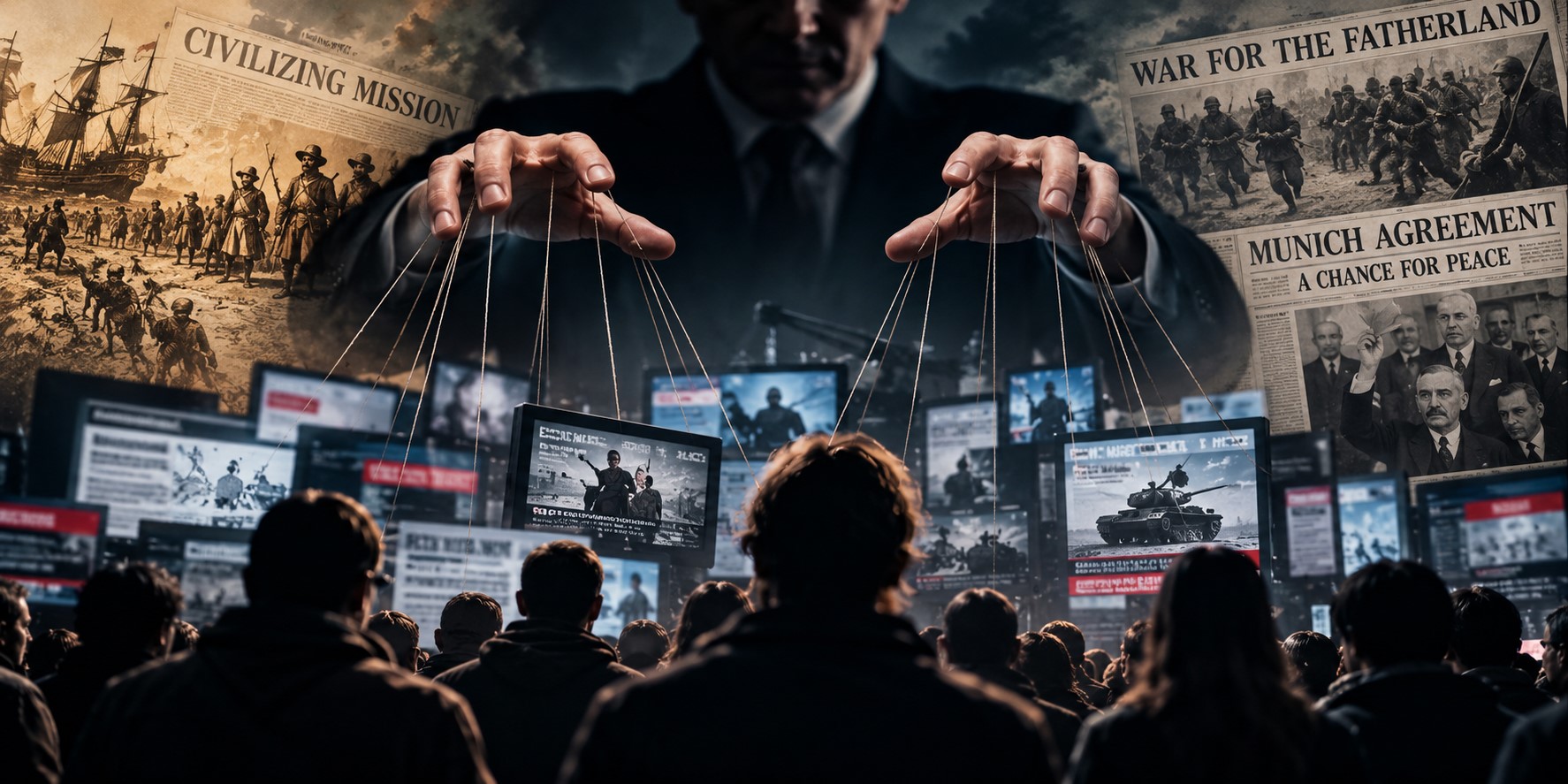
Colonialism was described as a civilizing mission. The First World War was accompanied by slogans about defending the homeland, honour, and freedom. The 1938 Munich Agreement was presented by British Prime Minister Neville Chamberlain as an opportunity to preserve peace. In each of these cases, political rhetoric helped explain decisions to the public — decisions that would have far-reaching consequences.
But does this mean that every public slogan conceals deception? No. And this is precisely where critical analysis begins.
Political decisions rarely have a single cause. Government officials may simultaneously seek security, economic advantages, the preservation of power, and public support. The problem arises when a complex situation is deliberately oversimplified, inconvenient facts are left out, and the interests of particular groups are presented as the only possible choice for society as a whole.
Manipulation of public consciousness does not necessarily involve an outright lie. Sometimes, all it takes is carefully chosen language, selective attention to certain facts, silence about others, and a framework that makes a particular decision seem natural, inevitable, or morally beyond question.
To understand how this works, we need to examine history, research on communication, and specific techniques used to shape the way information is presented.
1. The “Civilizing Mission”: How Colonialism Was Given a Moral Justification
For centuries, European empires relied on a variety of arguments to justify the expansion of their power: spreading religion, promoting trade and education, introducing legal systems, and supposedly bringing superior civilization to other societies.
These arguments were not always merely cynical window dressing. Some supporters of imperial policies genuinely believed they were bringing progress to other peoples. However, good intentions expressed in political rhetoric do not, by themselves, establish that a policy was just or that its consequences matched its promises.
In her research on the British Empire, colonialism, and missionary activity, historian Anna Johnston examines how religious and moral rhetoric gave colonial expansion the appearance of a socially beneficial mission. The idea that other peoples needed to be “civilized” helped present imperial rule as a moral obligation rather than simply a struggle for territory, resources, and influence.
Source: Cambridge University Press — The British Empire, Colonialism, and Missionary Activity.
Historian Peter J. Cain, in his research on Britain’s “civilizing mission,” also demonstrates that supporters of imperialism could sincerely regard imperial rule as morally justified. At the same time, such rhetoric strengthened domestic support for the empire and reinforced the authority of the elites who governed it.
Source: Peter J. Cain — Character, ‘Ordered Liberty’, and the Mission to Civilise.
This example illustrates an important mechanism of political communication: those in power can explain their actions in the language of universal values while simultaneously gaining specific political or economic advantages.
However, a thorough analysis requires additional questions:
- Who determines what counts as “civilization” or “progress”?
- Do the people supposedly being helped have the right to determine their own future?
- Who controls the territory, resources, and political institutions after such a “mission” has been carried out?
- Can the societies being governed refuse the proposed model without facing coercion?
If rhetoric about doing good does not recognize people’s right to make their own choices, it can become a tool for justifying domination.
At the same time, it would be wrong to conclude that every educational, humanitarian, or modernization initiative is a cover for exploitation. Each case must be examined on its own merits, including the actions taken, the distribution of benefits, the use of coercion, and the perspectives of the people directly affected.
2. The First World War: When National Unity Becomes a Tool of Mobilization
The First World War marked a turning point in the history of mass political propaganda.
Between 1914 and 1918, the governments of the warring states systematically used newspapers, posters, public speeches, censorship, and other communication tools to mobilize their populations. The aim was not simply to report events, but also to shape attitudes toward the war, the enemy, and their own countries’ military efforts.
In their study The Universal Laws of Propaganda: World War I and the Origins of Government Manufacture of Opinion, media researcher John Maxwell Hamilton and historian Elisabeth Fondren examine how the First World War contributed to the development of systematic government practices for shaping public opinion.
Source: Journal of Intelligence History, 2023.
Historical materials held by the UK’s National Archives also document how government departments participated in wartime propaganda, worked with the press, and operated under censorship restrictions.
Source: The National Archives — Propaganda.
Why does this matter?
War requires more than military resources. It also requires public support, a willingness to accept losses, acceptance of restrictions, and a belief that continuing the conflict is justified.
National slogans can help a society unite in the face of a genuine threat. But they can also narrow the space available for questioning decisions.
For example, if a military campaign is described exclusively as a struggle for honour and the homeland, the public may receive far less information about its political objectives, costs, prospects for success, and possible alternatives.
It is important not to oversimplify history here. The causes of the First World War cannot be reduced to elite manipulation alone. They included rivalry between major powers, alliance systems, militarism, nationalism, imperial ambitions, and specific diplomatic decisions. Ordinary people also had their own beliefs, fears, and motivations.
Nevertheless, the experience of the war demonstrates how government communication can turn a complex conflict into a morally unambiguous story: “we defend good; they represent evil.”
When a political message leaves no room for checking facts, expressing doubts, or engaging in debate, it ceases to be merely an explanation of events and becomes a tool of mobilization.
3. The Munich Agreement of 1938: How a Promise of Peace Can Conceal the Cost of a Decision
The Munich Agreement is a particularly revealing example of why political promises must be compared with documentary evidence and subsequent events.
On September 29–30, 1938, Germany, Great Britain, France, and Italy agreed to the transfer of Czechoslovakia’s Sudetenland to Germany. Czechoslovakia itself was not allowed to participate in the negotiations as an equal party, despite the fact that the decision directly affected its territory and security.
British Prime Minister Neville Chamberlain wanted to avoid war. After returning to London, he declared that he had brought back “peace with honour” and expressed his belief that the agreement meant peace for their time.
His remarks can be read in this historical resource from the United States Holocaust Memorial Museum:
USHMM — Chamberlain’s “Peace for Our Time” Speech.
Subsequent events did not confirm expectations of lasting peace. In March 1939, Nazi Germany occupied the remaining Czech lands. In September, Germany invaded Poland, prompting Great Britain and France to enter the war against Germany.
The agreement and its historical context are available in this documentary archive:
German History in Documents and Images — The Munich Agreement.
What does this case demonstrate?
First, the word “peace” does not automatically establish that an agreement is just or that its long-term consequences will be beneficial.
Second, when politicians promise security, we need to ask: security for whom, under what conditions, and at whose expense?
Third, the public presentation of an agreement may emphasize the achievement of a compromise while pushing other questions into the background — including sovereignty, the interests of parties excluded from negotiations, and the risk of future aggression.
At the same time, a retrospective analysis must recognize that in 1938 European societies genuinely feared another major war, and governments were making decisions under considerable uncertainty. The historical lesson is not that all negotiations amount to betrayal. It is that the stated purpose of a decision does not remove the need to examine its terms, consequences, and costs for everyone affected by it.
4. How Manipulation Works: Five Common Mechanisms
Historical examples reveal several recurring techniques.
4.1. Replacing Specific Interests with Universal Values
Political decisions are explained using words such as “security,” “freedom,” “order,” “stability,” “justice,” or “national unity.”
These values can be genuine and important. The manipulation lies not in using them, but in treating them as sufficient justification for any particular policy.
For example, the statement “this is necessary for security” does not answer the following questions:
- What specific threat exists?
- What evidence supports the claim?
- Why is the proposed measure expected to help?
- What risks and costs could it create?
- Have alternative options been considered?
When these questions are dismissed as inappropriate or disloyal, society is deprived of the opportunity to evaluate the decision on its merits.
4.2. Creating a False Dilemma
This technique reduces a complex situation to two options: support the proposed decision or supposedly oppose security, peace, or one’s own country.
The message may sound like this:
“Either you support this plan, or you want chaos.”
Yet complex situations often allow for other possibilities. They should be examined rather than dismissed simply because they do not fit the preferred political narrative.
However, not every situation offers many realistic alternatives. Critical thinking does not mean assuming that every option is equally good. It means checking whether the choice is genuinely as limited as the speaker claims.
4.3. Appealing to Fear and Guilt
Fear encourages people to respond quickly to potential danger. Guilt can push individuals to prove their loyalty. The image of an external enemy can strengthen group cohesion.
These emotions are not signs of weakness; they serve natural psychological functions. The problem arises when emotions replace evidence.
If a message demands immediate agreement and implies that anyone who disagrees will be responsible for a catastrophe, it is worth pausing and checking the factual basis of the claim.
This is especially important during wars, terrorist attacks, epidemics, and other crises, when public anxiety is understandable and often justified.
4.4. Concealing the Costs and the Distribution of Benefits
A political program may benefit some groups while imposing costs on others.
If a message describes only the expected advantages but omits the costs, risks, and people who will bear them, the audience receives an incomplete picture.
Relevant questions include: Who will finance the decision? Who stands to gain the most? Who will bear the risks? Are there independent assessments of its effectiveness?
This does not mean that a policy is manipulative simply because certain groups benefit from it. The important questions are whether those benefits have been disclosed transparently and whether the claims made about the policy are supported by evidence.
4.5. Repetition: When Familiarity Begins to Feel Like Truth
A repeated claim may seem more convincing simply because people have heard it many times. But familiarity with a message is not evidence of its accuracy.
This is particularly relevant to short slogans that are easy to repeat, remember, and share without additional context.
It is therefore important to distinguish between two questions: “How often do I hear this?” and “What evidence supports the claim?”
5. Media Headlines: How Facts Can Be Distorted Without an Explicit Lie
One of the most effective tools for shaping public opinion is the headline. Many people scroll through news feeds, read only the opening lines, or share an article without opening it.
A headline does more than summarize an event. It suggests what the reader should consider important, whom they should hold responsible, and what conclusions they should draw.
Academic research supports this observation.
In a 2014 article published in the Journal of Experimental Psychology: Applied, Ullrich Ecker, Stephan Lewandowsky, Ee Pin Chang, and Rekha Pillai found that headlines containing misleading emphasis could influence readers’ memories, conclusions, and behavioural intentions. Even after reading the main text, people may struggle to correct a false impression created by the headline.
Source: The Effects of Subtle Misinformation in News Headlines.
Another study, published in the Journal of Media Psychology in 2021, compared accurate headlines with exaggerated headlines and clickbait-style questions. The results of two experiments indicated that accurate headlines were more conducive to understanding and remembering information.
Source: Carcioppolo, Lun & McFarlane — Exaggerated and Questioning Clickbait Headlines and Their Influence on Media Learning.
Example 1. Statistics Without Context
Hypothetical headline:
“Crime Has Increased by 50% — The Situation Is Spiralling Out of Control!”
The number itself may be accurate. But drawing conclusions requires additional information:
- Did the number rise from 2 cases to 3, or from 2,000 to 3,000?
- What period is being compared?
- Has the method of recording incidents changed?
- Has crime increased overall, or only in a particular category?
- Is there independent data confirming the trend?
A headline can use an accurate percentage while creating an exaggerated impression by omitting baseline figures and context.
Example 2. A Prediction Presented as an Established Fact
Hypothetical headline:
“The New Law Will Destroy Small Businesses.”
The article itself may describe a forecast made by a business association, the results of a survey, or an analyst’s assessment. This may be important information, but it is not the same as a proven future outcome.
Consider the difference:
- “Business Association Warns of Risks Posed by New Law”
- “New Law Will Destroy Small Businesses”
The first makes clear who is expressing the assessment. The second presents a prediction as though it were an established fact requiring no further evidence.
Example 3. Shifting the Emphasis
Imagine a study that identifies a small positive effect associated with a particular program, while also finding considerable uncertainty and no statistically convincing results for its primary outcome.
One headline might read:
“Study Finds a Positive Trend Among Program Participants.”
Another might say:
“Scientists Prove the Program Works.”
The first conveys a cautious finding. The second may exaggerate the strength of the evidence, even if the article itself contains all the necessary qualifications.
Example 4. A Question That Plants Suspicion
Hypothetical headline:
“Is the Government Hiding the Real Reasons Behind the Tariff Increase?”
Technically, the author has not asserted anything. Yet the wording directs readers toward a particular suspicion before they have examined the evidence.
Questions are not inherently manipulative. They become problematic when they create the impression that a suspicion is well-founded without providing a sufficient factual basis.
All four examples are illustrative, not quotations from specific publications. Their purpose is to demonstrate how the presentation of information can influence perception without an obvious falsification of facts.
When reading the news, it is therefore important to assess not only whether an article contains false statements, but also whether its headline accurately reflects the content, exaggerates the certainty of researchers’ findings, or omits essential information.
6. Does This Mean That Modern Political Statements Are All Manipulation?
No. Such a conclusion would itself be an example of oversimplification.
States have genuine security, economic, and diplomatic interests. Politicians may sincerely believe that particular decisions are necessary. Media outlets may make mistakes because of limited information, tight deadlines, or unreliable sources rather than a deliberate intention to deceive their audiences.
At the same time, powerful words about peace, security, and justice should not exempt governments from accountability for the evidence, specific terms, and consequences of their decisions.
When evaluating contemporary statements, it is useful to distinguish at least four levels:
- Fact: What exactly happened, or what does the document provide for?
- Interpretation: How does a particular politician, journalist, or expert explain the event?
- Prediction: What consequences are expected, and how reliable is the evidence supporting that forecast?
- Interest: Who supports a particular decision, who may benefit from it, and what arguments do its critics offer?
This distinction helps prevent confirmed facts from being confused with opinions and assumptions.
It is also important not to use historical analogies as ready-made proof. A modern diplomatic agreement does not automatically repeat Munich simply because it involves peace or compromise. Such a conclusion requires comparing the specific circumstances: the terms of the agreement, the rights of the parties involved, the nature of the threat, the mechanisms of security guarantees, and the actual fulfilment of commitments.
History is useful not as a collection of labels, but as a way to ask more precise questions.
7. How to Check Political Claims and Avoid the Trap of Your Own Beliefs
Critical thinking does not mean distrusting everything. It means matching the level of confidence in a conclusion to the quality of the evidence supporting it.
UNESCO’s handbook Journalism, Fake News & Disinformation discusses fact-checking practices, source evaluation, and ways to distinguish different forms of information disorder.
Source: UNESCO — Journalism, Fake News & Disinformation: Handbook for Journalism Education and Training.
In practice, this means:
1. Find the original source. If a news story refers to a study, read the study itself. If it concerns a law or an agreement, consult the document rather than relying solely on commentary about it.
2. Check who is making the claim. Is it an official document, an independent expert, a politician, an organization with a direct interest, or an anonymous social media post? The source’s status matters, but it does not guarantee accuracy.
3. Separate facts from interpretations. “The government adopted the decision” is a claim that can be checked against an official document. “The decision proves that the government is acting against the people” is an interpretation that requires separate arguments and evidence.
4. Check the context and the numbers. Find out what the figures are being compared with, which period the data covers, and whether important limitations have been omitted.
5. Compare independent sources. What matters is not the number of websites repeating a story, but whether their information comes from independent sources. Ten publications copying the same post do not constitute ten independent confirmations.
6. Pay attention to language. Words such as “proven,” “everyone,” “never,” “inevitable,” “traitors,” and “the only possible way” may be justified in particular circumstances, but they deserve especially careful scrutiny.
7. Ask yourself what evidence could change your mind. If no possible evidence could persuade you to reconsider your position, there is a risk that you are defending not a conclusion, but your identity or membership in a group.
8. Do not share information merely because it confirms your beliefs. Be especially cautious when it triggers intense anger, fear, or a sense of moral superiority.
These principles apply to official statements, alternative media, and social media posts alike. Reliability should be judged not by whether we like a conclusion, but by how well it is supported by evidence.
Conclusion: Freedom of Thought Begins with the Right to Ask Questions
The history of colonialism shows how domination can be justified through the language of civilization and moral duty. The First World War demonstrates how states used mass communication to mobilize society. The Munich Agreement reminds us that promises of peace must be assessed alongside the terms of agreements, the rights of all parties, and the consequences that follow.
Modern media add another dimension: headlines, short videos, social media posts, and algorithmic recommendations can influence which facts people encounter first and how they interpret them.
However, manipulation does not always imply a large-scale conspiracy, and the existence of a political interest does not prove deception. To reach a well-founded conclusion, we need to establish exactly what was said, which facts have been verified, what information was omitted, and what alternative explanations exist.
The most effective defence against manipulation is not the belief that we already know the truth, but the willingness to question even those claims we most want to believe.
Freedom of thought is not simply the ability to choose between ready-made positions. It is the ability to examine facts independently, recognize complexity, ask uncomfortable questions, and change one’s mind when convincing evidence emerges.
And it is this ability that helps a society distinguish a well-founded decision from persuasive rhetoric.
Primary Sources and Research
- Johnston, Anna. The British Empire, Colonialism, and Missionary Activity. Cambridge University Press.
https://doi.org/10.1017/CBO9780511550324.002 - Cain, Peter J. Character, ‘Ordered Liberty’, and the Mission to Civilise: British Moral Justification of Empire, 1870–1914. The Journal of Imperial and Commonwealth History, 2012.
https://doi.org/10.1080/03086534.2012.724239 - Fondren, Elisabeth; Hamilton, John Maxwell. The Universal Laws of Propaganda: World War I and the Origins of Government Manufacture of Opinion. Journal of Intelligence History, 2023.
https://doi.org/10.1080/16161262.2022.2036498 - The National Archives (UK). Propaganda: Research Guide.
https://www.nationalarchives.gov.uk/help-with-your-research/research-guides/propaganda/ - United States Holocaust Memorial Museum. Chamberlain’s “Peace for Our Time” Speech.
https://encyclopedia.ushmm.org/content/en/timeline-event/holocaust/1933-1938/chamberlains-peace-for-our-time-speech - German History in Documents and Images. The Munich Agreement (September 29, 1938).
https://germanhistorydocs.org/en/nazi-germany-1933-1945/ghdi%3Adocument-1542 - Ecker, Ullrich K. H.; Lewandowsky, Stephan; Chang, Ee Pin; Pillai, Rekha. The Effects of Subtle Misinformation in News Headlines. Journal of Experimental Psychology: Applied, 2014.
https://doi.org/10.1037/xap0000028 - Carcioppolo, Nick; Lun, Di; McFarlane, Soroya Julian. Exaggerated and Questioning Clickbait Headlines and Their Influence on Media Learning. Journal of Media Psychology, 2021.
https://doi.org/10.1027/1864-1105/a000298 - UNESCO. Journalism, Fake News & Disinformation: Handbook for Journalism Education and Training.
https://www.unesco.org/en/articles/journalism-fake-news-disinformation