

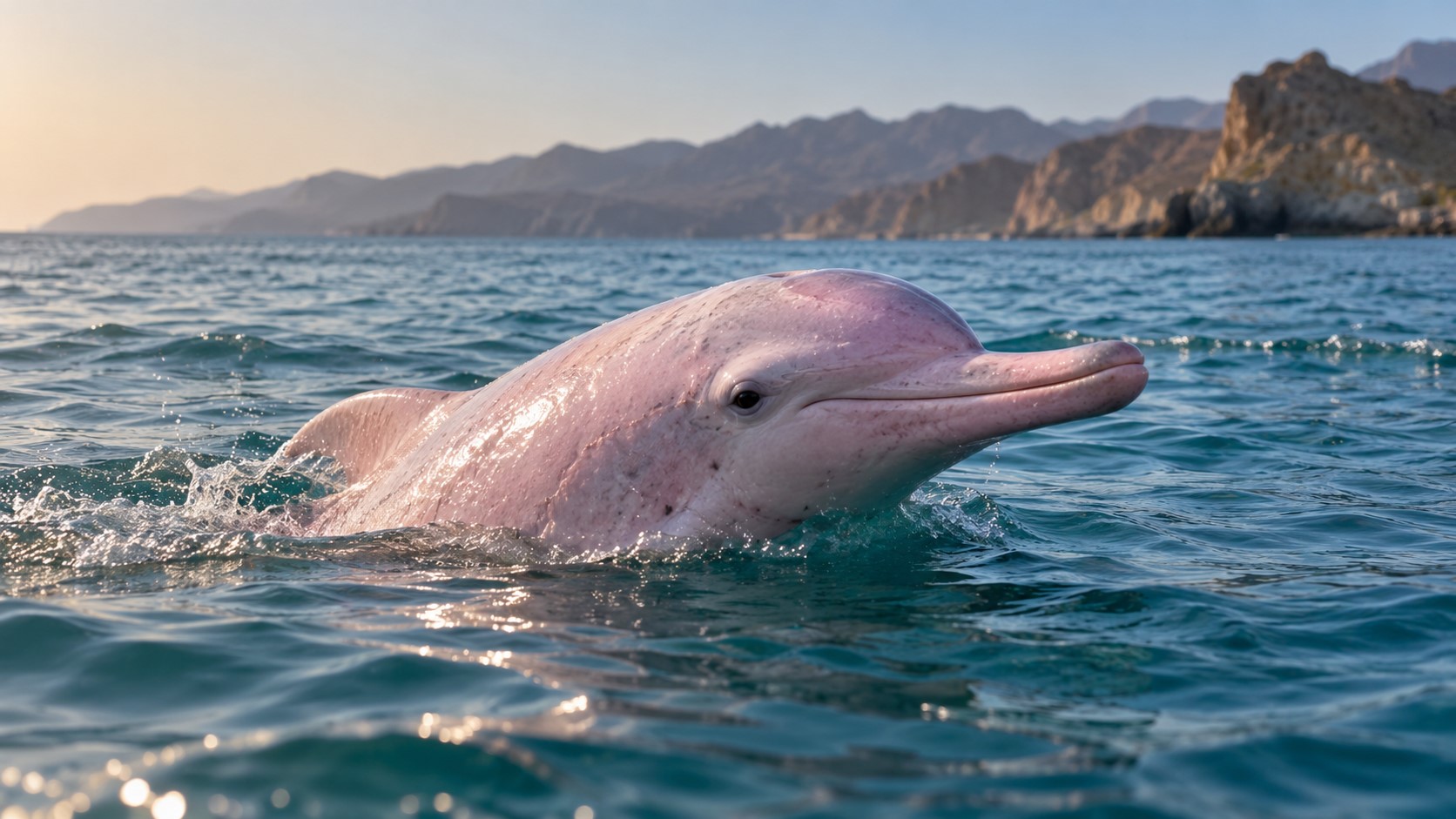
The ocean holds countless mysteries, and some of them seem almost magical. Imagine a pale pink dolphin surfacing in turquoise waters near the shore. Now add to that picture a fascinating world of sounds that dolphins use to find food, recognize one another, and navigate their surroundings, even in darkness.
In October 2026, an unusual dolphin spotted off the coast of Oman attracted attention far beyond the region. Footage of the animal near Kantab Beach once again reminded people just how diverse the coloration of marine mammals can be.
Yet behind those striking images lies a much more fascinating story. Why do some dolphins turn pink? Do they have their own language? What frequencies do they use to communicate? Can their sounds heal humans? And what is happening to Black Sea dolphins during Russia’s full-scale war against Ukraine?
Let us explore these questions through the lens of science, separating established facts from myths and exaggerations without losing any of the wonder that nature inspires.
The Pink Dolphin off the Coast of Oman: What Do We Know?
In October 2026, videos of an unusually pale, pinkish-gray dolphin began circulating on social media. The animal had reportedly been spotted near Kantab Beach, close to Muscat, the capital of Oman.
Its unusual coloration immediately prompted speculation that it might belong to one of the humpback dolphin species, some populations of which can develop pinkish or almost white coloration as they age.
However, on October 22, 2026, Oman Observer published a clarification citing Aida Al Jabri, a marine environment specialist with Oman’s environmental protection authority. According to her assessment, the animal shown in the first video was identified as a Risso’s dolphin (Grampus griseus).
A second video, allegedly showing a pink humpback dolphin near Muscat, raised questions about its authenticity. According to the specialist, humpback dolphins are known in other parts of Oman’s coastline, including Musandam, the waters near Masirah Island, and the Al Wusta and Dhofar regions.
Therefore, identifying the animal in the first video as an Indian humpback dolphin would be inaccurate: the identification reported by local specialists points to a different species.
Source: Oman Observer — Pink Dolphin in Oman Sparks Curiosity as Experts Question Second Video.
This case is interesting for more than the animal’s unusual appearance. It demonstrates how quickly a wildlife observation can become a viral sensation when speculation about a species or the cause of its coloration is added to genuine footage.
To understand where the pink color comes from, we need to look at several different dolphin species.
Why Are Some Dolphins Pink?
Pink coloration in dolphins does not always have the same origin. It can be associated with age-related changes, blood circulation, the accumulation of scars, or individual differences in pigmentation.
It is also important to distinguish genuinely pink skin from a pinkish appearance caused by blood vessels showing through the skin.
1. The Amazon River Dolphin: The Famous Pink Inhabitant of Freshwater
The Amazon river dolphin, also known as the boto (Inia geoffrensis), inhabits the Amazon and Orinoco river systems in South America.
It is often called the pink river dolphin, but not every individual has the same coloration. Young animals are generally gray, while adults can range from gray to pink, sometimes with a particularly vivid hue.
Coloration is influenced by age, individual characteristics, blood circulation, and skin condition. Some adult males display especially pronounced pink coloration.
The Amazon river dolphin has a long, narrow snout, a flexible neck, and broad pectoral fins. Its unusual body structure helps it maneuver among submerged trees and vegetation in flooded forests.
Unlike most marine dolphins, the boto is adapted to freshwater river environments.
2. Humpback Dolphins: Why Do Some Adults Become Almost Pink?
Humpback dolphins belong to the genus Sousa. They inhabit coastal waters in tropical and subtropical regions of Africa, Asia, and Australia.
Their name comes from the distinctive hump-like feature beneath the dorsal fin. These dolphins generally remain close to shore in shallow coastal waters.
Their coloration varies by species and population.
- Indo-Pacific humpback dolphins (Sousa chinensis) in some populations are born gray and become lighter with age. Adults may develop white or pinkish coloration.
- Indian Ocean humpback dolphins (Sousa plumbea) generally retain dark gray or slate-gray coloration throughout life. Pink is not a typical defining feature of this species.
- Australian humpback dolphins (Sousa sahulensis) also have their own characteristic coloration and physical features.
Therefore, it is incorrect to claim that all humpback dolphins are born dark and eventually turn pink. Such changes occur only in certain species and populations.
The International Whaling Commission provides further information about these differences in its cetacean identification handbook.
Source: International Whaling Commission — Humpback Dolphin.
3. Risso’s Dolphin: From Dark Gray to Almost White
Risso’s dolphin (Grampus griseus) is another species that can develop an unusual pale appearance.
Young individuals are generally dark gray or brownish-gray. As they age, their skin becomes covered with numerous pale scars and scratches. These may result from social interactions, contact with other animals, and other forms of skin injury.
In older individuals, the scars can cover a substantial portion of the body, making the dolphin appear almost white.
A pinkish hue may also be influenced by blood vessels visible beneath the skin, lighting conditions, and sunlight reflected from the water.
According to Oman Observer, this was the species identified in the first video from Oman’s coastline.
4. Can Dolphins Be Pink Because of Albinism?
Yes. Disorders of pigmentation can also change an animal’s appearance.
Albinism is a genetic condition in which an organism produces very little or no melanin. It can affect the coloration of skin, hair, fur, and eyes.
However, not every white or pink animal has albinism. Other genetic pigmentation variations exist, as do natural age-related changes.
Determining the cause of an individual dolphin’s unusual coloration may require detailed observations and, in some cases, veterinary or genetic investigations. A video alone is generally insufficient to establish the cause.
Amazing Facts About Dolphins: What Does Science Really Tell Us?
Dolphins are not fish. They are marine mammals belonging to the order Cetacea. They breathe atmospheric air through their lungs, give birth to live young, and feed their offspring with milk.
They have evolved remarkable adaptations for aquatic life while retaining the fundamental characteristics of mammals.
Dolphins Breathe Consciously
Unlike humans, dolphins do not breathe through a completely automatic process. They must regularly surface to inhale through a blowhole located on top of the head.
As a result, dolphin sleep has some unusual characteristics. They can rest while maintaining the ability to breathe and respond to potential threats. Some species exhibit unihemispheric slow-wave sleep, in which one brain hemisphere rests while the other remains relatively alert.
This does not mean dolphins never experience proper sleep. Rather, they use a specialized resting mechanism suited to their aquatic lifestyle.
Dolphins Use Echolocation
Echolocation is one of the most remarkable navigation mechanisms in the animal kingdom.
A dolphin produces short sound pulses that travel through water, bounce off objects, and return as echoes. By analyzing these echoes, the animal can obtain information about an object’s distance, position, and certain physical characteristics.
Echolocation helps dolphins:
- Locate fish and other potential prey.
- Navigate murky water and environments with limited light.
- Estimate the distance to obstacles.
- Investigate their surroundings.
This mechanism is particularly important for toothed whales, the group that includes dolphins.
Dolphins Can Recognize One Another Through Individual Sound Signals
Research on bottlenose dolphins (Tursiops truncatus) has shown that they use distinctive vocalizations known as signature whistles.
These whistles help individuals recognize one another and maintain social relationships. In certain situations, dolphins reproduce another individual’s signature whistle, a behavior researchers interpret as a possible way of addressing that animal.
This is one of the most fascinating examples of complex social communication among animals.
Scientific source: NOAA — Research on Individual Dolphin Whistles.
Dolphins Have Complex Social Lives
Depending on their species, environment, and circumstances, dolphins may live alone, in pairs, or in groups.
They can cooperate while hunting, maintain relationships with relatives, care for their young, and learn from one another.
Some bottlenose dolphin populations form complex social networks in which individuals develop long-lasting alliances.
However, dolphins should not be idealized. Their behavior also includes competition, aggression, and struggles over resources. Complex social behavior does not mean that every interaction is friendly.
Dolphins Do Not Chew Food the Way Humans Do
Dolphin teeth are primarily adapted for capturing prey. They generally swallow fish and other aquatic animals whole or in large pieces rather than chewing them thoroughly.
Their diets vary by species and may include fish, squid, and other cephalopods.
Some dolphins use sophisticated hunting strategies. They coordinate their movements in groups, herd fish into particular areas, or take advantage of features of the seabed.
Dolphins Are Not Universal Human Rescuers
There are many stories of dolphins approaching people in the water or swimming alongside them. However, scientific evidence does not establish that dolphins systematically rescue humans with a specific conscious intention.
Wild animal behavior depends on circumstances. Even when a dolphin appears friendly, it remains a powerful wild animal, and contact can be dangerous for both the human and the dolphin.
What Frequencies Do Dolphins Use to Communicate?
This is one of the most fascinating questions about marine mammals. However, dolphins do not communicate at one fixed frequency. They use a broad range of acoustic signals, and the characteristics of these sounds depend on the species and the function of the signal.
Sound frequency is measured in hertz (Hz) or kilohertz (kHz). One kilohertz equals 1,000 cycles per second.
According to the Woods Hole Oceanographic Institution, bottlenose dolphins use approximate frequency ranges such as the following:
| Type of signal | Approximate frequency range | Main function |
|---|---|---|
| Whistles | 0.2–30 kHz | Social communication |
| Echolocation clicks | 40–150 kHz | Navigation and prey detection |
These ranges are approximate and are not universal for all dolphin species. Frequencies can vary according to species, behavior, and environmental conditions.
Source: Woods Hole Oceanographic Institution — Frequency Ranges of Marine Animal Sounds.
Three Main Categories of Dolphin Sounds
1. Whistles. These are tonal sounds frequently used in social communication. They help dolphins maintain contact, coordinate behavior, and recognize familiar individuals.
2. Clicks. These are short, pulsed signals used by toothed whales for echolocation. By analyzing returning echoes, a dolphin can obtain information about objects in the water.
3. Burst-pulse sounds and other vocalizations. Rapid sequences of clicks, pulsed sounds, and other acoustic signals may be involved in social interactions, including situations involving excitement or conflict.
Dolphin sounds should not be reduced to a simple dictionary of words comparable to human language. Scientists are investigating what information the signals convey, how dolphins learn sounds, and how acoustic communication relates to behavior.
Can Dolphins Hear Ultrasound?
Yes. Toothed whales have hearing adapted to high-frequency signals, many of which lie beyond the normal range of human hearing.
A person with typical hearing can generally perceive sounds up to around 20 kHz, although individual abilities vary. Dolphins can detect much higher frequencies; in some species, the hearing range extends well above 100 kHz.
This is why a substantial part of their acoustic world is inaccessible to the human ear without specialized equipment.
Can We Translate Dolphin Language?
Science does not yet have a universal translator that can turn dolphin sounds into human sentences.
Researchers record signals using hydrophones and analyze their frequencies, durations, repetition patterns, and the contexts in which they occur. This helps them identify relationships between particular sounds and specific situations.
However, proving that a particular sequence of signals represents an abstract concept is much more difficult. It requires controlled experiments and reproducible results.
Modern machine-learning technologies help scientists process large collections of acoustic recordings. Yet identifying recurring sound patterns does not, by itself, mean that researchers have fully decoded dolphin language.
Does Dolphin Language Have Healing Properties?
The idea that dolphin sounds have healing powers has attracted public interest for many years. Popular accounts sometimes claim that dolphin whistles can harmonize the nervous system, alter brain activity, or help treat various medical conditions.
However, three different phenomena must be distinguished: the effects of sound on people, the psychological effects of spending time near water, and the effectiveness of specific therapeutic programs.
What Can Actually Affect Human Well-Being?
A peaceful natural environment, observing animals, listening to pleasant sounds, and experiencing positive emotions may contribute to a subjective feeling of relaxation.
These effects are not unique to dolphins. People may experience similar feelings while walking by the sea, listening to natural sounds, or interacting with animals.
However, such experiences should not automatically be equated with medical treatment.
What Does Research Say About Dolphin-Assisted Therapy?
Dolphin-assisted therapy is offered at some facilities as a complementary approach for people with various conditions, including autism spectrum disorder.
However, a systematic review published in the Journal of Clinical Psychology in 2021 did not find convincing evidence that dolphin-assisted therapy is effective. The authors highlighted methodological problems in the available studies that make it difficult to assess the results reliably.
This does not mean that people cannot experience positive emotions when observing or interacting with marine animals. It means that a subjective improvement in mood is not proof that dolphin sounds have a specific therapeutic effect.
Scientific source: PubMed — An Updated Review of the Efficacy of Dolphin-Assisted Therapy for Autism and Developmental Disabilities.
Therefore, there is currently insufficient scientific evidence to claim that dolphin language cures diseases or has a unique, proven therapeutic effect on humans.
The most accurate scientific conclusion is that dolphin acoustic communication is remarkably complex and valuable to study, but its specific healing properties for humans have not been demonstrated.
Black Sea Dolphins: Which Species Live off Ukraine’s Coast?
The Black Sea is a distinctive ecosystem that supports three main forms of cetaceans. All are important to marine ecology, and their populations face a range of threats.
According to the international conservation agreement ACCOBAMS and research on Black Sea cetaceans, these are:
- Black Sea bottlenose dolphin (Tursiops truncatus ponticus).
- Black Sea harbour porpoise (Phocoena phocoena relicta).
- Black Sea common dolphin (Delphinus delphis ponticus).
The harbour porpoise is also a cetacean, but it belongs to the porpoise family rather than the dolphin family.
All three forms are adapted to the Black Sea, but they differ in size, feeding habits, behavior, and distribution.
Source: ACCOBAMS — Results of the Systematic Aerial Survey of Black Sea Cetaceans.
1. The Black Sea Bottlenose Dolphin
The bottlenose dolphin is one of the best-known dolphins in the world. It has a robust body, a short, rounded snout, and a distinctive curved dorsal fin.
Bottlenose dolphins display complex social behavior, can learn, and are capable of coordinating their movements while hunting. They feed mainly on fish and other available marine organisms.
The Black Sea population has been affected by historical hunting, accidental capture in fishing gear, pollution, and other human-related pressures.
2. The Black Sea Common Dolphin
The common dolphin has a streamlined body and a distinctive contrasting pattern on its sides, often resembling an hourglass.
It may form groups that travel and hunt together. Its diet consists mainly of fish and cephalopods.
The Black Sea form of the common dolphin has also suffered from historical hunting and other threats that affect food availability and survival.
3. The Black Sea Harbour Porpoise
The harbour porpoise is smaller than the bottlenose dolphin. It has a short, blunt snout and a less prominent dorsal fin.
These animals usually live alone or in small groups. They feed on fish and other small marine organisms.
Harbour porpoises are particularly vulnerable to becoming entangled in fishing nets. They may also be affected by underwater noise, deteriorating water quality, and changes in the marine ecosystem.
How Well Have Black Sea Cetaceans Been Studied?
In 2019, an international team of researchers conducted a systematic aerial survey of a substantial part of the Black Sea as part of the ACCOBAMS initiative and the CeNoBS project.
Over 15 days of research, the team surveyed 7,324 kilometers of transects and recorded 1,744 cetacean sightings.
The study provided important information about the distribution and abundance of the three groups. However, it covered approximately 52% of the Black Sea’s surface area, not the entire sea.
Such surveys are essential for long-term monitoring. Without reliable baseline data, it is difficult to assess population changes and the consequences of war.
Scientific source: Paiu et al., 2024, Frontiers in Marine Science. Density and Abundance Estimates of Cetaceans in the Black Sea Through Aerial Surveys.
Are Black Sea Dolphins Threatened by the War in Ukraine?
Yes. Scientific research indicates that military activity creates additional serious risks for Black Sea cetaceans.
It is important to note that cetacean deaths were recorded before the full-scale invasion as well. Populations were already affected by accidental capture in fishing gear, pollution, food shortages, disease, and other factors.
However, after the full-scale war began, researchers recorded a sharp increase in reports of dead cetaceans washing up along the Black Sea coast.
How Can Explosions and Military Noise Harm Dolphins?
Dolphins rely heavily on hearing and acoustic orientation. Loud underwater sounds, explosions, and noise from military vessels can therefore create serious problems for them.
Potential mechanisms of impact include the following.
Acoustic disruption. Intense noise can mask natural signals, interfere with sound perception, and alter animal behavior.
Changes in behavior and diving patterns. In response to noise, cetaceans may change their routes, diving patterns, or use of particular habitats.
Physical injuries. Underwater explosions can cause traumatic injuries. Some researchers have also considered the possibility of decompression-related disorders associated with changes in diving depth and rapid ascent.
Disruption of feeding and social interactions. If animals are forced to leave familiar habitats or cannot use acoustic signals normally, their ability to find food and maintain social relationships may be affected.
Not every animal death can be directly attributed to a particular explosion or military vessel. Establishing such a link requires examinations of carcasses, analysis of injuries, laboratory testing, and other evidence.
Nevertheless, the combined observations and scientific findings indicate that military activity represents a serious additional risk.
What Did Research on Cetacean Deaths in 2022 Reveal?
In 2023, Royal Society Open Science published a study examining how social media data could be used to assess the impact of the war on Black Sea cetaceans.
Researchers collected reports of dead animals found along the Black Sea coast and compared them with pre-war information. They also conducted field observations in Tuzly Lagoons National Nature Park in southern Ukraine.
According to the study, approximately 2,500 dead cetaceans were reported along Black Sea coastlines during the first three months of the full-scale invasion.
This figure refers to collected reports of carcasses found along the coast. It is not a complete count of all cetaceans that died. Many dead animals may never reach the shore, making the actual scale of mortality extremely difficult to determine.
The researchers also noted that the number of carcasses recorded in some coastal areas was considerably higher than in pre-war observations.
However, these estimates have methodological limitations. Access to the coastline was uneven, systematic monitoring in combat zones was impossible, and researchers could not establish the cause of death for every animal.
Scientific source: Węgrzyn et al., 2023, Royal Society Open Science. The Use of Social Media in Assessing the Impact of War on Cetaceans.
This research is important not only because of the data collected. It also demonstrates how scientists can use eyewitness reports and publicly available digital sources to document the environmental consequences of war when conventional field monitoring is restricted.
Has It Been Proven That All Dead Dolphins Were Victims of the War?
No. Such a conclusion would be an unjustified generalization.
Before the war, cetaceans in the Black Sea were already dying because of fishing bycatch, disease, and other causes. Multiple factors were operating simultaneously in 2022, while access to comprehensive investigations was limited.
A 2023 report in Science noted that Ukrainian scientists were examining dead animals to investigate the possible effects of the war, pollution, and other factors. In some cases, researchers did not find characteristic signs that would conclusively establish a specific cause of death.
The scientifically justified conclusion is therefore that the war created an additional and significant risk for cetaceans, and studies documented a sharp increase in reports of their deaths. However, it is not possible to determine the exact cause of death for every animal.
Additional source: Science — Research on the Environmental Consequences of the War.
What Other Threats Do Black Sea Dolphins Face?
Even without war, Black Sea cetaceans face numerous dangers.
Accidental Capture in Fishing Nets
One of the most serious threats is accidental entanglement in fishing gear. Dolphins and harbour porpoises can become trapped in nets and drown because they cannot reach the surface to breathe.
Water Pollution
Marine mammals can be affected by toxic substances, plastics, wastewater, and pollutants that accumulate throughout food chains.
Declining Food Resources
Overfishing and changes in the marine ecosystem can reduce food availability. This affects the animals’ condition, reproduction, and the survival of their young.
Shipping Noise
Persistent noise from ships can mask natural acoustic signals and alter cetacean behavior. This is particularly important for animals that depend on sound to navigate their environment.
Disease and Epidemics
Infectious diseases can also cause mass mortality among marine mammals. This is why investigations of dead animals should include laboratory testing rather than attributing every case to a single factor.
Protecting Black Sea cetaceans requires international cooperation, systematic monitoring, and efforts to reduce human pressure on the marine ecosystem.
Why Are Dolphins Important to Marine Ecosystems?
Dolphins are predators that help regulate populations of fish and other marine organisms. Their condition can also provide information about the overall health of the environments in which they live.
When cetacean populations decline, this may indicate broader ecological problems, including overfishing, pollution, declining food resources, or other environmental changes.
However, dolphins are not simple indicators of water purity. Their condition depends on many factors, and assessing an ecosystem requires comprehensive research.
Protecting dolphins means safeguarding not only individual animals but also the marine environment on which countless other organisms depend.
How Can People Help Protect Dolphins?
Marine mammal conservation begins with responsible behavior toward nature.
Here is what everyone can do:
- Avoid touching or feeding wild dolphins or pursuing them for photographs.
- Do not approach dolphins in boats in ways that force them to change direction or alter their behavior.
- Never leave plastic, fishing equipment, or other waste on the coast.
- Report stranded or injured cetaceans to local wildlife authorities.
- Support conservation organizations involved in research and marine wildlife protection.
- Share reliable information about cetaceans rather than spreading sensational claims without evidence.
If you find a dolphin stranded on the beach, do not attempt to drag it into the water or treat it yourself. Contact specialists who have the appropriate training and equipment.
During the war in Ukraine, it is particularly important not to put yourself in danger while trying to help wildlife. Explosive remnants may remain along the coast, so any intervention must be coordinated with the relevant authorities.
The Wonders of Nature Need More Than Admiration — They Need Protection
The unusual dolphin reported off Oman’s coast reminds us how extraordinary marine mammals can be. Its coloration has natural explanations, and behind its beauty lie complex biological processes that scientists are still working to understand.
Dolphins communicate through whistles, clicks, and other acoustic signals. They use echolocation, learn from experience, and maintain complex social relationships. However, claims about the special healing properties of dolphin language do not yet have sufficient scientific support.
The story of Black Sea cetaceans reveals another side of the relationship between humans and nature. War, noise, explosions, pollution, and other threats can have serious consequences for animals that have no way to escape human conflict.
Nature does not need beautiful legends in place of truth. It needs our attention, scientific understanding, and concrete action.
Perhaps the most important lesson dolphins offer us is this: the world is far more complex and fascinating than it first appears. And the more we learn about it, the better we understand why it must be protected.
Scientific Sources and Further Reading
- Oman Observer. Pink Dolphin in Oman Sparks Curiosity as Experts Question Second Video. October 22, 2026. Read the article.
- International Whaling Commission. Humpback Dolphin — Whale Watching Handbook. Information about humpback dolphin species and coloration. Read more.
- Woods Hole Oceanographic Institution. Frequency Ranges of Marine Animal Sounds. Information about the acoustic frequency ranges of marine animals. Read more.
- NOAA. Scientific resources on individual signature whistles in dolphins. Read more.
- Marino, L., and Lilienfeld, S. O. Third Time’s the Charm or Three Strikes You’re Out? An Updated Review of the Efficacy of Dolphin-Assisted Therapy for Autism and Developmental Disabilities. Journal of Clinical Psychology, 2021. PubMed.
- ACCOBAMS / Frontiers in Marine Science. Paiu et al. Density and Abundance Estimates of Cetaceans in the Black Sea Through Aerial Surveys. 2024. Scientific publication.
- Royal Society Open Science. Węgrzyn et al. The Use of Social Media in Assessing the Impact of War on Cetaceans. 2023. Full text.
- Science. Research on the environmental consequences of war and the deaths of Black Sea cetaceans. Read more.
Editorial note: This article distinguishes established scientific findings from expert reports and questions that remain under investigation. Figures relating to cetacean deaths during the war should not be interpreted as a definitive count of all losses or as proof of a single cause of death for every animal.